

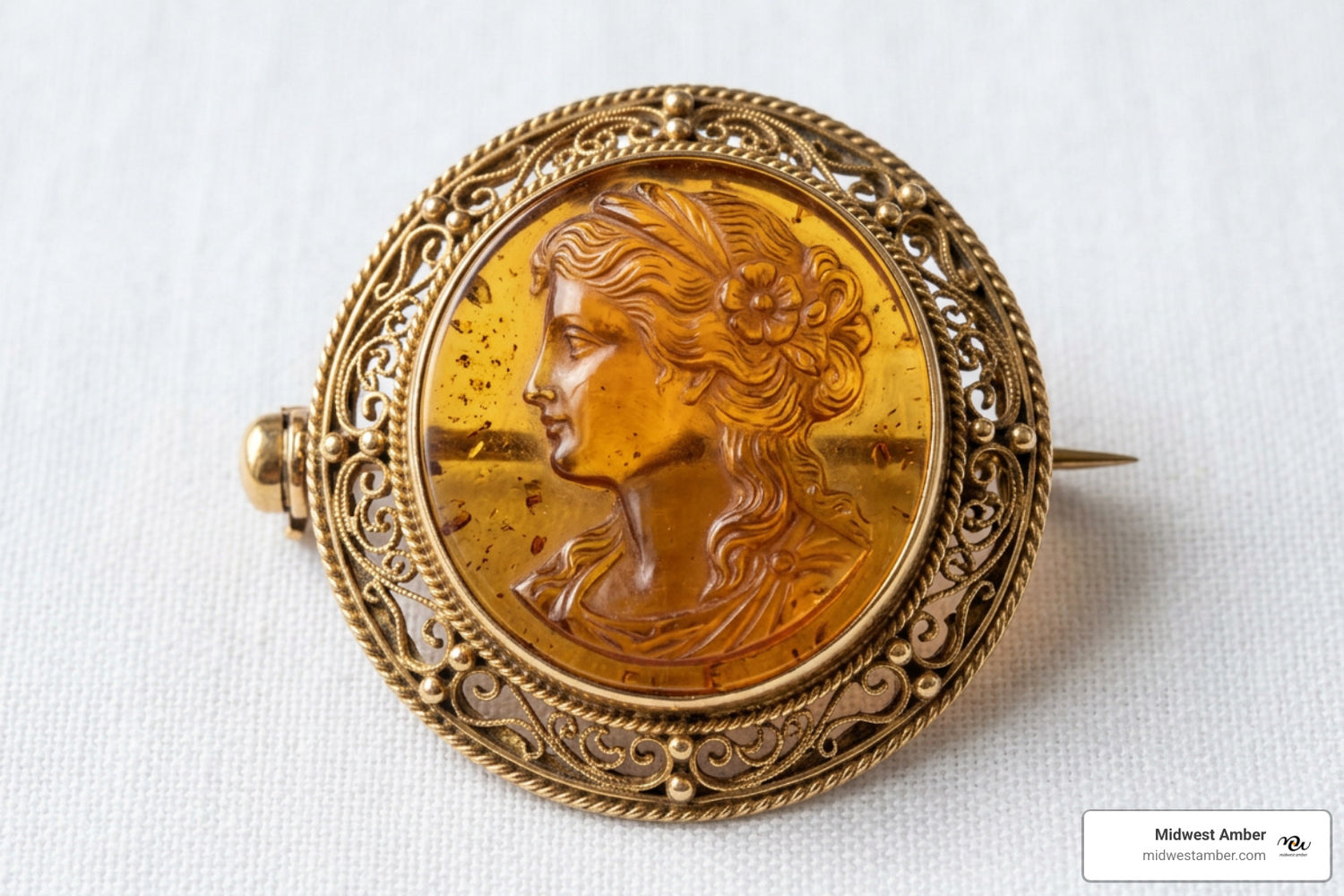
Why Spotting a Genuine Amber Cameo Brooch Is Harder Than You Think
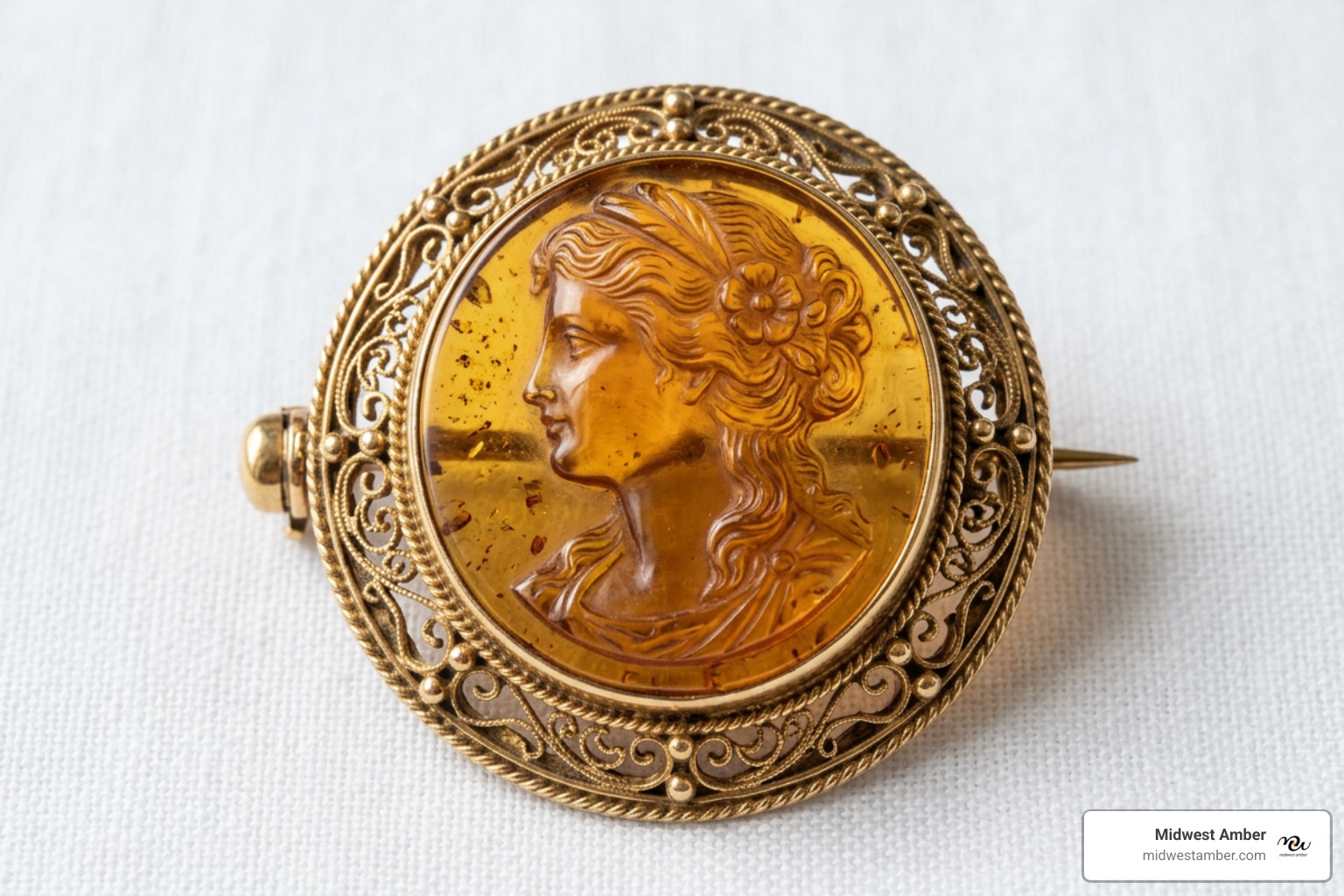
An amber cameo brooch is one of the most beautiful - and most faked - pieces of antique jewelry on the market today.
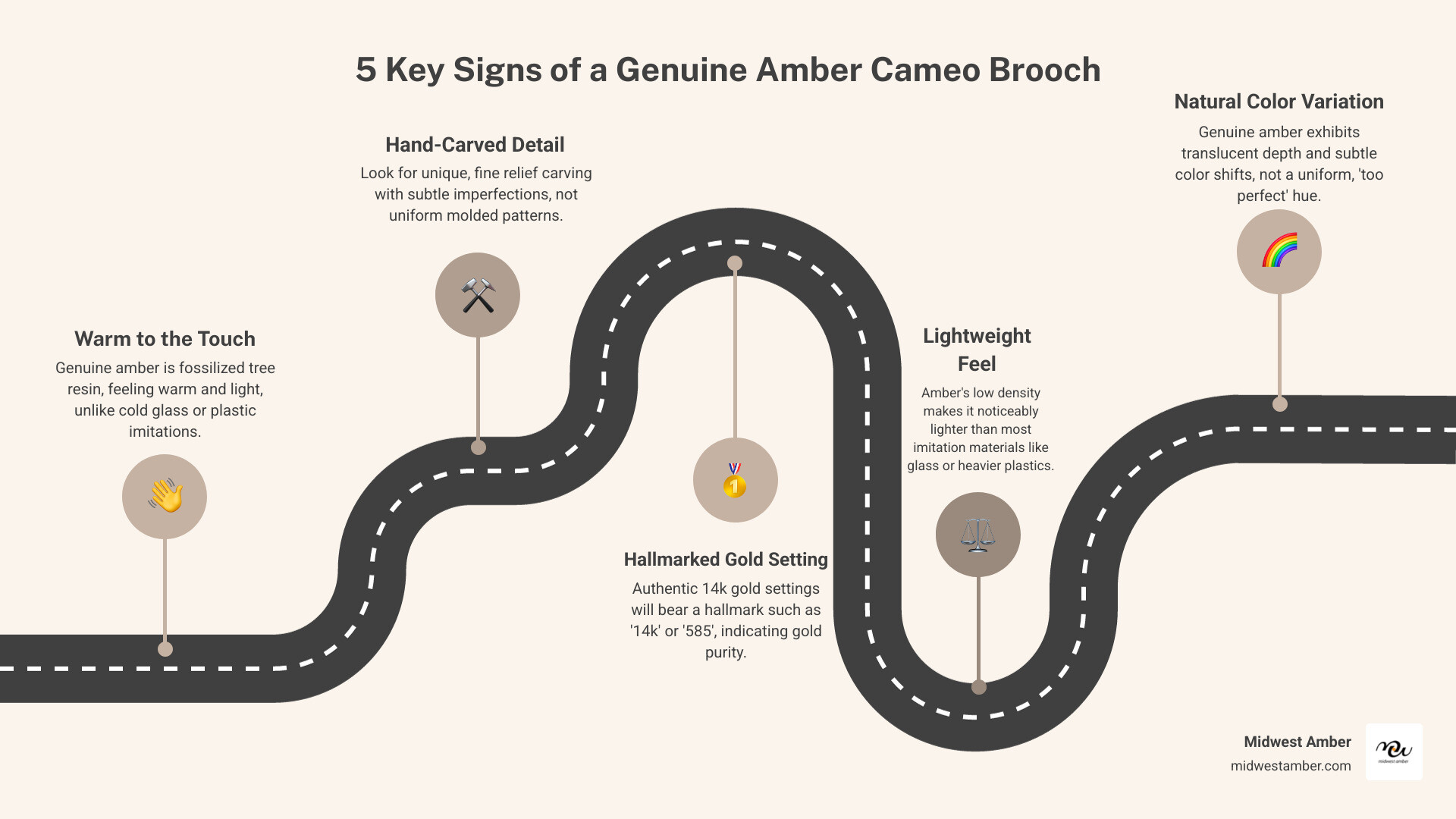
Here's a quick reference to help you identify a genuine one at a glance:
| Feature | Genuine Amber Cameo Brooch | Fake or Reproduction |
|---|---|---|
| Material | Fossilized tree resin, warm to the touch | Plastic or glass, feels cold |
| Weight | Naturally lightweight | Often heavier than expected |
| Carving | Hand-carved relief with fine detail | Molded, uniform, no variation |
| Gold setting | Hallmarked (e.g., 14k / 585) | No hallmark or stamped "gold tone" |
| Color | Natural variation, translucent depth | Uniform, too perfect |
| Age signs | Patina, wear on clasp, closed-back setting | Looks too new, machine-made finish |
Baltic amber is not a stone or gem. It is fossilized resin formed over 45 million years ago, which makes it lightweight, warm, and completely unique in every piece.
That also makes it easy to imitate with cheap plastic. And when a piece is mounted in gold and carved into a cameo, the price goes up - and so does the temptation to fake it.
I'm Gabriel Ciupek, President and owner of Midwest Amber, with years of hands-on experience sourcing, pricing, and authenticating genuine Baltic amber jewelry, including every style of amber cameo brooch from handcrafted floral designs to antique auction pieces. In the sections below, I'll walk you through exactly what to look for so you can buy with confidence.
Amber cameo brooch terminology:
- ornamental pin
- sterling silver pin
- amber brooch
Defining the Amber Cameo Brooch: Artistry and Origin
When we talk about an amber cameo brooch, we are describing a marriage of prehistoric nature and classical art. Unlike a standard cabochon, which is polished smooth to show off the internal inclusions of the resin, a cameo is a piece of art carved in "relief." This means the design is raised above the background surface.
The origin of these pieces is often tied to the Baltic region — specifically Poland and Lithuania — where the world's finest amber is found. However, the tradition of carving these into intricate cameos often traveled to jewelry hubs like Venice, Italy. In Venice, master carvers who were used to working with shells or coral applied their skills to the "Gold of the North."
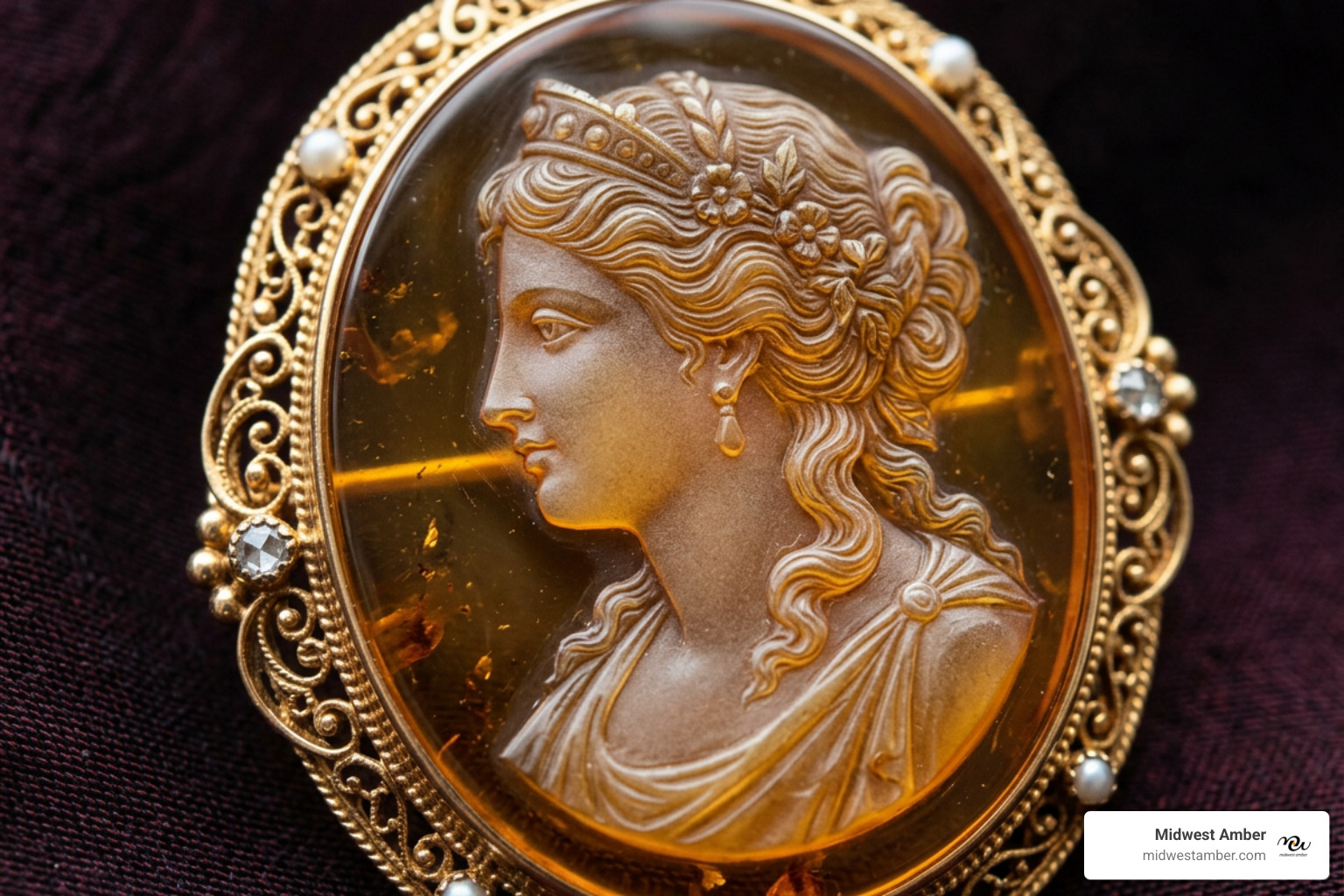
The process of making an amber cameo brooch is incredibly delicate. Because amber is relatively soft (ranking between 2 and 2.5 on the Mohs scale), a carver must be extremely precise. One wrong move and the 45-million-year-old resin could chip or crack. This is why high-quality amber brooches are so highly prized; they represent hours of manual labor and artistic vision.
Common Motifs in an Amber Cameo Brooch
If you are hunting for an antique piece in the Chicago or Northbrook area, you’ll notice that certain designs appear more frequently than others. These motifs often reflect the era in which the brooch was created:
- Classical Profiles: The most iconic cameo design is the profile of a woman. These often feature elaborate hairstyles and draped clothing. A famous example is the depiction of Botticelli’s Venus, which often utilizes the natural translucency of amber to create a stunning 3D effect.
- Floral Designs: Many Baltic amber pieces, like the "Fairy Flower" or "Lily" designs, feature intricate petals and leaves. These are often made from multicolor amber—blending cognac, lemon, and green hues.
- Mythological Scenes: You might find an agate cameo brooch featuring cherubs or lions, but in amber, these scenes are rarer and highly collectible.
- Nature and Insects: While some brooches feature an insect-amber-brooch with a real prehistoric critter trapped inside, cameo carvers sometimes mimic these natural wonders by carving insects directly into the surface.
Baltic Amber vs. Shell and Agate Cameos
It’s easy to get confused when looking at a display case full of vintage jewelry. While shell and agate are the most common materials for cameos, amber offers a completely different "vibe."
| Feature | Baltic Amber Cameo | Shell Cameo | Agate (Stone) Cameo |
|---|---|---|---|
| Origin | Fossilized Tree Resin | Marine Shell (Conch/Helmet) | Chalcedony Quartz |
| Feel | Warm, lightweight | Cool, lightweight | Cold, heavy |
| Hardness | Very Soft (2.0-2.5) | Soft (3.5) | Hard (6.5-7.0) |
| Light Effect | Translucent/Glowing | Opaque | Layered/Banded |
| Rarity | High (for quality carvings) | Common | Moderate |
Amber is uniquely "organic." When you hold an amber cameo brooch, it won't feel like a cold stone. It warms up quickly to your body temperature. This "organic warmth" is one of the primary ways we distinguish genuine Baltic amber from agate or glass imitations.
Key Characteristics of Genuine 14k Gold Settings
A masterpiece deserves a proper frame. For a high-end amber cameo brooch, that frame is usually 14k gold. In the United States, especially in our local markets like Arlington Heights or Schaumburg, 14k gold is the standard for fine jewelry because it balances purity with durability.
When we inspect a brooch, the first thing we look for is the hallmark. For 14k gold, you should see "14k" or the European equivalent, "585." This number indicates that the metal is 58.5% pure gold. If you see "9ct" (found on some British imports) or "375," that indicates a lower gold content, which is common in some agate cameo brooches.
While gold is the gold standard (pun intended), many stunning pieces use a sterling silver pin setting, sometimes oxidized to give it a vintage, darkened look that makes the amber "pop."
Identifying Antique Amber Cameo Brooch Mounts
The way the amber is mounted can tell us a lot about its age. Here are the "red flags" and "green flags" we look for in antique mounts:
- Closed-Back vs. Open-Back: Many antique amber brooches feature a "closed-back" setting. In these designs, the amber is backed by a thin layer of gold or even colored foil (foiled cabochons). This was done to enhance the color and "fire" of the amber.
- Foliate Frames: Victorian and Edwardian pieces often feature frames decorated with gold leaves, vines, or flowers. This intricate metalwork is a hallmark of quality.
- The Clasp: An antique amber brooch pin will usually have a "C-clasp" or an early safety catch. If the pin is very long (extending past the edge of the brooch), it's often a sign of a 19th-century piece.
- Art Deco Influence: If the setting is geometric or uses "early plastic" accents (like black jet or Bakelite) alongside the amber, you're likely looking at a piece from the 1920s or 30s. Some Art Deco amber cameo brooches are highly sought after for their bold, contrasting colors.
How to Authenticate Antique Amber vs. Modern Reproductions
Now we get to the "detective work." Because an amber cameo brooch can be quite valuable—with some pieces reaching over €599 ($650+)—fakes are everywhere. Modern reproductions often use "pressed amber" (small scraps melted together) or straight-up plastic.
Here are the tests we use at Midwest Amber to verify authenticity:
- The UV Light Test: This is our favorite. Under a UV flashlight, genuine Baltic amber will fluoresce. It usually glows a milky blue or yellowish-green. Plastic will not change color or will look dull.
- The Saltwater Test: Amber is incredibly buoyant. If you mix about 1 part salt to 2 parts water, genuine amber will float. Plastic and glass will sink like a stone. Note: Do this only if the amber is loose or if the metal setting is small enough not to weigh it down!
- The Static Test: Rub the amber against a piece of wool or silk for 20 seconds. Genuine amber becomes electrostatically charged and will pick up tiny bits of paper or hair. This is why the Greeks called amber "electron."
- The "Feel" Test: Plastic feels "greasy" and stays room temperature. Amber feels "grippy" and warms up in your hand.
If you're looking at an amber spider brooch or a cameo, look at the carving edges under a magnifying glass. Molded plastic will have rounded, soft edges and maybe a "seam" from the mold. Hand-carved amber will have sharp, crisp details and tiny, unique imperfections.
Market Value and Auction Results
What should you expect to pay for a genuine amber cameo brooch? The market varies wildly based on age, artist, and gold content.
- Modern Artisanal Pieces: High-quality new pieces, like a unique cameo brooch in oxidized silver, typically range from $300 to $400.
- Mid-Range Gold Pieces: A standard 9ct or 14k gold-mounted brooch with a nice carving usually realizes between $200 and $600 at auction.
- High-End Antiques: Rare pieces, such as an antique amethyst cameo or a master-carved amber Venus in a 14k gold foliate frame, can easily fetch $700 to $1,500+.
Provenance matters! If a brooch comes from a notable collection—like the estate of a retired ambassador or a private London collection—the price will climb. Always ask for a condition report. A "tiny nick visible under 10x magnification" is normal for an antique, but a large crack in the resin significantly drops the value.
Frequently Asked Questions about Amber Cameos
How do I clean and maintain my amber cameo brooch?
Amber is an organic material, which means it’s a bit "picky" about how it’s treated. To keep your cameo glowing:
- Use Warm Water and Mild Soap: Avoid harsh chemicals or jewelry dips. A soft toothbrush can help clean the crevices of the carving.
- Dry Thoroughly: Use a soft, lint-free cloth.
- Avoid Perfume and Hairspray: Always put your jewelry on after you’ve applied your scents and sprays. The chemicals can dull the polish of the amber over time.
- Store Separately: Because amber is soft, harder stones like diamonds or even silver pins can scratch it. Keep it in a soft pouch.
- Professional Polishing: If your antique piece has lost its luster, a professional jeweler experienced with amber can restore its shine without damaging the carving.
Can a cameo brooch be converted into a pendant?
Yes! In fact, many high-quality amber cameos are designed with a "dual-purpose" setting. Look for a hinged bail on the back. This is a small loop that folds down when you want to wear the piece as a brooch and flips up so you can slide it onto a gold chain or a pearl necklace.
This versatility is a huge selling point for collectors. You can wear it as a statement pin on a blazer during the day and as an elegant gold and amethyst cameo pendant for a formal evening event.
Where is the best quality amber for cameos produced?
The "Big Three" for amber cameo production are Poland, Lithuania, and Italy.
- Poland and Lithuania: This is where the raw material—the Baltic Amber—is sourced. Artisans here have a 45-million-year-old connection to the resin and produce some of the most naturalistic floral carvings.
- Venice, Italy: Venetian carvers are world-renowned for their "Intaglio" and "Cameo" techniques. Many of the finest antique amber cameos featuring classical figures were carved by Italian masters using imported Baltic amber.
At Midwest Amber, we specialize in 100% natural, ethically sourced amber directly from these regions, ensuring that every piece we offer in the Chicago area is a genuine piece of history.
Conclusion
Finding a genuine amber cameo brooch is like finding a tiny, golden time capsule. Whether it’s a 3D depiction of Venus or a delicate "Lily" design, these pieces offer a connection to the ancient past and the artistic brilliance of the present.
By checking for hallmarks, testing for buoyancy, and looking for the tell-tale glow under UV light, you can protect yourself from the "early plastic" pretenders. A real amber brooch isn't just an accessory; it's an investment in a 45-million-year-old miracle.
If you’re ready to start your collection or need help authenticating a family heirloom, we’re here to help. Check out The Ultimate Guide to Buying Real Amber Jewelry for more expert tips. At Midwest Amber, we’ve spent over 20 years bringing the finest, certified Baltic amber to our neighbors from Chicago to Lake Zurich. We’d love to help you find your next masterpiece!

Leave a comment
This site is protected by hCaptcha and the hCaptcha Privacy Policy and Terms of Service apply.