

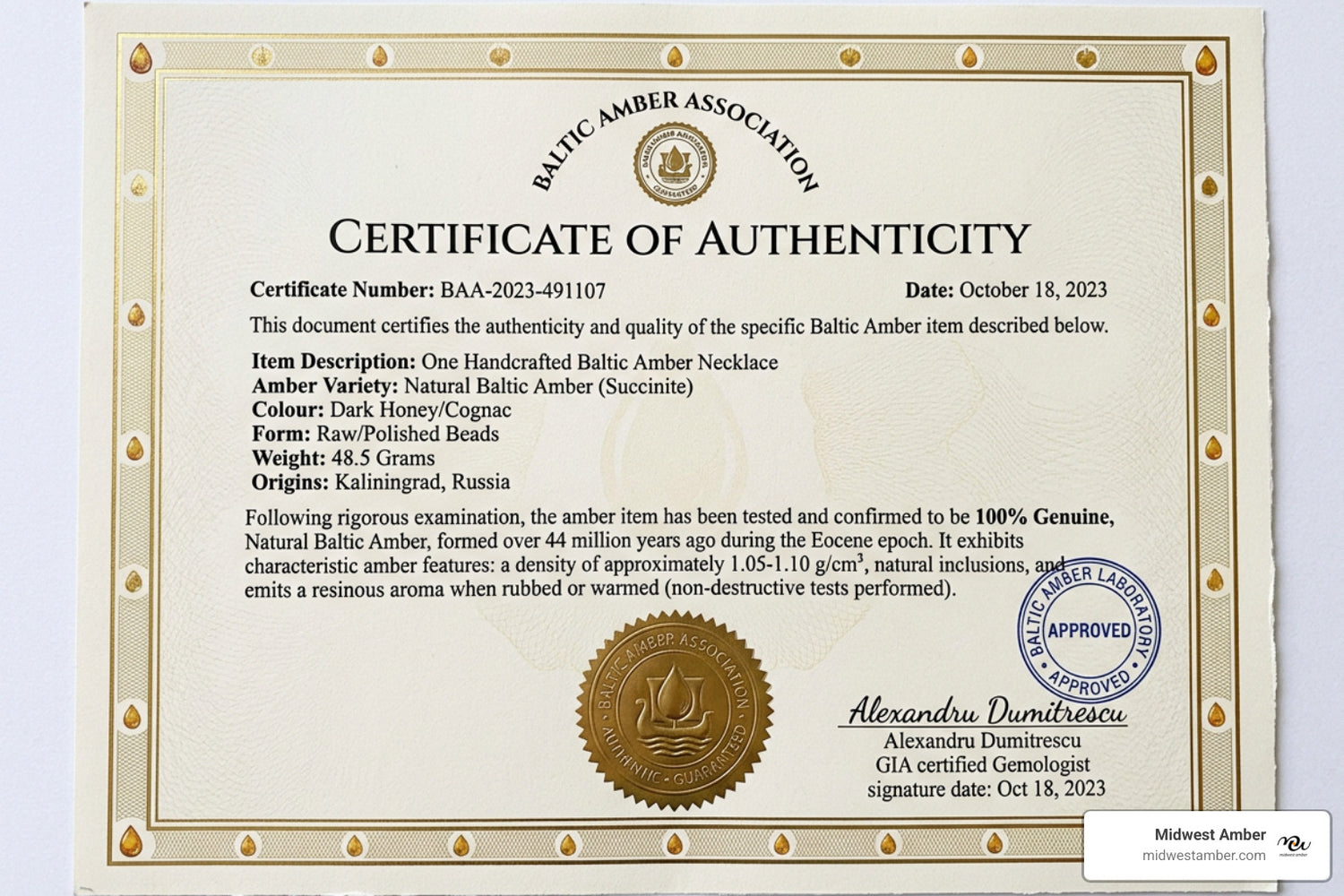
Why a Baltic Amber Certificate of Authenticity Matters More Than You Think
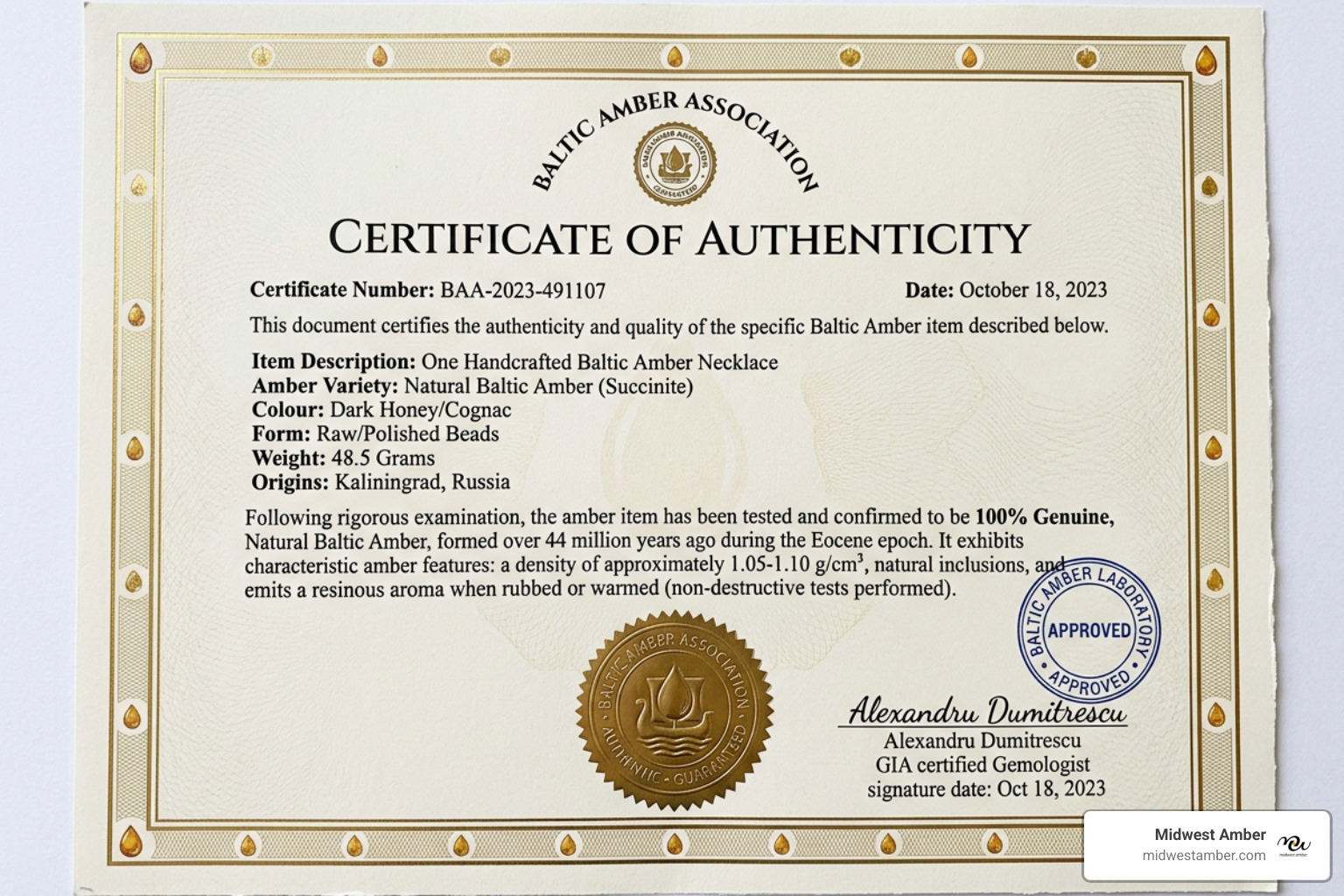
A baltic amber certificate of authenticity is a document issued by a seller or accredited laboratory that confirms a piece of amber is genuine, natural Baltic amber — not a plastic imitation, copal resin, or pressed substitute.
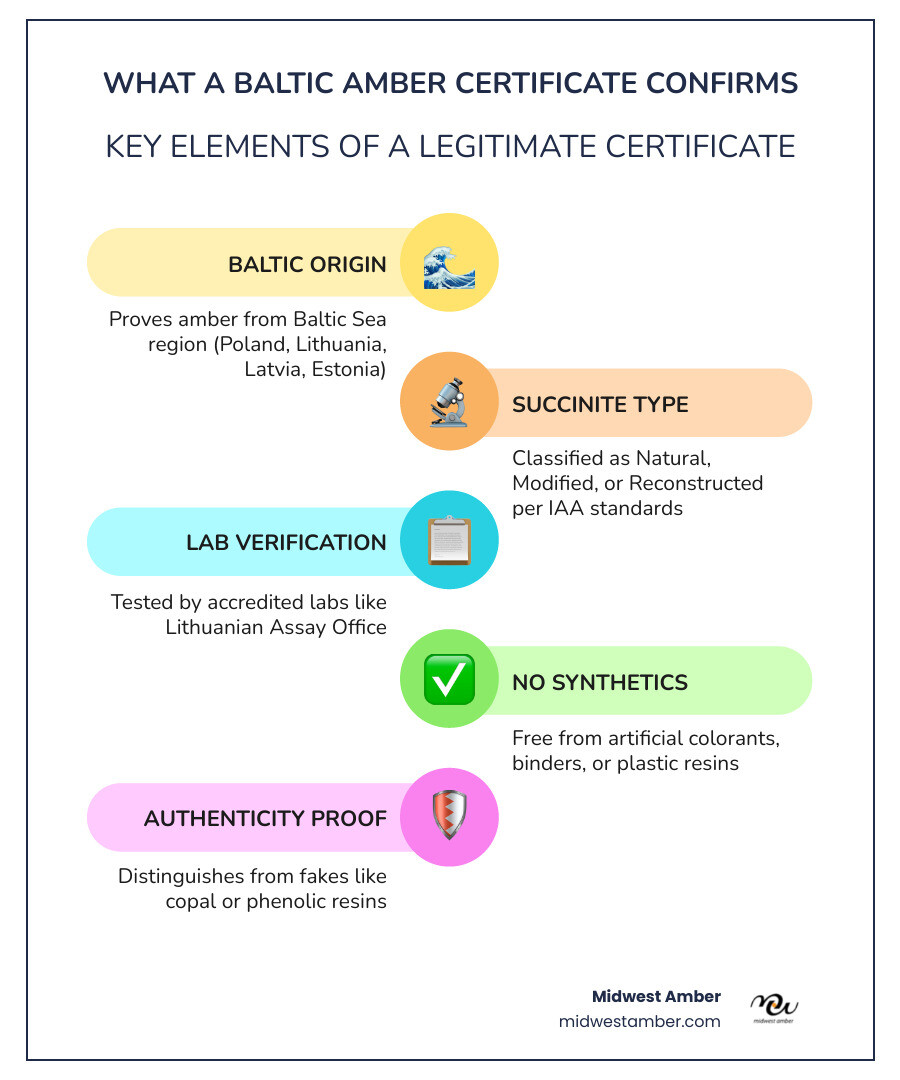
Here's what a legitimate certificate typically confirms:
- The amber originates from the Baltic Sea region (Poland, Lithuania, Latvia, or Estonia)
- The amber type — Natural, Modified, or Reconstructed — follows International Amber Association classification standards
- The piece has been tested or verified, ideally by an accredited lab such as the Lithuanian Assay Office
- No artificial colorants, binding agents, or synthetic resins were used
The Baltic amber market has a real problem: demand is high, genuine supply is limited, and fakes are everywhere. Copal resin, modern plastics, and phenolic resins are routinely sold as the real thing — sometimes even with certificates attached. The challenge is that Baltic amber is not regulated by any single global authority, which means certificates vary widely in reliability.
I'm Gabriel Ciupek, President of Midwest Amber, Inc., with decades of experience sourcing and selling certified Baltic amber jewelry and a deep understanding of what a genuine baltic amber certificate of authenticity looks like versus one that isn't worth the paper it's printed on. In the sections below, I'll walk you through everything you need to know to buy with confidence.
Understanding the Baltic Amber Certificate of Authenticity
When we talk about a baltic amber certificate of authenticity, we are essentially talking about a passport for your jewelry. It tells you where the amber came from, how old it is (roughly 40 to 50 million years!), and whether it has been tampered with. In our two decades of experience serving the Chicago area—from Northbrook to Elmhurst—we've seen that a simple piece of paper can be the difference between a family heirloom and a piece of melted plastic.
A true verification document should align with the standards set by the International Amber Association (IAA) in Gdansk, Poland. This organization is the gold standard for amber classification. They ensure that "Baltic amber" (scientifically known as succinite) is distinguished from younger resins like copal. If you want to dive deeper into the specifics of what to look for, check out our definitive guide to certified Baltic amber.
Why You Need a Baltic Amber Certificate of Authenticity
You might wonder, "It looks like amber, it feels like amber, why do I need a card?" Well, for starters, it’s about consumer trust. Because high-quality amber is a limited resource, the market is flooded with "man-made" or "created" stones.
Beyond peace of mind, there are practical reasons:
- Insurance Value: If you have a high-value piece, insurance companies often require a baltic amber certificate of authenticity to establish replacement value.
- Resale Protection: Should you ever decide to part with your jewelry, having a certificate from a reputable source significantly increases its resale value.
- Fraud Prevention: It protects you from "Copal," which is often sold as Baltic amber but is actually a much younger, softer resin that lacks the durability and succinic acid content of the real deal.
Types of Certificates and What They Guarantee
Not all certificates are created equal. Depending on where you shop, you might encounter different formats:
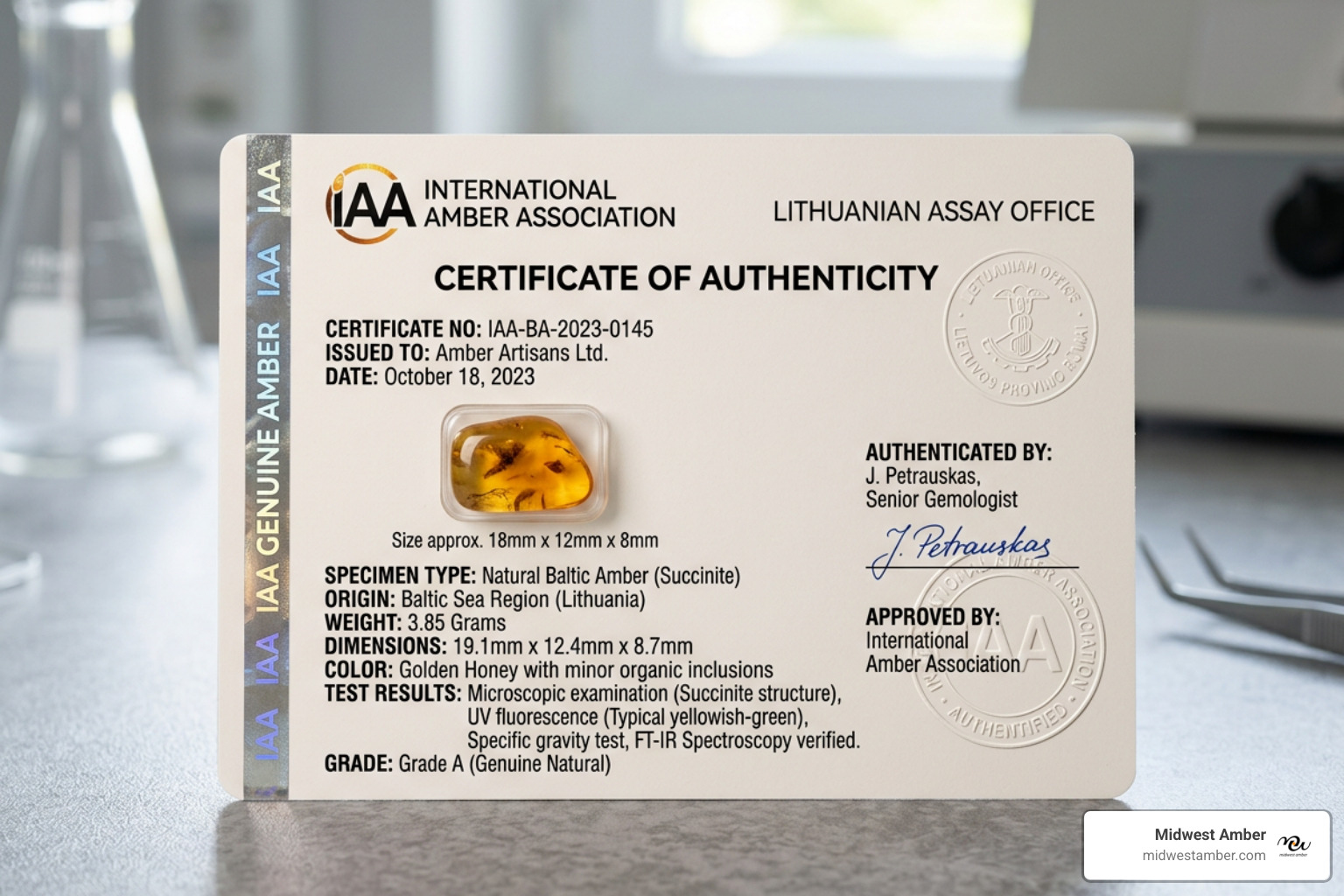
- Retail Cards: These are standard cards provided with individual jewelry pieces. They guarantee the amber is 100% natural and has been tested for authenticity.
- Reseller Shipment Certificates: If you are a boutique owner in Glenview or Palatine buying in bulk, these certificates cover an entire shipment, verifying the batch's origin.
- Photo Certificates: For high-value items or unique specimens with rare inclusions, a photo certificate is the "platinum" version. It includes a high-resolution image of the specific item so the certificate cannot be swapped for a fake.
Classification Standards and Laboratory Testing
To truly understand what your certificate is telling you, you need to know how the industry classifies "succinite." We follow the strict guidelines of the IAA and the Lithuanian Assay Office. These institutions categorize amber based on how much human intervention has occurred.
| Amber Type | Description |
|---|---|
| Natural Baltic Amber | The "purist" choice. Only mechanical treatment (cutting, grinding, polishing) without any change to physical properties. |
| Modified Baltic Amber | Subjected to thermal or high-pressure treatment to change color or transparency (e.g., creating "sun spangles"). |
| Reconstructed (Pressed) | Made of small pieces of Baltic amber pressed together under high pressure/heat. No binding agents allowed. |
| Bonded Amber | (Avoid these!) Pieces joined with glues or resins. We do not sell or recommend bonded products. |
For a more detailed look at the beauty hidden within these classifications, explore our article on uncovering truly authentic amber jewelry.
Scientific Verification via FT-IR Spectroscopy
If you want "undeniable proof," you look for FT-IR (Fourier-transform infrared) spectroscopy. This is a scientific test conducted by institutions like the State Research Institute Center for Physical Sciences and Technology in Lithuania.
When amber is tested this way, it produces a specific graph (a spectrum). Genuine Baltic amber has a very distinct feature known as the "Baltic shoulder"—a specific curve in the graph that no other resin or plastic can perfectly replicate. This is how scientists distinguish 50-million-year-old succinite from 1-million-year-old copal.
Safety Certifications for Baby Teething Jewelry
Safety is our number one priority, especially for our customers in family-focused communities like Arlington Heights and Lake Zurich. When purchasing amber teething necklaces, a baltic amber certificate of authenticity isn't enough; you also need safety certifications.
Reputable sellers ensure their baby products meet European EN 71 safety standards. This includes:
- Age Grading: Specifically certified for children under 3 years.
- Pop-out Clasps: Designed to release under tension to prevent choking.
- Individually Knotted Beads: If the string breaks, only one bead falls off.
We take these standards seriously to ensure that every piece is as safe as it is beautiful. You can learn more about finding certified baby jewelry here.
Spotting Fakes and Reliable Home Testing Methods
While a professional lab test is the only 100% certain way to verify amber, you can do quite a bit of detective work at home. Before you try these, some tests (like the hot needle test) can damage your jewelry, so proceed with caution!
Common Baltic Amber Imitations
The world of fake amber is surprisingly creative. Here are the "usual suspects" you might find at flea markets or unreputable online shops:
- Copal: The most common fake. It’s young tree resin. It's softer than amber and melts at a lower temperature (under 150°C).
- Phenolic Resin: Often used for "amber" beads. They have a very exact shape and look "too perfect."
- Celluloid: Usually yellow and cloudy. It’s hard to distinguish by sight, but it smells like burnt plastic when heated.
- Casein: A plastic made from milk! It’s heavier than real amber and has a turbid, cloudy appearance.
- Glass: Easy to spot because it’s cold to the touch and cannot be scratched by a metal needle.
For more tips on avoiding these traps, read our buyer's guide to authentic stone jewelry.
Reliable Home Tests for a Baltic Amber Certificate of Authenticity
If you’ve misplaced your baltic amber certificate of authenticity or want to double-check a vintage find, try these:
- The Saltwater Float Test: This is the most famous test. Mix about 7-8 teaspoons of salt into a glass of water. Genuine amber will float, while most plastics and glass will sink. (Note: This won't work if the amber is set in silver or gold!)
- The Rubbing/Electrostatic Test: Wrap the amber in a soft cloth and rub it vigorously for 20-30 seconds. Real amber will become electrostatically charged and can pick up tiny bits of paper or dust. It should also emit a faint, pleasant smell of pine resin.
- The Scent Test: This is the most reliable "sensory" test. When warmed (either by friction or a hot needle in an inconspicuous spot), real Baltic amber smells like a Christmas tree—piney and fresh. Fakes will smell like chemicals, burnt plastic, or nothing at all.
- UV Light Test: If you have a UV flashlight, shine it on your amber. Authentic Baltic amber usually fluoresces a pale blue or greenish color.
For a deep dive into these methods, check out our guide on how to tell if your amber is genuine and unlocking the secrets of genuine stones.
Frequently Asked Questions about Amber Certification
Do all certificates carry the same weight?
In a word: No. Because the industry isn't strictly regulated by a government body, anyone with a printer can make a "certificate." A reliable baltic amber certificate of authenticity should come from a seller with a long-standing reputation or be backed by a third-party laboratory like the International Amber Association. Look for stamps, holographic seals, or reference numbers that can be traced back to a lab.
How does sourcing from Lithuania or Latvia affect authenticity?
The Baltic Sea region—specifically Lithuania, Latvia, and Poland—is the source of over 90% of the world's high-quality amber. Sourcing directly from these regions ensures you are getting "succinite." Artisans in places like Palanga, Lithuania, have been working with this material for generations, and their expertise is often reflected in the quality of the certification provided.
Can I verify a certificate independently?
Yes! If the certificate is issued by a major lab like the Lithuanian Assay Office, you can often contact them with the reference number to verify the results. For vendor-issued cards, check the vendor’s history. For instance, at Midwest Amber, we have over 20 years of experience and stand behind every piece we sell. If a certificate looks like a photocopy or lacks specific company contact info, that’s a red flag.
For more buying tips, see our ultimate guide to buying real amber jewelry.
Conclusion
Navigating amber can feel like a journey through time, but you don't need a time machine to find the real deal. Whether you're in Chicago, Schaumburg, or Buffalo Grove, your goal is the same: finding a piece of history that is as authentic as it is beautiful.
At Midwest Amber, we take the guesswork out of the process. We specialize in 100% natural, ethically sourced amber from Poland and Lithuania. Every piece of our handcrafted jewelry is backed by our 20 years of experience and a commitment to transparency. We don't just sell jewelry; we sell a connection to the ancient world, guaranteed by a baltic amber certificate of authenticity you can trust.

Leave a comment
This site is protected by hCaptcha and the hCaptcha Privacy Policy and Terms of Service apply.