

What Is an Amber Insect Inclusion? A Window Into Ancient Life

An amber insect inclusion is a prehistoric organism — most often an insect — that became permanently encased in tree resin millions of years ago, preserving it in extraordinary three-dimensional detail.
Quick answer:
- What it is: An insect (or other organism) trapped and preserved inside fossilized tree resin (amber)
- How old: Baltic amber inclusions range from 44–55 million years old (Eocene epoch); Burmese amber can be ~100 million years old
- Most common types: Flies and mosquitoes (45% of finds), ants, beetles, spiders
- Why it matters: Inclusions preserve ancient life in microscopic detail, offering a direct look at prehistoric ecosystems
- Where they come from: Primarily the Baltic region (Lithuania, Poland), Myanmar (Burma), and the Dominican Republic
Imagine looking through a golden window at a tiny mosquito that last moved 50 million years ago — wings intact, body structure visible, frozen mid-moment. That is exactly what an amber insect inclusion offers. It is not just a curiosity. It is a genuine fossil, a time capsule formed when sticky tree resin flowed over a living creature, hardened over millennia, and preserved what would otherwise have vanished completely from Earth's record.
These specimens sit at a fascinating crossroads of natural history, science, and beauty — which is why collectors, paleontologists, and jewelry lovers all find themselves drawn to them.
I'm Gabriel Ciupek, President and owner of Midwest Amber, Inc., with years of hands-on experience sourcing, evaluating, and working with genuine Baltic amber — including pieces containing authentic amber insect inclusions. In the guide below, I'll walk you through everything you need to know, from how these remarkable fossils form to how to spot a fake.
Amber insect inclusion terminology:
The Science of the Amber Insect Inclusion
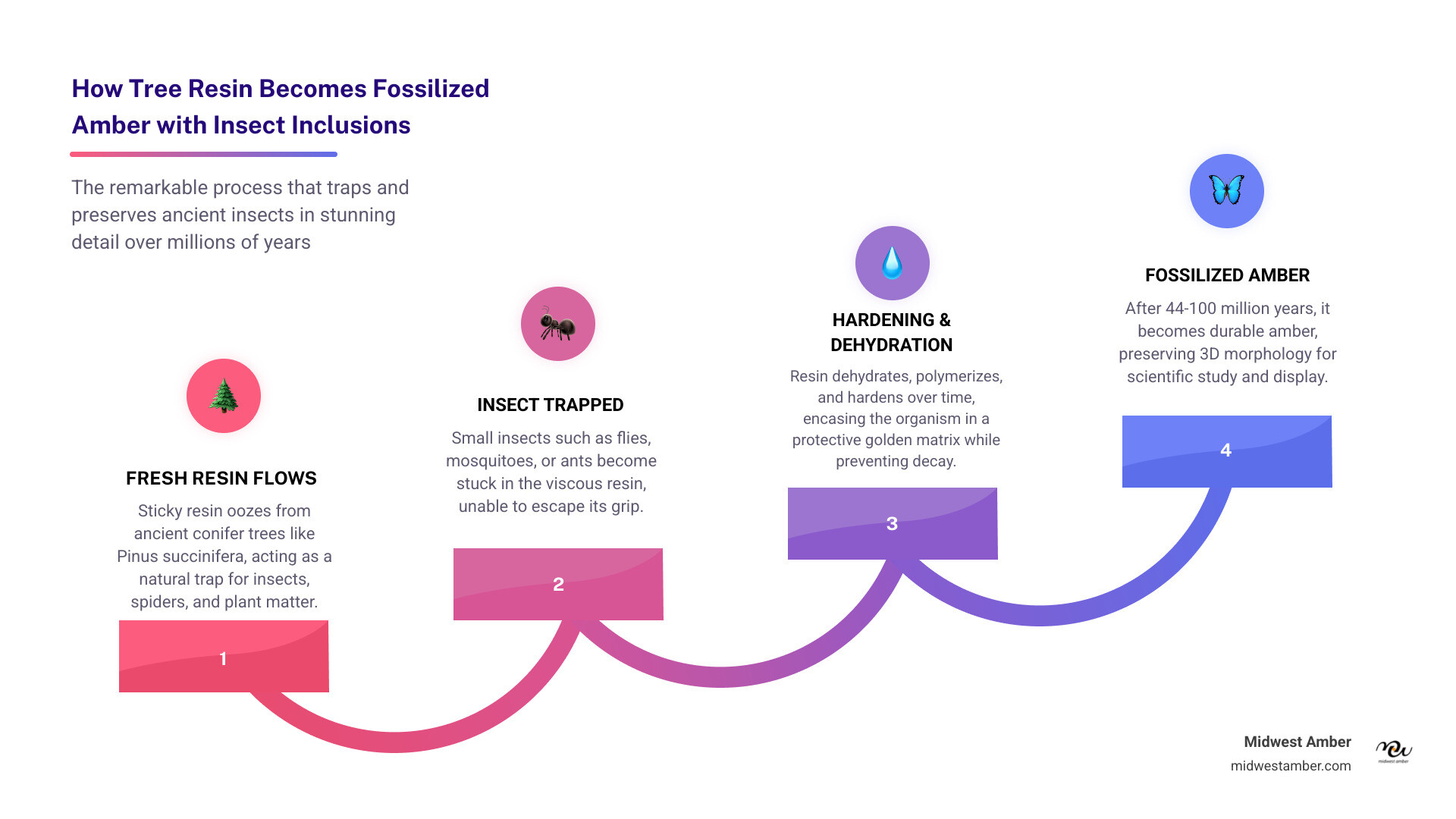
To understand the magic of an amber insect inclusion, we first have to clear up a common misconception: amber is not a stone. It is fossilized tree resin. Millions of years ago, in ancient forests, trees (specifically the Pinus succinifera in the Baltic region) would exude a thick, sticky resin. This wasn't sap, which carries nutrients, but a defensive substance meant to seal wounds and protect the tree from pests.
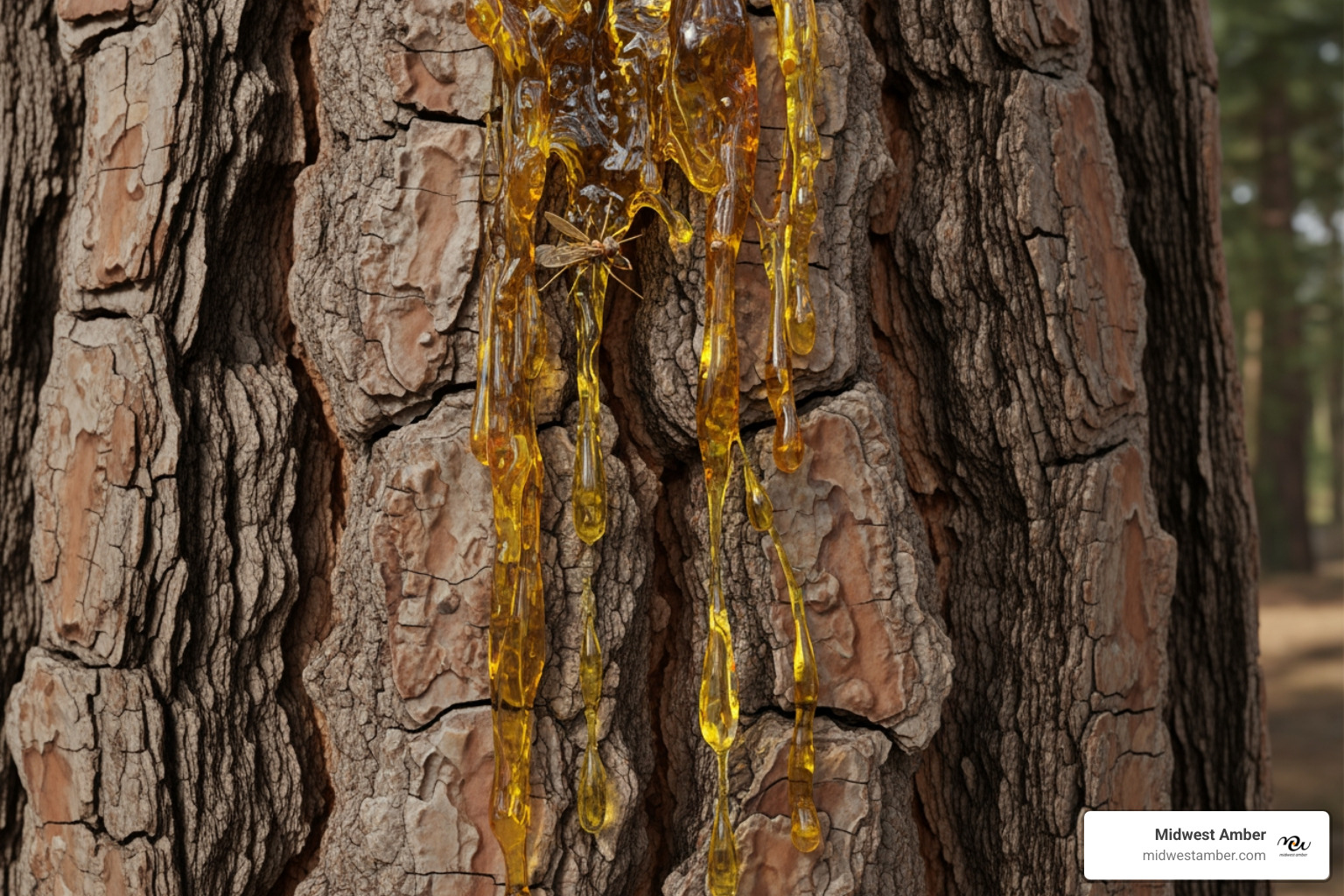
As this resin flowed down the bark, it acted as a lethal "sticky trap." A wandering ant or a landing fly would find itself mired in the goo. More resin would flow over the creature, sealing it off from the air. This is the crucial first step. Once sealed, the process of dehydration and polymerization begins. Over millions of years, the organic compounds in the resin link together to form a hard, plastic-like substance that can survive the geological pressures of being buried in the earth.
For more detailed information on this process, you can explore our guide on amber inclusions.
How Fossilization Preserves Ancient Morphology
Unlike traditional fossils found in rock, which are often flattened and distorted (compressed fossils), an amber insect inclusion is preserved in three dimensions. The resin acts as a perfect mold. While the soft internal tissues of the insect eventually decompose, the rigid exoskeleton remains. In many cases, the decomposition of internal organs actually helps preserve surface structures in finer detail, leaving a hollow but perfectly shaped cavity that reflects every microscopic hair, scale, and wing vein.
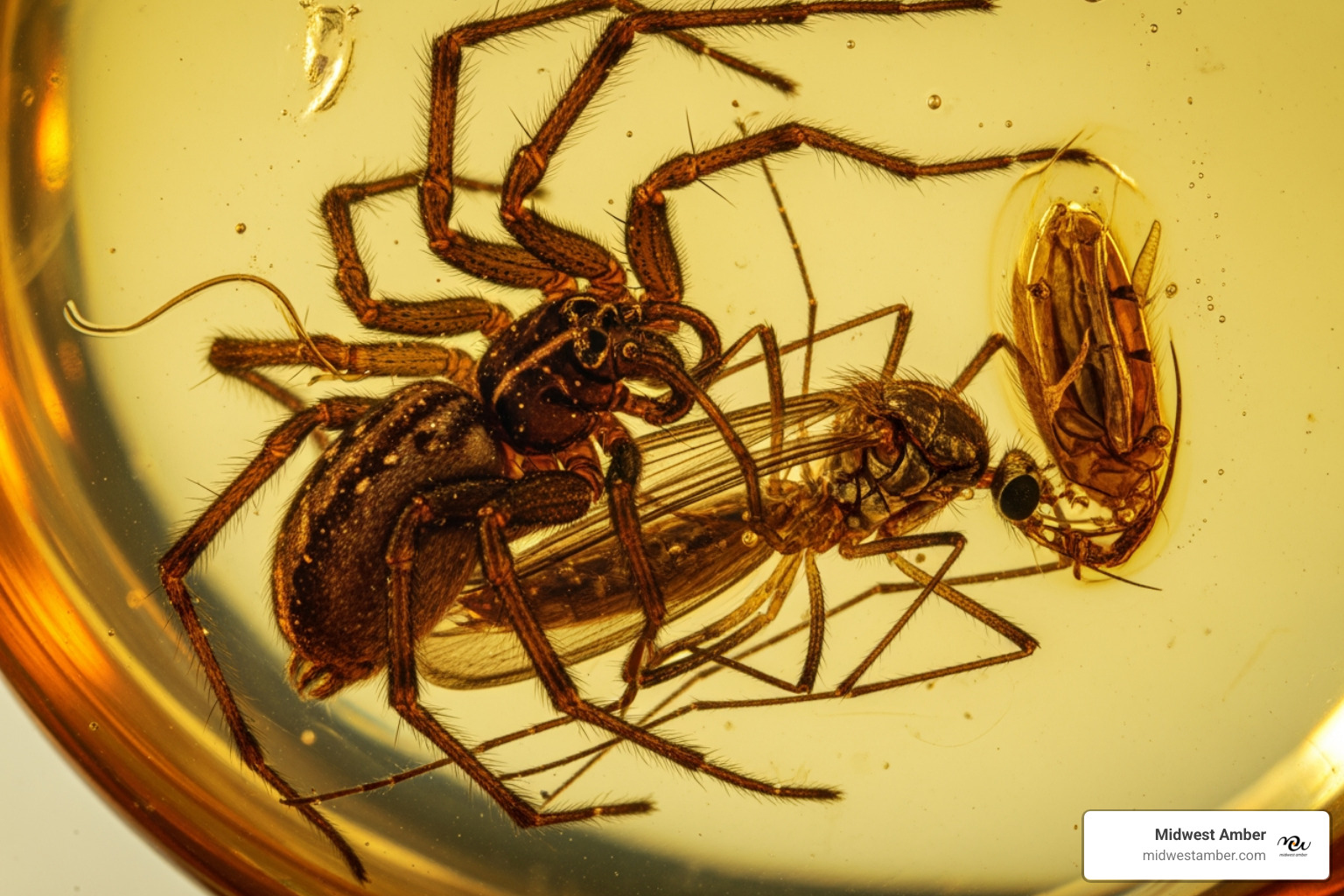
This level of detail is so high that scientists can often identify the exact species of a 40-million-year-old fly. We can see evidence of ancient behavior, such as a Burmese amber with large beetle inclusion or even a Burmese Amber with spider and mosquito inclusion where the predator-prey relationship is frozen in time. You can learn more about the scientific research on amber inclusions and preservation to see how these "puzzle pieces" help us reconstruct ancient climates.
Major Sources of Genuine Amber Inclusions
While amber is found in many places, only a few locations are famous for high-quality amber insect inclusion specimens. Each source offers a different "snapshot" of Earth's history.
| Feature | Baltic Amber | Burmese Amber | Dominican Amber |
|---|---|---|---|
| Geological Age | 44–55 Million Years (Eocene) | ~100 Million Years (Cretaceous) | 15–20 Million Years (Miocene) |
| Primary Color | Golden, Yellow, Cognac | Reddish, Brown, Honey | Clear Yellow, Rare Blue |
| Clarity | High to Milky | Varies (Often Darker) | Very High / Transparent |
| Common Fauna | Flies, Ants, Spiders | Beetles, Extinct Wasps | Mosquitoes, Stingless Bees |
Baltic Amber: The Eocene Time Capsule
Baltic amber is the "gold standard" for collectors and jewelry makers alike. Formed during the Eocene epoch, it originated in a massive primeval forest in Northern Europe (Fennoscandia). Today, it is primarily sourced from Lithuania and Poland. It is scientifically known as succinite because of its high succinic acid content, which is often linked to its legendary healing properties.
At Midwest Amber, we specialize in this specific variety. Whether it's a Baltic Amber with Insect Inclusion or a handcrafted piece from our collection, Baltic amber is prized for its warmth and the sheer variety of life it contains. You can Shop Genuine Baltic Amber with Inclusions to find your own piece of history.
Burmese and Dominican Varieties
Burmese amber (Burmite) is significantly older, dating back to the Cretaceous period—the age of the dinosaurs. It often contains more primitive insect forms and is generally harder than Baltic amber. You might find a Burmese amber with swarm of mosquitoes inclusion that shows a 100-million-year-old moment of high insect activity.
Dominican amber, on the other hand, is much younger (Miocene) and comes from a tropical leguminous tree rather than a conifer. It is famous for its incredible clarity, making it easy to see specimens like Dominican Amber with Mosquitos.
Identifying Common and Rare Amber Insect Inclusion Types
What exactly are you looking at when you peer into a piece of amber? Statistics tell a fascinating story. In Baltic amber, nearly 99% of inclusions are arthropods (insects and arachnids).
Most Frequent Amber Insect Inclusion Finds
If you find a bug in amber, there is a 90% chance it is an insect and a 9% chance it is a spider. Within the insect world, Diptera (flies and mosquitoes) are the kings, making up about 45% of all finds. This includes over 800 species! Ants, wasps, and beetles are also relatively common.
Because these creatures were highly active in the ancient forest, they were the most likely to get stuck. If you're looking for your first piece, you can Find Your Fossil Amber With Bugs Near You or discover unique amber specimens in our online shop.
Rare Botanical and Vertebrate Specimens
While bugs are common, other inclusions are incredibly rare:
- Botanical Inclusions: On average, only one in a thousand inclusions is of plant origin. Oak flower trichomes (tiny hairs) are the most frequent plant find, often indicating the resin was produced in the spring.
- Vertebrates: Finding a lizard, a bird feather, or mammalian hair is the "holy grail" for collectors. These are exceptionally rare because larger animals could usually pull themselves free from the sticky resin.
- Marine Life: Since resin forms on land, finding a snail or an aquatic insect is a major scientific event.
For those interested in the rare beauty of ancient flora, an amber flower inclusion necklace is a stunning way to wear a botanical fossil.
How to Authenticate a Genuine Amber Insect Inclusion
Because an amber insect inclusion can be quite valuable, the market is unfortunately flooded with fakes. Some are modern plastic; others are "copal" (young resin that hasn't fully fossilized). Some fakes even feature modern insects "injected" into real amber.
Testing Your Amber Insect Inclusion at Home
You don't need a laboratory to perform basic authentication. Here are the most effective tests:
- The Salt Water Test: Mix a solution of 1 part salt to 4 parts water. Genuine amber will float, while most plastics and glass will sink.
- UV Light Test: Real Baltic amber fluoresces under UV light, typically glowing a pale blue or greenish-yellow.
- Static Electricity: Rub the amber vigorously against a wool sweater for 20 seconds. Genuine amber will become electrostatically charged and pick up tiny bits of paper.
- The Scent Test: If you rub the amber until it gets warm, it should emit a faint, pleasant smell of pine resin. Fakes often smell like burnt plastic or chemicals.
For a deeper dive, check out our Guide to Authenticating Your Baltic Amber.
Spotting Forgeries and Modern Fakes
A major red flag is the "too good to be true" inclusion. If you see a large, perfectly centered, brightly colored scorpion in a cheap piece of "amber," it is almost certainly a forgery. Real inclusions are usually tiny (1–5 mm) and often look like they were struggling to escape—legs might be splayed or wings slightly tattered.
Always buy from reputable sellers who provide certifications. At Midwest Amber, we draw on over 20 years of experience to ensure every piece is 100% natural and ethically sourced. You can learn more about the craftsmanship behind our pieces in our article on mosquito rings.
Caring for and Displaying Fossil Amber
Amber is a "soft" gemstone, measuring only about 2 to 2.5 on the Mohs hardness scale. This means it can be scratched easily and requires gentle care to stay beautiful for another 50 million years.
Proper Storage for Longevity
- Cleaning: Use only a soft cloth and lukewarm water. Never use ultrasonic cleaners or harsh chemicals, which can degrade the surface.
- Avoid Sunlight: Prolonged exposure to direct sunlight can cause amber to darken or become brittle over time.
- Separate Storage: Store your amber pieces in individual soft pouches to prevent them from being scratched by harder jewelry like diamonds or gold.
If you have a special piece, like an insect amber brooch, keeping it in a climate-controlled environment will prevent the oxidation that can eventually cloud the stone.
Frequently Asked Questions
How old is the most common amber with insects?
The most common and popular variety is Baltic amber, which formed during the Eocene epoch, approximately 44 to 55 million years ago. This was a time when the Earth was much warmer, and vast forests covered the region that is now the Baltic Sea.
Can you extract DNA from an amber insect inclusion?
While Jurassic Park made the idea famous, science has shown that DNA is a very fragile molecule. Even in the perfect seal of amber, DNA degrades significantly over millions of years. While we can see the three-dimensional structure of the insect, extracting viable genetic material from a 50-million-year-old specimen is currently beyond our scientific capabilities.
Why are most inclusions so small?
Most amber insect inclusion specimens are between 1 and 5 mm. This is due to "surface tension" and "escape mechanisms." A large beetle or dragonfly has the strength to pull itself out of the sticky resin. Only the smallest creatures—those lacking the leverage to break free—remain trapped forever.
Conclusion
An amber insect inclusion is more than just a piece of jewelry; it is a tangible connection to a world that existed long before humans. Whether you are a collector looking for a rare Baltic Amber Fossil & Inclusion or someone looking for a unique gift, these fossils offer a beauty that is truly timeless.
At Midwest Amber, we take pride in our Polish and Lithuanian heritage, working with skilled artisans to bring you handcrafted, genuine Baltic amber. Every piece we sell is a certified, ethically sourced treasure. We invite you to explore our collection of Fascinating Finds Amber Jewelry For Men Featuring Ancient Inclusions and discover the prehistoric wonder for yourself.
From our home base in the Chicago area to our customers across the country, we are dedicated to preserving the story of amber—one inclusion at a time. Visit our Store - Fossil Amber Inclusion links or browse our own handcrafted collections today!

Leave a comment
This site is protected by hCaptcha and the hCaptcha Privacy Policy and Terms of Service apply.