

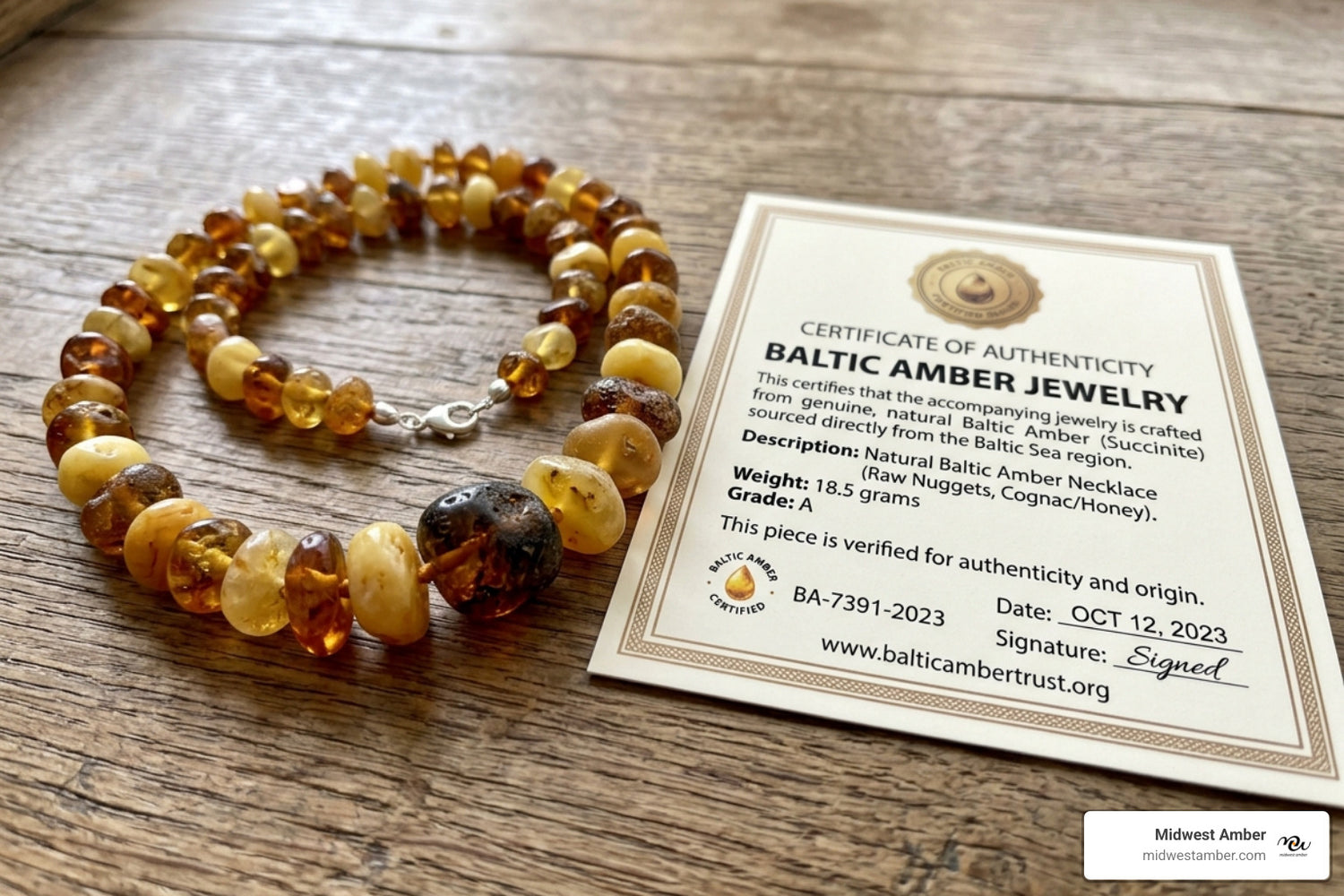
Why Amber Jewelry Certification Matters Before You Buy
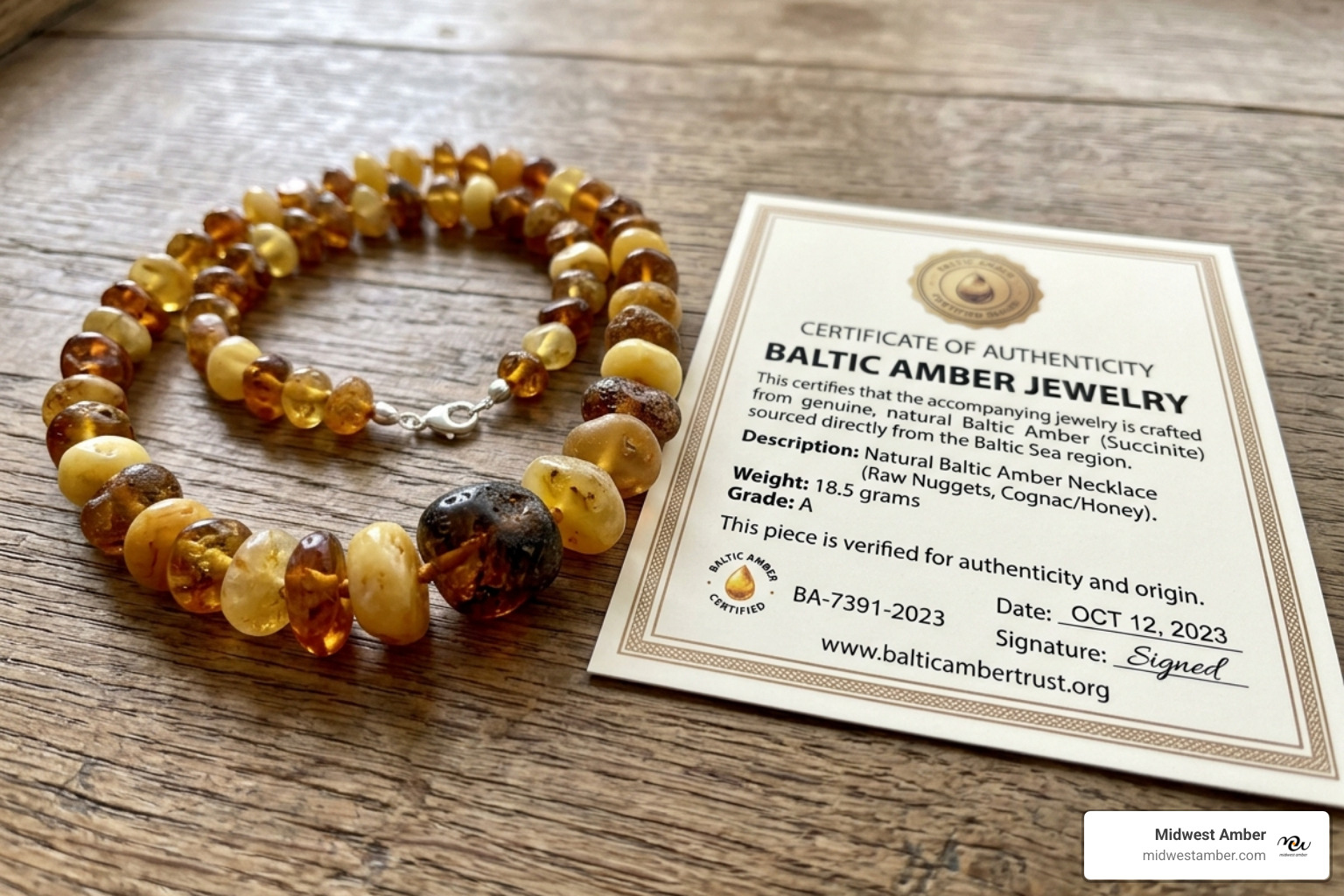
Amber jewelry certification is how buyers confirm that a piece contains genuine, natural Baltic amber — not copal, plastic, glass, or pressed resin sold as the real thing.
Here is a quick summary of what you need to know:
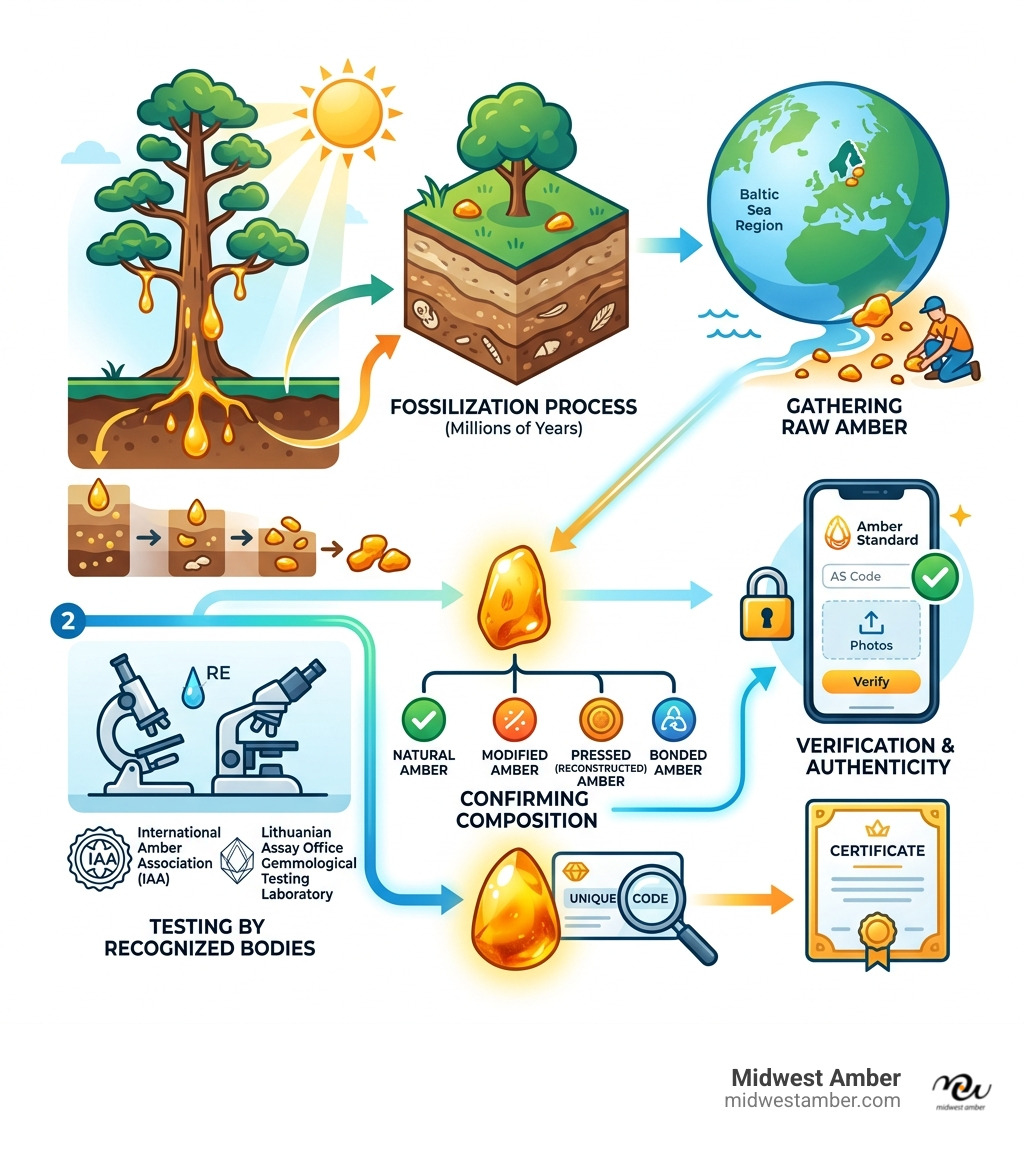
- Who certifies amber? The two most recognized bodies are the International Amber Association (IAA) and the Lithuanian Assay Office Gemmological Testing Laboratory.
- What does a certificate confirm? Whether the amber is natural, modified, pressed (reconstructed), or bonded.
- How do you verify a certificate? Legitimate systems like Amber Standard let you enter a unique AS code and upload photos at amberstandard.com to check authenticity.
- Why does it matter? Baltic amber is widely faked. Copal, plastics, and glass imitations flood the market and are difficult to spot without proper testing.
- Who should care most? Anyone buying amber jewelry — especially teething necklaces for babies, prayer beads, or high-value inclusion pieces.
Baltic amber has been treasured for thousands of years. The ancient Greeks called it elektron, meaning "made by the sun." Today, with Kaliningrad Oblast in Russia holding roughly 90% of the world's amber supply and raw amber prices rising, sophisticated fakes have become a serious problem. A certificate is no longer a nice-to-have — it is your first line of defense.
I'm Gabriel Ciupek, President and owner of Midwest Amber, Inc., with over 20 years of experience sourcing and selling genuine, certified Baltic amber jewelry crafted by skilled Polish and Lithuanian artisans — making amber jewelry certification a cornerstone of everything we do. In the sections below, we'll walk you through exactly how certification works, which institutions to trust, and how to protect yourself from fakes.
Understanding Baltic Amber and Its Global Value
To understand why amber jewelry certification is so vital in April 2026, we first have to look at what amber actually is. Unlike diamonds or sapphires, amber is an organic gemstone. It is the fossilized resin of ancient coniferous trees. While amber is found in various parts of the world, Baltic amber is the "gold standard."
The majority of the world’s supply—roughly 90%—is concentrated in the Kaliningrad Oblast of Russia, though it is also found along the shores of Poland, Lithuania, and Denmark. This resin began its journey during the Upper Carboniferous Period, with some of the oldest samples dating back approximately 320 million years. However, most Baltic amber we see in jewelry today formed about 45 to 50 million years ago.
What makes it so valuable? Beyond its warm glow and lightweight feel, Baltic amber is a scientific marvel. It contains between 3% and 8% succinic acid, a substance historically used in folk medicine for its purported analgesic and anti-inflammatory properties. Furthermore, amber acts as nature’s time capsule. Over 1,000 extinct animal species and countless plant fragments have been identified trapped within its golden depths. You can learn more about the scientific research on Baltic Amber properties to see why this material is so unique.
The Rarity of Genuine Inclusions
In amber, what’s inside often dictates the price. A clear piece of amber is beautiful, but a piece containing a prehistoric ecosystem is priceless. We’ve seen specimens weighing over 90 grams that contain perfectly preserved crickets, mosquitoes, or ancient leaves.
Because these inclusions significantly increase the value of a piece, they are also the most frequently faked. Scammers will often embed modern insects into plastic or copal, centering them perfectly to attract unsuspecting buyers. Genuine inclusions are rarely "perfectly" placed; they tell a story of a struggle for survival millions of years ago. To avoid being misled, it’s worth unlocking the secrets of genuine stones to understand what a real inclusion should look like.
The Role of Official Amber Jewelry Certification
Since amber is not a mineral and its market is largely unregulated, the industry has stepped up to create its own standards. When we talk about amber jewelry certification, we are referring to documents issued by recognized gemmological authorities.
The most prestigious organization is the International Amber Association (IAA), founded in 1996. Based in Poland, the IAA has about 350 members worldwide, including scientists, collectors, and jewelers. However, achieving "Recommended Company" status is difficult; currently, only 45 companies worldwide hold this distinction. This status means the company has undergone rigorous scrutiny and ongoing supervision to ensure they only sell authentic Baltic amber.
Another heavyweight in the field is the Lithuanian Assay Office, which operates under the Ministry of Finance of Lithuania. Their Gemmological Testing Laboratory provides independent, expert verification that a piece is 100% natural Baltic amber. For a deeper dive into these standards, check out our more info about certified Baltic amber.
How to Verify an Amber Jewelry Certification Card
A piece of paper is only as good as the system behind it. In recent years, the Amber Standard system has revolutionized how we verify authenticity. Each certified piece is assigned a unique AS code.
As a buyer, you can go to the Amber Standard verification system and enter this code. The system will display high-quality photos of the exact item associated with that code. This "fingerprint" identification ensures that a certificate for a high-value pendant hasn't been photocopied and sold with a plastic imitation. This level of transparency is what we strive for at Midwest Amber, ensuring every customer feels confident in their purchase.
The Importance of Amber Jewelry Certification for Teething Products
For many parents in the Chicago suburbs and across the US, amber is first introduced through teething necklaces. Because these products are intended for children, certification is about more than just "real vs. fake"—it’s about safety.
Authentic amber teething jewelry should meet the EN71-1 European safety standards. This certification ensures the jewelry features safety mechanisms like pop clasps or screw clasps that break under specific tension, and that the beads are hand-knotted individually so they won't scatter if the string breaks. Furthermore, only genuine Baltic amber contains the succinic acid levels that parents seek for natural relief. Our guide to buying real amber jewelry explains these safety features in detail.
Distinguishing Genuine Baltic Amber from Sophisticated Fakes

The market is currently flooded with "amber" that has never seen a prehistoric forest. The most common culprit is Copal. Copal is also a natural tree resin, but it is much younger—usually less than 30 million years old. Because it hasn't fully polymerized, it is softer, melts at lower temperatures (below 150°C), and can even be sticky to the touch.
Other fakes include:
- Plastic and Phenolic Resins: Often used for "bakelite" style beads.
- Glass: Heavy, cold to the touch, and impossible to scratch with a needle.
- Pressed Amber (Ambroid): Made by heating small scraps of amber and pressing them into a single block. While it contains "real" amber, its structure is altered, making it less valuable than natural stones.
If you are unsure about a piece you already own, we have a guide on how to tell if your amber is real or resin.
Reliable At-Home Authenticity Tests
While nothing beats a lab-issued amber jewelry certification, there are several non-destructive (and a few destructive) tests you can perform at home.
| Feature | Natural Baltic Amber | Copal | Plastic/Glass |
|---|---|---|---|
| Salt Water Test | Floats (in saturated solution) | Floats | Sinks |
| Static Test | Picks up tiny bits of paper | Weak charge | No charge |
| Scent (Rubbing) | Faint pine/resin smell | Sweet/medicinal smell | Chemical or no smell |
| Solvents (Acetone) | No reaction | Becomes sticky | May dissolve or discolor |
| Hardness | 2.0 - 2.5 (Scratches easily) | Very soft | Harder to scratch |
The Salt Water Test: This is the most famous DIY method. Mix one part salt with two parts water. Genuine amber has a specific gravity of about 1.08, meaning it will float in salt water but sink in fresh water. Most plastics and glass will sink immediately. Note: This test won't work if the amber is set in heavy silver or gold.
Why Certification Outperforms Home Testing
Home tests are helpful, but they have limits. For instance, the "Hot Needle Test"—where you touch a heated needle to an inconspicuous spot to smell for pine resin—is destructive. You don't want to poke a hole in a $500 pendant!
Furthermore, sophisticated "reconstructed" or "pressed" amber will pass the salt water and scent tests because it is technically amber, just heavily processed. Only a professional lab using infrared spectroscopy can definitively tell the difference between a natural stone and one that has been thermally modified to change its color or create "sun spangles." This is why we always recommend looking for where to buy certified Baltic amber from reputable sources.
Navigating Regional Standards: Poland, Lithuania, and Russia
The Baltic region has a rich heritage of amber craftsmanship. In Gdańsk, Poland, often called the "World Capital of Amber," artisans have been carving this resin for centuries. Lithuania is equally famous for its high-tech gemmological labs and traditional bead-making techniques.
When you look at an amber jewelry certification card, the origin matters. Most high-quality jewelry sold in the US, including our collection at Midwest Amber, is sourced directly from these two countries to ensure ethical labor practices and raw material traceability.
Official Classifications of Amber Products
The International Amber Association classifies amber into four distinct categories. Understanding these is crucial for knowing what you are paying for:
- Natural Baltic Amber: The stone has only undergone mechanical treatment (grinding, cutting, polishing) without any change to its natural properties.
- Modified Baltic Amber: The stone has been subjected to thermal or high-pressure treatment to change its color or clarity (e.g., creating "green" amber).
- Reconstructed (Pressed) Baltic Amber: Small pieces of amber pressed together under high pressure.
- Bonded Baltic Amber: Consists of two or more parts of natural, modified, or reconstructed amber bonded together with a colorless binding agent.
Always check your Baltic Amber Certificate of Authenticity to see which classification your jewelry falls under. At Midwest Amber, we specialize in 100% natural and handcrafted pieces.
Frequently Asked Questions about Amber Jewelry Certification
What does an official amber certificate confirm?
An official certificate confirms the authenticity of the material (that it is genuine Baltic amber), its classification (natural, modified, or pressed), and often its weight and origin. If the piece has significant inclusions, the certificate may also verify their organic nature.
How can I tell if a certificate is fake?
Look for a unique identification code, a physical address of the laboratory, and a holographic seal or official stamp. Most importantly, verify the code on the issuing organization's website. If the "certificate" is just a generic card with no company name or contact info, it likely holds no value.
Does certification increase the price of amber?
Yes, but for a good reason. The cost of lab testing and the overhead of maintaining membership in organizations like the IAA are reflected in the price. However, this "premium" is actually an investment in the resale value and peace of mind that your jewelry is a genuine piece of natural history.
Conclusion
When imitations are becoming harder to spot, amber jewelry certification is your ultimate safeguard. Whether you are looking for a unique statement ring, a handcrafted pendant, or a safe teething necklace for your little one, the presence of a verified certificate ensures you are getting the real deal.
At Midwest Amber, we bring over 20 years of experience to the table. Our roots are firmly planted in the traditions of Polish and Lithuanian artisans, and we are committed to providing only 100% natural, ethically sourced Baltic amber. From our base in the Chicago area to our customers nationwide, we stand behind every piece we sell.
Ready to add a piece of ancient history to your collection? Explore our collection of certified Baltic amber and experience the warmth and beauty of the "Gold of the North" for yourself.


Leave a comment
This site is protected by hCaptcha and the hCaptcha Privacy Policy and Terms of Service apply.