

Showing the Secrets of Ancient Amber
Antique amber beads for sale are fossilized treasures that have captivated collectors for centuries. To find genuine antique amber beads, here's what you need to know:
Quick Authentication Guide:
- Age Indicators - Look for natural crazing patterns, wear consistent with age, and irregular hand-drilled holes (typically larger than modern beads).
- Color Quality - Authentic antique pieces often feature rich cherry, butterscotch, or egg yolk tones with natural variations.
- Price Range - Expect to pay $625 to $22,500, with average pieces selling around $2,842.
- Simple Tests - Real amber floats in saltwater, feels warm to touch, and creates static when rubbed.
- Trusted Sources - Purchase from reputable auction houses, certified dealers, or established amber specialists.
The market for antique amber beads has grown steadily, driven by collectors who appreciate the historical significance and natural beauty of Baltic amber. These organic gems, formed over 45 million years ago, carry stories from ancient trade routes like the famed Amber Road.
Understanding what makes amber genuine is crucial. This popularity has brought an influx of imitations like plastic, glass, and younger copal resin masquerading as authentic Baltic amber. Learning to authenticate these pieces protects your investment and ensures you acquire a true piece of natural history.
I'm Gabriel Ciupek, President of Midwest Amber, Inc. I've spent years training teams on amber authentication and working with suppliers to ensure our antique amber beads for sale meet the highest standards. My experience has taught me that education is key to confident purchasing.
Relevant articles related to antique amber beads for sale:
The Allure of Ancient Amber: History and Value
In ancient Rome, a small amber statuette could purchase a slave, and amber with insect inclusions was worth 120 swords. Amber has captivated humanity for millennia, not just for its beauty but for its perceived power and rarity. Its journey from ancient forests to cherished adornment shows its enduring appeal.
The story of amber begins with the Amber Road, a trade route connecting the Baltic Sea with the Mediterranean. This network facilitated the exchange of the "Gold of the North," as the Romans called it. Baltic amber artifacts date back to the Palaeolithic Era, and even Pharaoh Tutankhamun's burial ornaments featured large Baltic amber beads, solidifying its status as an ancient treasure. To learn more about amber's origins, explore Where Does Baltic Amber Come From? A Journey to the Eocene Epoch.
Amber also wove its way into global cultures. During China's Qing Dynasty (1644-1912), elaborate court necklaces became potent symbols of status for officials and aristocrats. Amber also graced fashionable European eras. Victorian and Art Deco jewelry frequently incorporated amber, adapting its natural beauty to the distinctive styles of the times. This proved its timeless versatility, and the market continues to reward collectors who value authenticity in these historical pieces.
Defining Characteristics of Antique Beads
When discussing antique amber beads for sale, we mean pieces that carry the marks of time and craftsmanship. Identifying these characteristics is key to distinguishing a true antique from a modern reproduction.
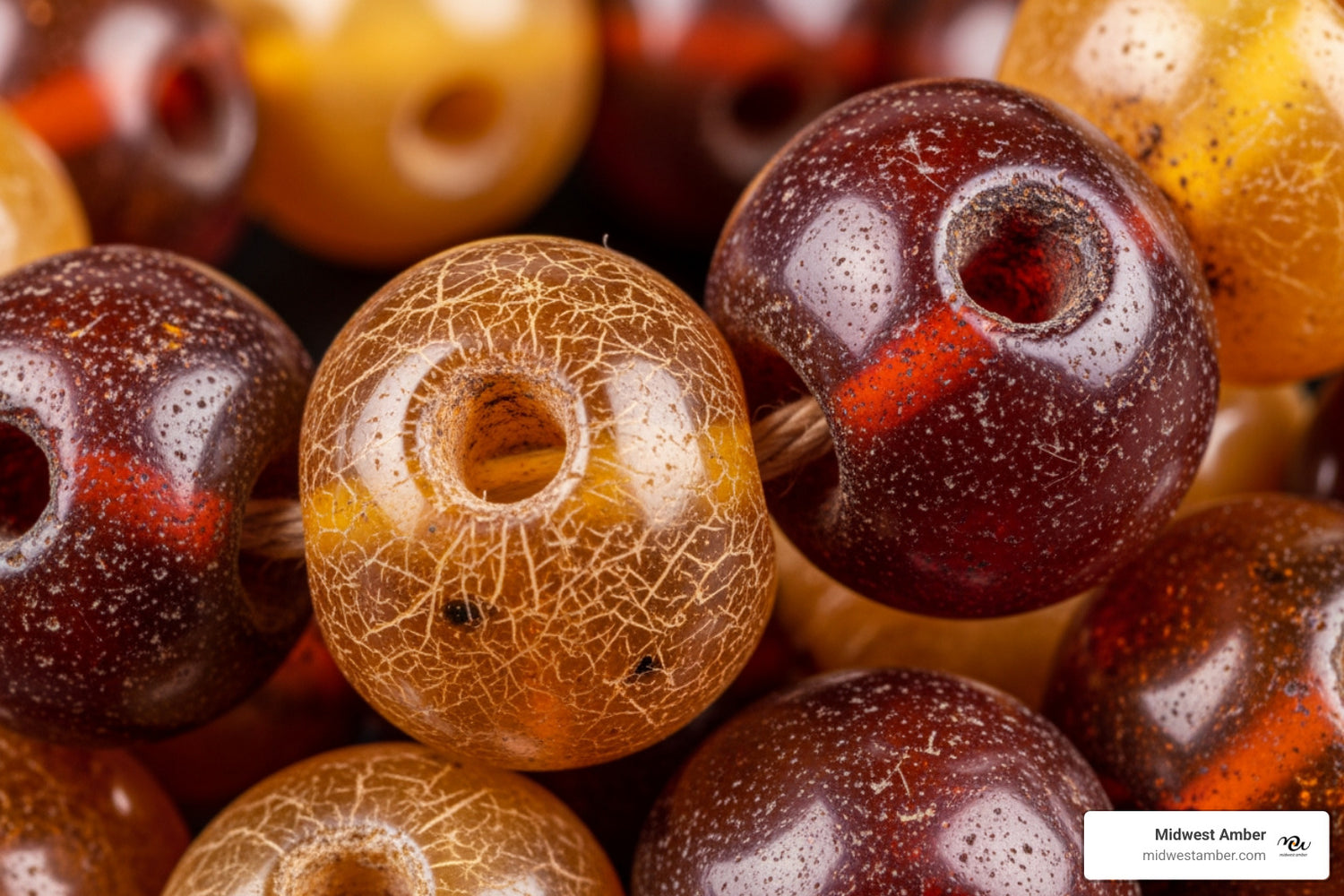
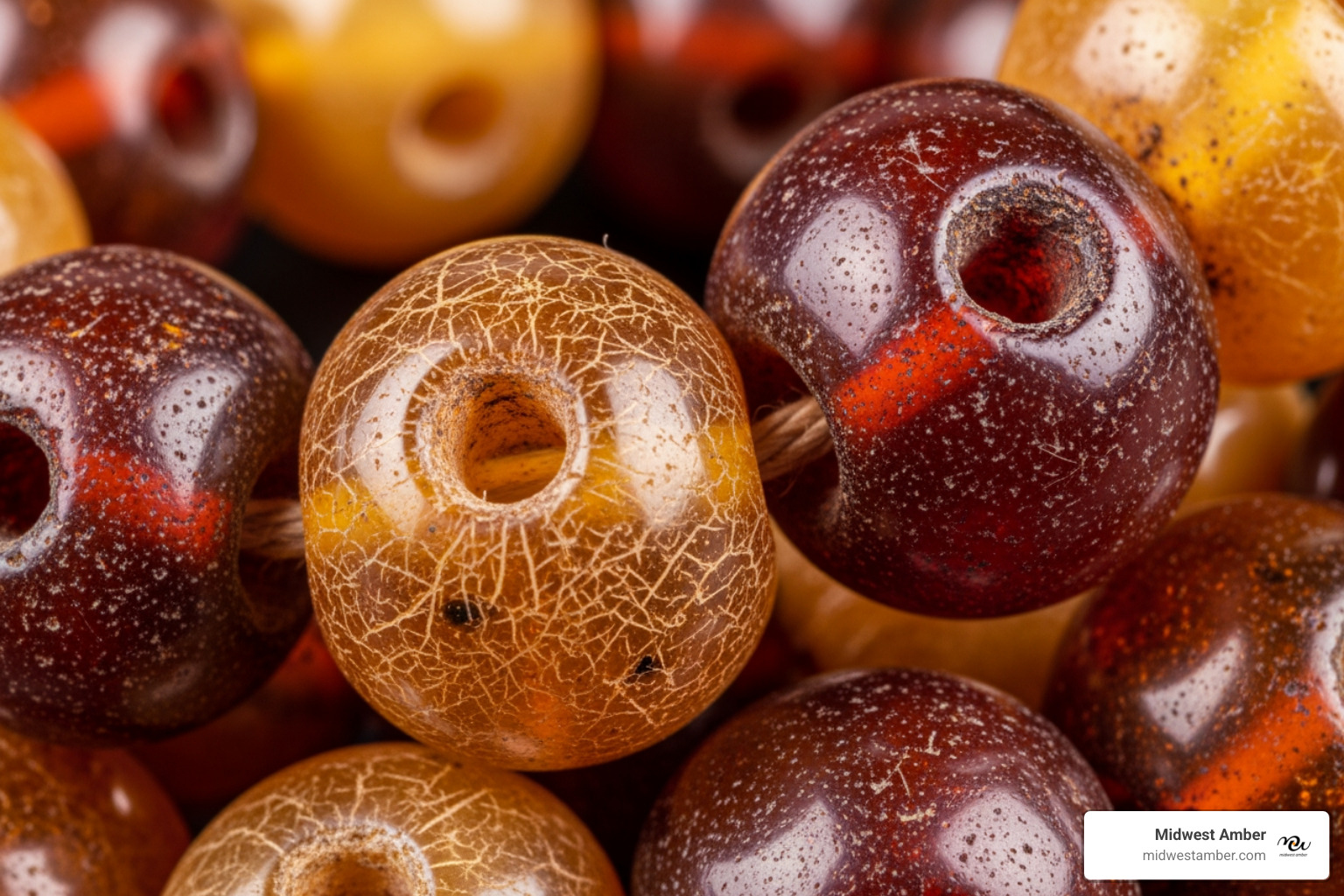
A telling sign is a natural patina and "crazing." Over time, amber develops a unique surface texture and color shifts from exposure to air, light, and skin oils. This aging process creates a network of fine lines (crazing) on the surface, which is prized by collectors as it tells a story.
Wear patterns are another indicator. Antique beads often show gentle, smooth wear around the drill holes and on surfaces where they rubbed against clothing or other beads. This is a testament to their history, not damage.
Hand-carved imperfections are a hallmark of antique craftsmanship. Unlike uniform modern beads, older beads show slight variations in shape, size, or faceting, reflecting the artisan's touch and adding to their charm.
The bead holes are also distinctive. Antique beads tend to have larger, irregularly drilled center holes compared to the small, uniform holes of contemporary pieces, which suggest a more modern origin. As we explore in Unearthing Natural Natural Amber: What Makes This Ancient Gem So Special, these details are crucial for appreciation.
What Makes Antique Amber Valuable?
The value of antique amber beads for sale blends natural beauty, rarity, and historical significance. Several factors make certain pieces more valuable to collectors.
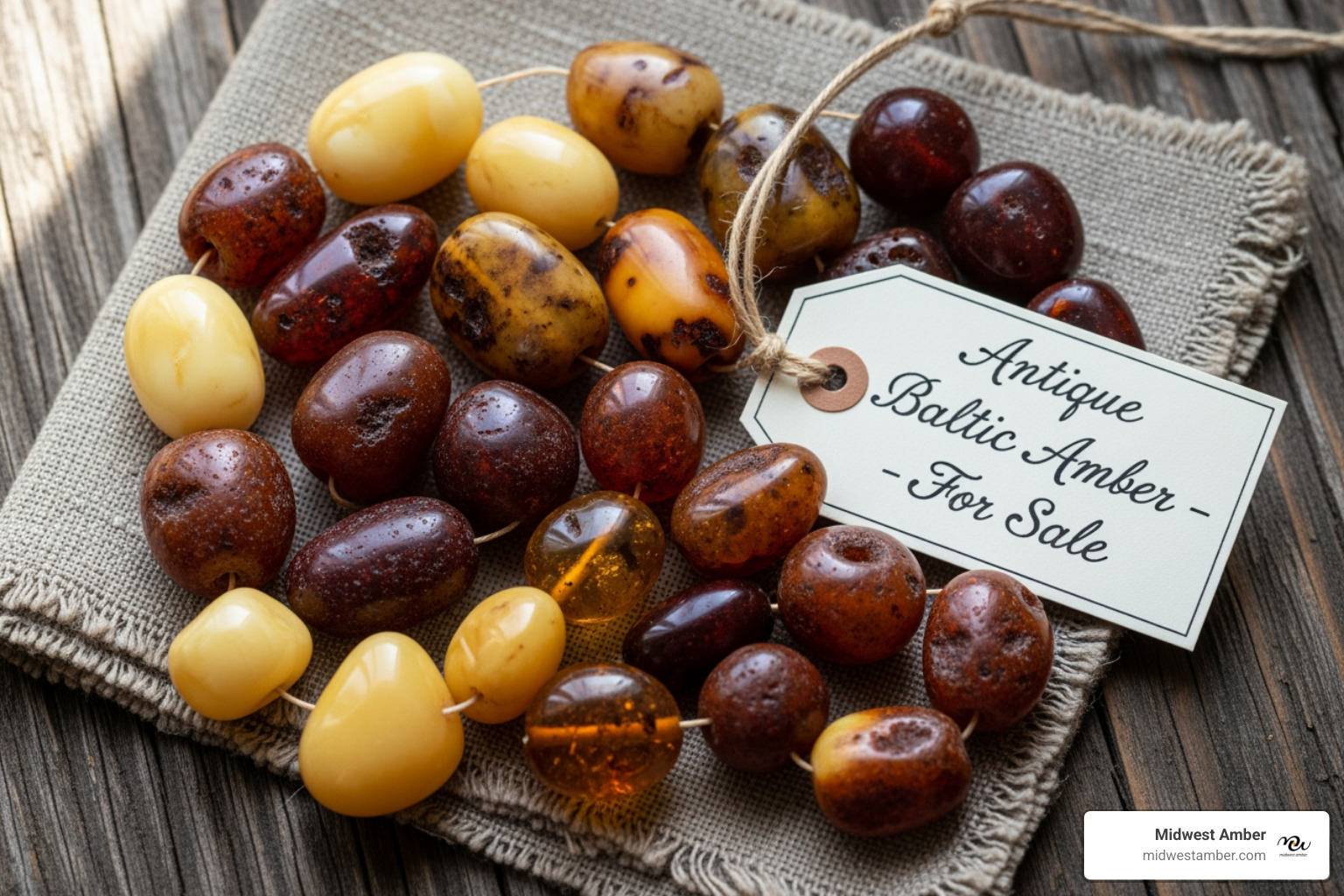
First, color and clarity are paramount. Coveted colors include "cherry amber" (deep reddish-brown), creamy "butterscotch amber," and milky "egg yolk" amber. The rare reddish-orange, or vermillion, color in a large necklace makes a piece exceptionally valuable. We dig deeper into these varieties in From Raw to Red: A Shopper's Guide to Every Type of Amber Jewelry.
Inclusions like ancient insects or plant matter dramatically increase amber's value. While rare in bead necklaces, amber with visible inclusions has always been highly prized. Ancient Romans, for example, valued amber with insect inclusions above many other treasures. To learn more about these fascinating specimens, check out Jurassic Gems: Where to Find Mosquito in Amber Necklaces.
Provenance, the documented history of ownership, also plays a significant role. A necklace with a well-documented history from a notable family or specific period achieves higher values at auction, adding authenticity and prestige.
Finally, bead size and weight are crucial. Large amber beads are exceptionally rare. A necklace of substantial, uniform beads is highly prized. The combination of rare color, size, and provenance can make a necklace an investment-grade artifact.
The Authenticator's Toolkit: Telling Real from Resin
Acquiring antique amber beads for sale is thrilling, but you need knowledge to distinguish genuine amber from imposters. The market has many fakes, so a discerning eye and simple tests are your best allies.
Imitations range from natural resins like copal to synthetics like plastic and glass. Copal is a younger resin that looks similar but lacks amber's age and hardness. Plastics like Bakelite, Faturan, and Lucite were popular in antique jewelry and can be mistaken for amber. Even modern plastic clasps are designed to mimic amber.
To help you steer this tricky terrain, here's a quick comparison of genuine amber versus common fakes:
| Characteristic | Genuine Amber | Copal (Younger Resin) | Plastic (Bakelite, Faturan, Lucite) | Glass |
|---|---|---|---|---|
| Age | 45+ million years (Baltic) | A few hundred to a few million years | Modern (19th-20th C plastics) | Varies widely |
| Warmth to Touch | Warm (organic material) | Slightly warm, cooler than amber | Cool (synthetic) | Cool (inorganic) |
| Weight | Very lightweight | Lightweight | Varies, often heavier than amber | Significantly heavier |
| Saltwater Test | Floats (density 1.04-1.10 g/cm³) | Sinks or floats (density 1.03-1.08 g/cm³) | Sinks (density >1.2 g/cm³) | Sinks (density >2.4 g/cm³) |
| Hot Needle Test | Pine scent | Resinous, sweet scent | Acrid, chemical smell | No smell (may crack) |
| UV Light | Fluoresces blue or green (Baltic) | Weak or no fluorescence | No fluorescence | No fluorescence |
| Hardness | Soft (2-2.5 Mohs), can be scratched by metal | Softer than amber, easily scratched | Varies (2-4 Mohs), can be scratched | Harder (5-7 Mohs), difficult to scratch |
| Bubbles | Small, round, often "sun spangles" | Larger, elongated, often numerous | Uniform, often perfectly round | Uniform, often perfectly round |
| Inclusions | Insects, plant matter (rare in beads) | Insects, plant matter (often more common) | None (unless embedded artificially) | None (unless embedded artificially) |
| Sound (Tap) | Dull, soft clink | Dull clink | Plastic-y clink | Sharp, glassy clink |
For a comprehensive guide on distinguishing the real deal, we highly recommend our article Real or Resin: How to Tell If Your Amber Jewelry Is Genuine.
Simple Home Tests for Authenticity
Before buying antique amber beads for sale, you can perform several simple, non-destructive home tests to gauge authenticity. These tests use amber's unique physical properties to help you spot obvious fakes.
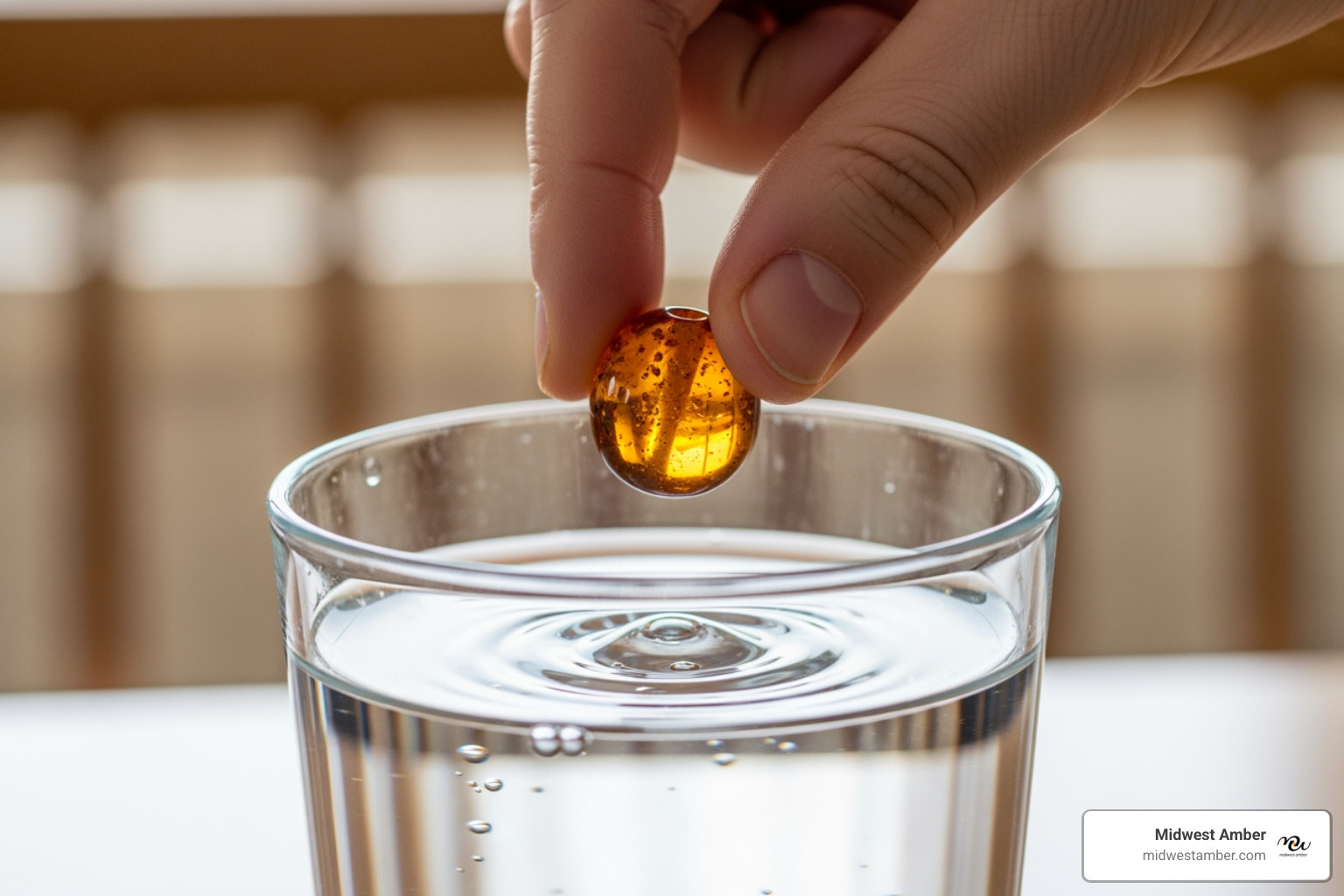
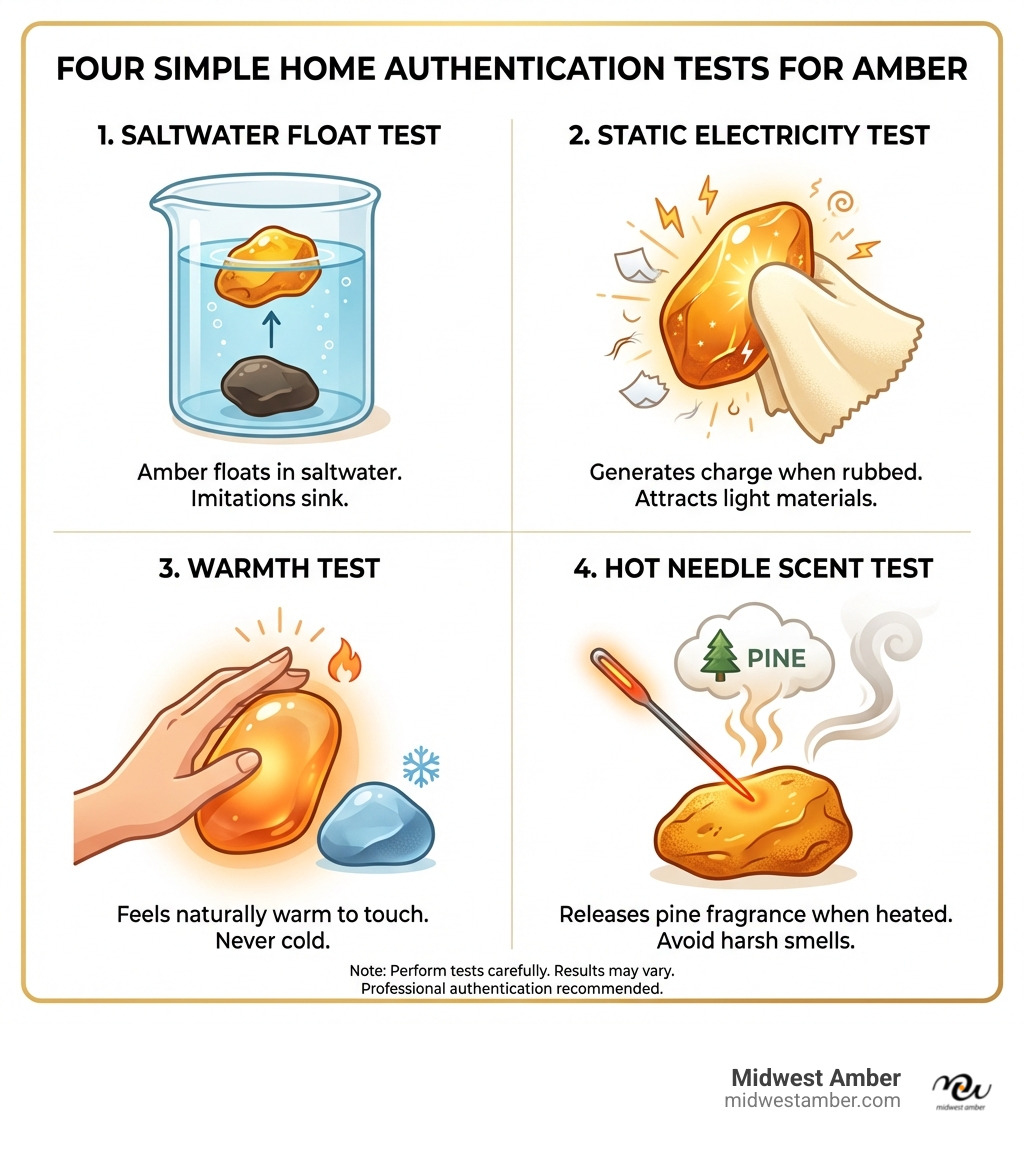
The Saltwater Float Test: This is a famous and effective home test. Genuine Baltic amber floats in saltwater but sinks in fresh water. Mix 2-3 tablespoons of salt into a glass of water. If your piece floats, it's likely genuine amber. If it sinks, it's probably an imitation like glass or plastic.
The Static Electricity Test: Amber is known for its electrostatic properties (the ancient Greeks called it "elektron"). Rub your amber bead with a soft cloth for 30-60 seconds. Genuine amber will generate enough static to pick up small pieces of paper or hair. If not, it might be a fake.
The Warmth to the Touch Test: As an organic material, amber feels warm to the touch. Unlike cool-feeling glass or plastic, genuine amber quickly warms against your skin.
The Scent Test (with extreme caution!): Use this test as a last resort, as it can cause damage. Heat a needle tip until red hot, then touch it to an inconspicuous spot on the amber (like inside a drill hole). Genuine amber emits a faint, pine-like scent. Plastics produce a chemical odor, and glass has no smell. This test can leave a mark, so be extremely cautious or avoid it.
These simple tests can provide strong indications of authenticity. For more detailed insights, read The Amber Truth: Unlocking the Secrets of Genuine Stones.
Advanced Authentication Methods
While home tests are a good start, advanced methods offer definitive answers for valuable or questionable antique amber beads for sale. These techniques require specialized equipment and expert knowledge, which is why Midwest Amber emphasizes certified authenticity.
The most common advanced method is UV light fluorescence. Genuine Baltic amber typically fluoresces with a blue or greenish glow under UV light due to its succinic acid. Many fakes show no fluorescence or a different reaction. This is a reliable, non-destructive test used by professionals.
The most reliable method is expert appraisal. Experienced gemologists and amber specialists can identify minute details, assessing age, craftsmanship, and material composition with precision. This is why we work with certified experts to guarantee our amber's authenticity.
The importance of certification cannot be overstated when investing in antique amber beads for sale. A certificate from a reputable source provides peace of mind and protects your investment. It should confirm the material, treatments, and sometimes origin. Midwest Amber offers certified, 100% natural, ethically sourced amber from Poland and Lithuania, providing full transparency. For more on certified amber, see Don't Get Fooled: The Definitive Guide to Certified Baltic Amber.
A Collector's Guide to Finding Antique Amber Beads for Sale
The market for antique amber beads for sale is vibrant, reflecting a growing appreciation for these treasures. Understanding market trends and value drivers is essential for any collector.
There is strong collector interest in genuine Baltic amber, especially pieces with unique colors, large size, and documented provenance. Limited supply and high demand create a favorable market. For example, a string of cherry amber beads estimated at £125-£250 sold for £980 at auction, showing the potential for strong performance.
However, prices vary. While exceptional pieces can reach £4995 (or $22,500), a graduated cherry amber bead necklace might sell for £360, and mixed lots for £140-£160. This range shows that quality, rarity, and demand are significant factors.
Key Factors Influencing the Value of Antique Amber Beads for Sale
Several factors influence the market value of antique amber beads for sale:
- Size and Weight: Large amber beads are rare. The necklace's weight in grams is a crucial value indicator. For example, a German Antique Diamond Cut Baltic Amber Bead Necklace was listed at 68 grams. Heavier necklaces generally command higher prices.
- Bead Uniformity and Graduation: A necklace with uniform beads (in size, shape, and color) or a smooth, well-executed graduation is often more desirable. This graduated cherry amber bead necklace is a prime example of how a well-graduated design can contribute to strong auction performance.
- Color and Clarity: As discussed, certain colors like cherry, butterscotch, and egg yolk are highly sought after. The transparency or desired opacity for specific amber types also impacts value.
- Condition: While some wear is expected in antiques, excessive damage reduces value. However, a necklace that "needs restringing" can still be valuable, as one sold for £520 at auction.
- Market Statistics: Prices for antique amber beads for sale range from around $625 to $22,500 for exceptional pieces, with an average price around $2,842. More modest pieces can be found for less, especially in mixed lots. This string of cherry amber beads achieved an impressive £980, showcasing the potential for strong returns.
Best Practices for Buying Antique Amber Beads for Sale
Navigating the market for antique amber beads for sale requires diligence. To make a wise investment, consider these best practices:
- Seek Reputable Sources: This is paramount. Look for established antique dealers, specialized amber retailers, and reputable auction houses. Online, check for a strong track record and clear authentication guarantees. Midwest Amber is a US-based company specializing in 100% natural, ethically sourced Baltic amber from Poland and Lithuania, backed by over 20 years of experience and certified authenticity. We provide transparency and trust. You can find more trusted sources in Real Deal Amber: Where to Buy Certified Baltic Amber Jewelry.
- Examine Condition Reports: For auction purchases, always review the condition report. It details any damage, repairs, or notable characteristics. Understand what phrases like "good condition commensurate with age" mean in terms of specific flaws.
- Ask for Provenance: A documented history adds value and helps confirm authenticity. While not always available, a strong provenance makes a piece exceptional.
- Beware of Fakes and Treated Amber: Be vigilant against imitations like plastic, glass, or copal. Also, be aware of treated amber (e.g., heat-treated). Treatments should be disclosed by the seller as they affect value. If a deal seems too good to be true, it probably is.
- Consider an Expert Appraisal: For high-value purchases, an independent expert appraisal is wise. It can confirm authenticity, assess condition, and provide an accurate valuation, protecting your investment.
By following these guidelines, you can confidently explore antique amber beads for sale and find a piece of history that speaks to you.
Preserving Your Piece of History: Care and Maintenance
Once you've acquired antique amber beads for sale, proper care is essential to preserve their beauty and integrity. Amber is an organic gem that, while durable, requires a gentle touch.
Proper Storage: Amber is soft (2-2.5 on the Mohs scale) and easily scratched. Store it separately in a soft cloth pouch or lined jewelry box. Avoid direct sunlight and extreme temperatures, which can cause cracking or color change.
Cleaning Methods: Keep it simple. A gentle wipe with a soft, damp cloth is usually enough. For a deeper clean, use lukewarm water and a mild soap. Wash gently, rinse, and dry immediately with a soft cloth. Avoid harsh chemicals and ultrasonic or steam cleaners, as they can cause damage.
Avoiding Chemicals: Amber is sensitive to chemicals like perfumes, hairsprays, and lotions, which can dull its luster or cause damage. Apply amber jewelry after cosmetics and fragrances, and remove it before using harsh substances.
Restringing Old Necklaces: Antique necklaces often need restringing as the original thread weakens over time. If you see wear, have it professionally restrung to prevent loss. A professional will use durable materials and ensure beads are knotted correctly.
By following these best practices, you can ensure your antique amber retains its natural glow. For more comprehensive care tips, refer to The Ultimate Guide to Amber Jewelry.
Frequently Asked Questions about Antique Amber
What are the most collectible styles or periods for antique amber beads?
Several collectible styles and periods for antique amber beads for sale are highly sought-after, each with unique charm:
- Victorian Era (1837-1901): Amber was popular, often used in elaborate necklaces and brooches, sometimes featuring intricate carvings.
- Art Deco Period (1920s-1930s): Amber's warm hues suited the bold, geometric designs of the era, especially in long, flapper-style necklaces.
- Chinese Court Necklaces (Qing Dynasty, 1644-1912): These ceremonial necklaces with large, round amber beads are prized for their historical and cultural significance.
- Baltic Amber Trade Beads: Ancient trade beads that traveled along routes like the Amber Road are incredibly collectible for their raw shapes and deep historical context.
- Early 20th Century European Pieces: Exquisite amber necklaces were crafted in Germany and other Baltic regions, often featuring graduated beads in butterscotch, cherry, or egg yolk colors.
Can antique amber be damaged easily?
Yes, as a soft organic gem (2-2.5 on the Mohs scale), antique amber can be damaged easily. It is susceptible to scratches and chipping, so careful handling and storage are crucial.
Beyond physical impact, amber is also vulnerable to:
- Chemicals: Perfumes, hairsprays, and cleaning agents can dull or damage the surface.
- Extreme Temperatures: Heat and rapid temperature changes can cause amber to crack or become brittle.
- Humidity: Both very high and very low humidity can be detrimental.
While some natural wear is expected in antiques, significant damage will reduce its value.
Are inclusions like insects common in antique beads?
While amber with insect inclusions is famously valuable, it is rare to find them within antique amber beads for sale.
This is for two main reasons:
- Crafting Choice: Artisans often selected the clearest amber for beads, using pieces with inclusions for other types of jewelry.
- Rarity: Amber with large, well-preserved inclusions is inherently rare. A bead with a clear insect inclusion is exceptional and highly valuable.
Therefore, don't expect every antique bead to contain an inclusion. The beauty of most lies in their rich color, historical patina, and resin quality.
Conclusion
Our journey reveals antique amber beads for sale are more than adornments; they are tangible history from ancient trade routes and imperial courts. Authenticating these treasures protects your investment and preserves a connection to the past.
We've explored antique amber's characteristics, from its patina to sought-after colors like cherry and butterscotch. We've also provided an authenticator's toolkit with home tests and advanced methods, stressing the need for expert appraisal. The market for these pieces is thriving, with collector interest driving values.
At Midwest Amber, we empower customers with knowledge. Our commitment to 100% natural, ethically sourced, and certified Baltic amber means you can trust us for genuine, high-quality pieces. We're here to help you find the enduring appeal of amber.
As you start your collecting adventure, each antique amber bead is a timeless investment in natural beauty and history.
Explore our certified Baltic Amber collection and find your next piece of history today.

Leave a comment
This site is protected by hCaptcha and the hCaptcha Privacy Policy and Terms of Service apply.