

Why Knowing Fake Amber Under UV Light Could Save You From a Costly Mistake
Spotting fake amber under UV light is one of the fastest and most reliable ways to check if a piece of amber jewelry is genuine before you buy it. Here's a quick answer:
How to spot fake amber under UV light:
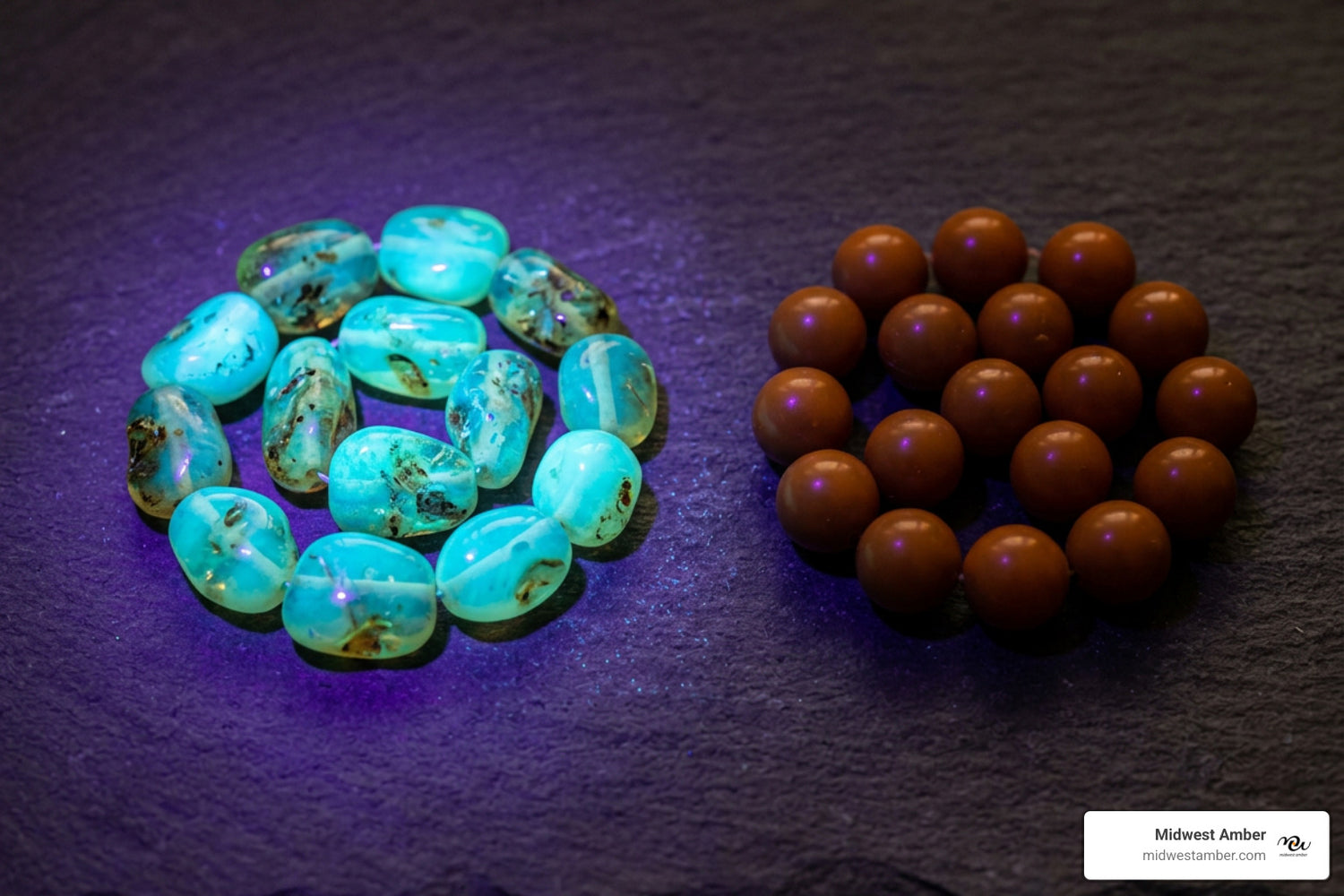
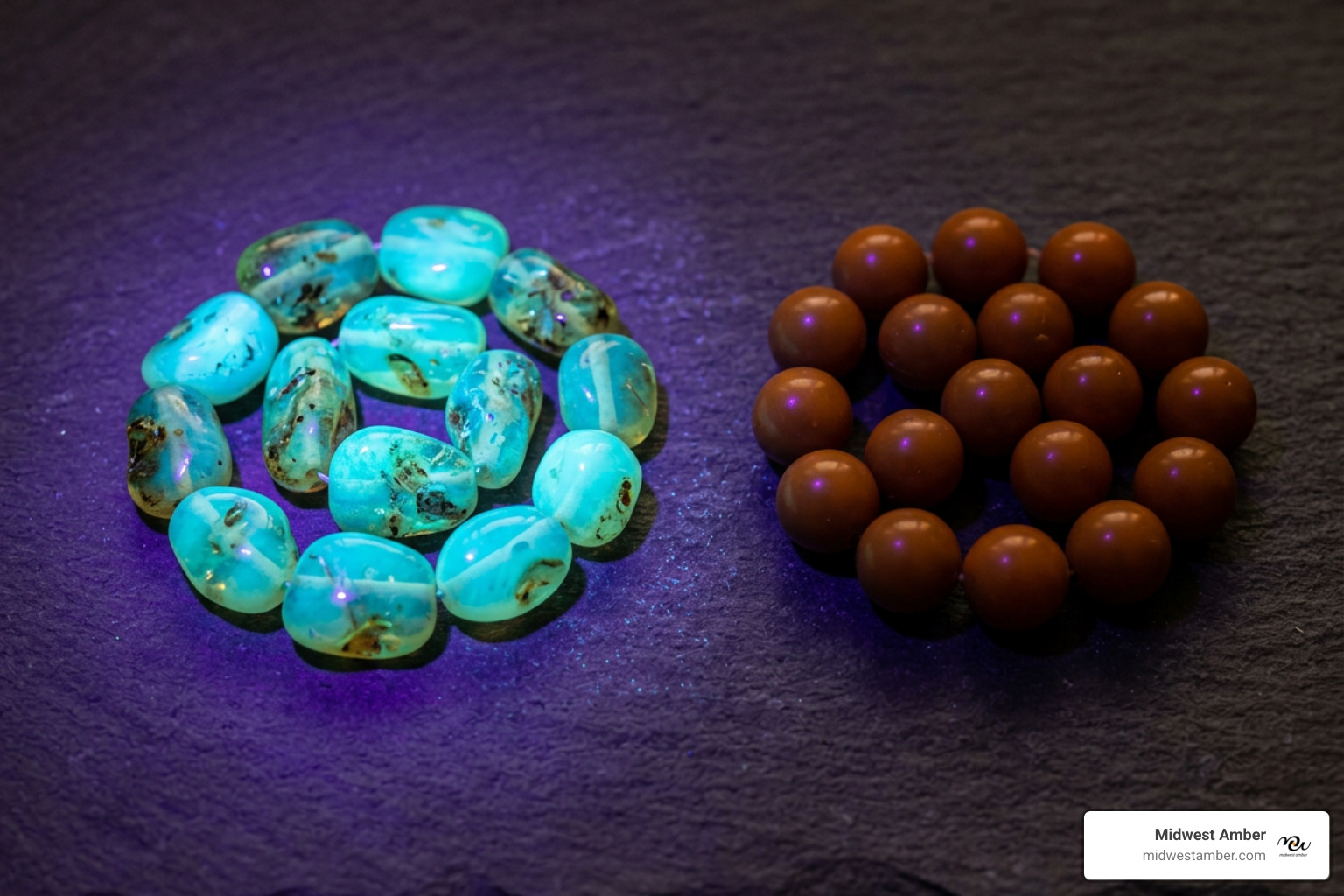
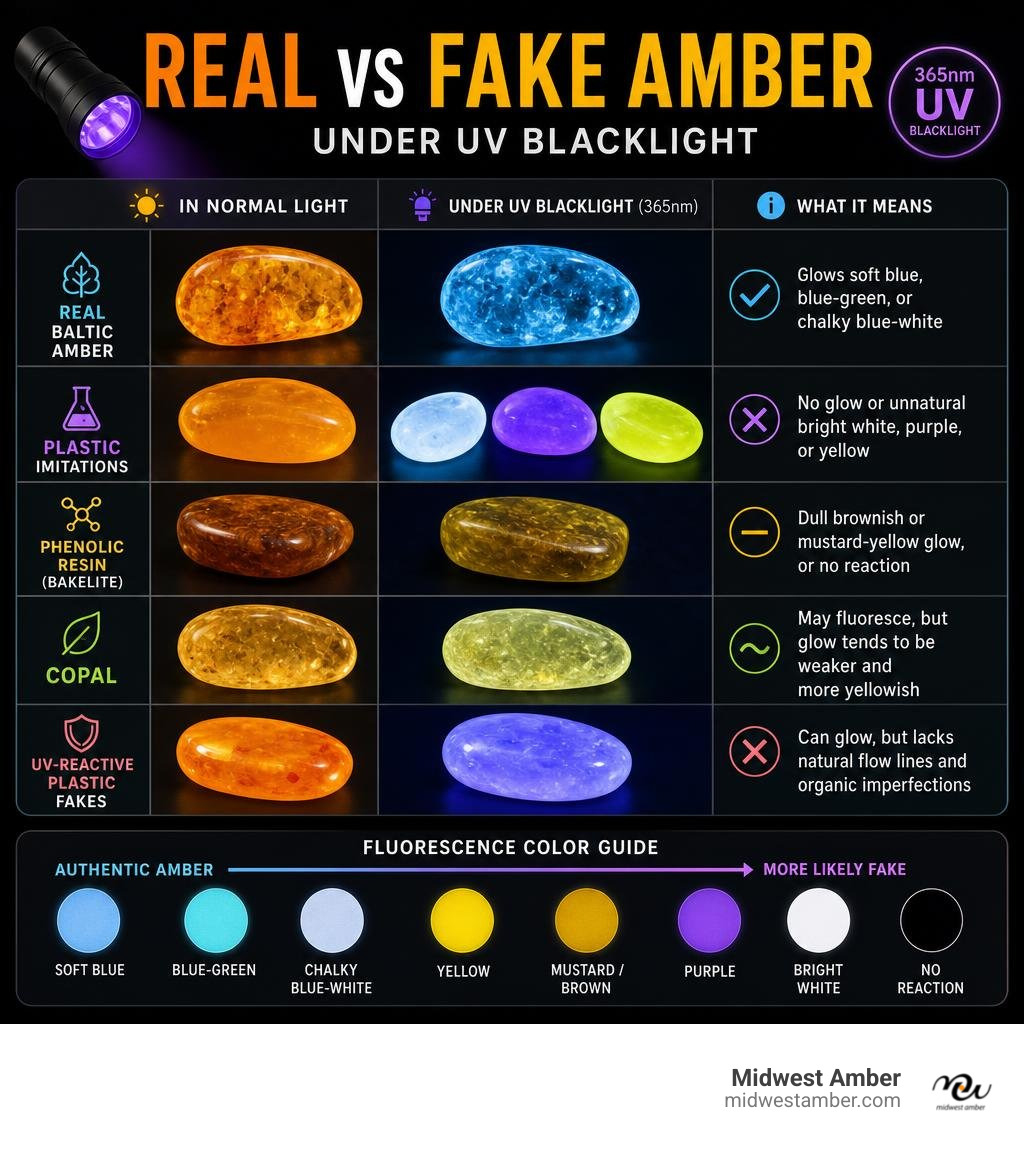
- Real Baltic amber glows a soft blue, blue-green, or chalky blue-white color under a 365nm UV blacklight
- Plastic imitations typically show no fluorescence, or glow an unnatural bright white, purple, or yellow
- Phenolic resin (Bakelite) usually shows a dull brownish or mustard-yellow glow, or no reaction at all
- Copal (young, immature resin often sold as amber) may fluoresce, but the glow tends to be weaker and more yellowish than genuine amber
- UV-reactive plastic fakes can glow, but they lack the natural flow lines and organic imperfections visible in real amber
The amber market has a serious counterfeiting problem. Estimates suggest that 40–60% of amber sold in tourist markets and through unauthorized dealers is either fake or misrepresented. That means if you've ever picked up a golden pendant at a market stall, there's a real chance it was plastic, resin, or copal — not the genuine Baltic amber you were paying for.
Genuine Baltic amber is fossilized tree resin, formed over 30–50 million years. It's irreplaceable. Fakes can be produced for pennies, while real amber can cost $2–$40 per gram or more depending on quality. The difference matters — not just financially, but because authentic amber carries a history and character that no factory can replicate.
A simple blacklight can reveal what the naked eye cannot.
I'm Gabriel Ciupek, President and owner of Midwest Amber, Inc., with years of hands-on experience sourcing, pricing, and authenticating genuine Baltic amber jewelry — including using the UV light test to identify fake amber under UV light at every stage of the supply chain. In the sections below, I'll walk you through exactly how to use a blacklight to test your amber, what results mean, and what other tests to combine for a confident answer.
Key fake amber under uv light vocabulary:
Why Does Genuine Amber Fluoresce Under Ultraviolet Light?
To understand why a blacklight is such an effective tool for spotting fake amber under UV light, we have to look at the science of fluorescence. When you shine ultraviolet (UV) light on certain substances, they absorb that invisible, high-energy light and re-emit it as visible light. This optical phenomenon is called fluorescence.
In genuine Baltic amber, this natural glow is primarily driven by organic compounds locked inside the fossilized resin over millions of years. One of the most important components is succinic acid, which is found in high concentrations (between 3% and 8% by weight) specifically in Baltic amber. Along with succinic acid, trace amounts of Polycyclic Aromatic Hydrocarbons (PAHs) and other natural organic compounds are suspended within the polymer matrix of the resin.
When UV light hits these molecules, their electrons jump to a higher energy state. As those electrons return to their ground state, they release that energy in the form of visible light photons—typically in the blue, green, or creamy white spectrum.
Because of this unique chemical fingerprint, almost all natural amber will react to UV light. The strength and precise color of the glow depend on the amber's age, geographic origin, and how it has been processed. For a deeper dive into the science of how these organic compounds react under different light sources, you can read more about the Amber Authenticity: UV Light Test (Shocking Results!).
How to Identify Fake Amber Under UV Light
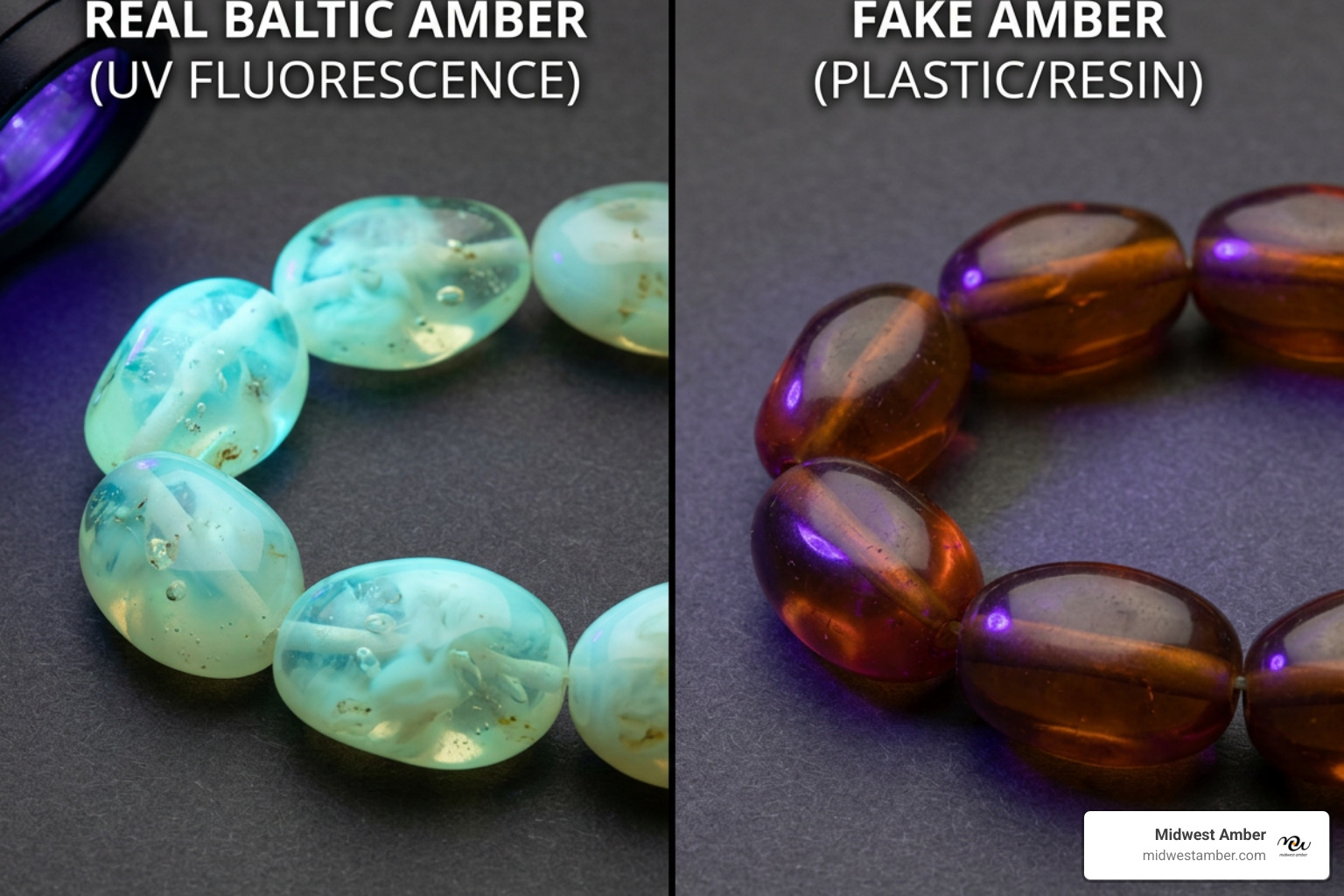
When you are trying to separate real Baltic amber from the flood of imitations, knowing what to look for under a blacklight makes all the difference. Counterfeiters use a wide variety of materials to mimic the warm, honey-like appearance of natural amber. Fortunately, these materials react very differently when exposed to ultraviolet light.
Plastic and Synthetic Polymer Imitations
Modern plastics, such as polystyrene, polyester, and acrylics, are cheap to produce and easily molded into beads or pendants. Under UV light, these materials are usually "inert," meaning they do not glow at all. If they do show a reaction, it is often an unnatural, harsh purple, bright white, or chemical yellow. These colors are a dead giveaway of synthetic optical brighteners added during the manufacturing process.
Phenolic Resins (Bakelite and Catalin)
Phenolic resins were incredibly popular for costume jewelry from the 1920s through the 1940s. While vintage collectible plastics like Bakelite have their own historical value, they are frequently passed off as expensive antique Baltic amber. Under long-wave UV light, phenolic resins behave very differently than natural amber. Instead of a vibrant blue or green glow, they tend to display a very dull, dark brownish or mustard-yellow fluorescence, or they may not react at all. You can learn more about identifying these vintage plastics in this detailed guide on Faux Amber Identifying Phenolic Resin Beads Under UV Light.
Copal (Young Resin)
Copal is tree resin that is much younger than genuine amber—typically ranging from a few thousand to a couple of million years old. Because it has not undergone the complete fossilization process (polymerization), it is softer and highly sensitive to heat and solvents. Under UV light, copal does fluoresce, but its glow is generally weaker, hazier, and distinctly more yellowish-white than the crisp, chalky blue-green of Baltic amber. To understand the physical and chemical differences between these two resins, check out our resource on Amber Vs Copal.
Step-by-Step Guide: Testing Your Jewelry with a Blacklight
Testing your jewelry at home or on the go is simple, but you need the right tools and environment to get accurate results. Follow this step-by-step guide to inspect your collection.
Step 1: Secure the Right UV Wavelength
Not all blacklights are created equal. Many cheap novelty blacklights operate at a 395nm wavelength, which emits a lot of visible purple light that can wash out the subtle fluorescence of amber. For gemstone testing, we highly recommend using a high-quality 365nm UV flashlight. A 365nm light emits pure, invisible UV light, allowing you to see the true fluorescence colors without a purple glare.
Step 2: Prepare a Completely Dark Room
To see the delicate glow of genuine amber, you must eliminate all ambient light. Find a room without windows, or wait until night and turn off all the lights.
Step 3: Inspect the Surface for Flow Lines
Place your amber jewelry on a dark, non-reflective surface. Shine the 365nm UV light directly onto the piece from a distance of 2 to 6 inches.
As you observe the glow, look closely for flow lines. Because natural amber formed from flowing tree sap, it contains organic swirls, microscopic bubbles, and structural imperfections. Under UV light, these natural flow lines will stand out as subtle variations in the intensity and color of the glow.
Plastic fakes made with UV-reactive resin might glow, but their fluorescence will be perfectly uniform, flat, and featureless because they lack these natural, organic layers. For more tips on setting up your blacklight test, you can reference Testing Amber with UV Light: A Simple Method.
For an in-depth visual comparison of how these internal structures look in real vs. synthetic pieces, read our guide on Real Or Resin How To Tell If Your Amber Jewelry Is Genuine.
Comparing Baltic Amber, Dominican Amber, and Copal Under UV
The geographical origin of amber plays a massive role in how it reacts under ultraviolet light. Below is a comparative breakdown of how the most common types of fossilized and semi-fossilized resins look when exposed to a 365nm blacklight.
| Resin Type | Age | Primary Origin | UV Fluorescence Color | Key Visual Indicators under UV |
|---|---|---|---|---|
| Baltic Amber | 30–50 Million Years | Baltic Sea Region (Poland/Lithuania) | Pale sky blue, chalky blue-white, or soft green | Distinct flow lines, cloudy cream patches, organic inclusions |
| Dominican Amber | 15–20 Million Years | Dominican Republic | Intense cobalt blue to bright teal | Strong surface glow; shifts from blue to green depending on thickness |
| Copal | <1 Million Years | Colombia, Madagascar, Indonesia | Weak yellowish-white or dull orange-green | Hazy, oily surface texture; lacks sharp, distinct flow lines |
The Usambara Effect and Blue Amber
One of the most spectacular sights in the gem world is Dominican or Sumatran blue amber under UV light. In normal daylight, this amber looks warm and golden, but when exposed to UV rays (even natural sunlight), it glows with a vivid, electric cobalt blue.
This dramatic color shift is caused by the Usambara effect, where the absorption and re-emission of light photons change depending on the thickness of the material. Thin edges of the amber allow the blue light to escape cleanly, while thicker centers can cause self-absorption, shifting the visible color slightly toward teal or green. To explore this fascinating optical phenomenon and see what to expect from rare blue specimens, check out Blue Amber Under UV Light — What to Expect & What's Normal (2026).
Limitations of the Blacklight Test and Complementary Methods
While the blacklight test is incredibly useful, it is not foolproof. Relying solely on a UV light can sometimes lead to false conclusions.
Why the Blacklight Test Has Limitations
- Surface Treatments: Some genuine amber is coated with heavy varnishes, lacquers, or oils to improve its shine. These surface coatings can block UV light from reaching the amber itself, or they may fluoresce with their own synthetic colors, giving a false negative.
- Heat Treatments: Amber is sometimes heated in autoclaves to clarify cloudy patches or darken its color (such as creating deep red or cherry amber). Heat-treated amber often has a heavily oxidized outer layer that may show very weak or even non-existent fluorescence under UV light.
- Advanced Forgeries: Some modern counterfeiters mix UV-reactive powders into liquid plastic resins to mimic the natural blue-green glow of authentic Baltic amber.
To protect yourself, we always recommend combining the blacklight test with other simple, non-destructive home tests.
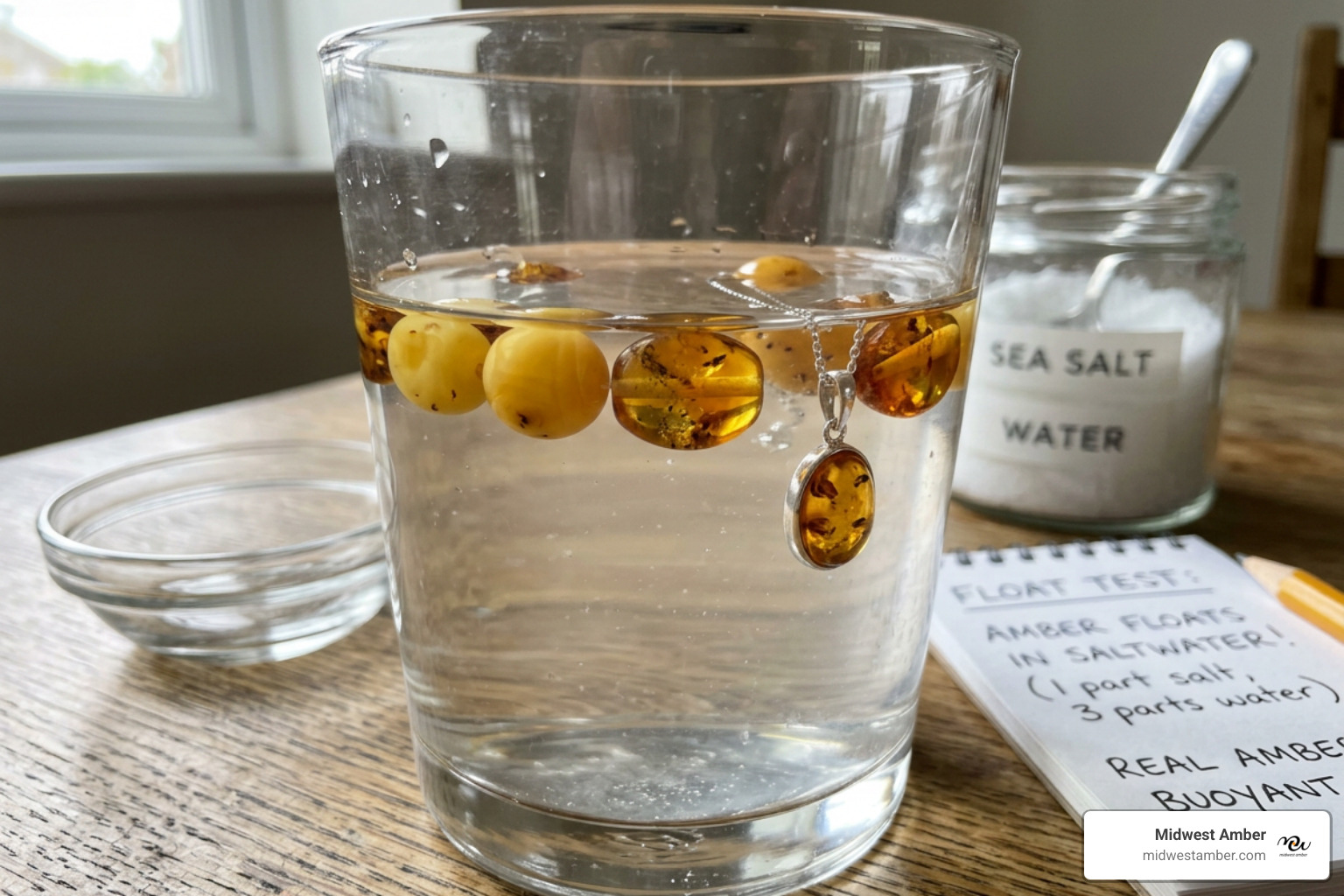
The Saltwater Float Test
Because genuine amber has a very low specific gravity (1.05 to 1.10), it is incredibly lightweight. It will sink in fresh water but float easily in saturated salt water.
- How to do it: Dissolve 7 to 8 tablespoons of table salt into one cup of warm water and stir until fully saturated. Drop your unmounted jewelry into the glass. Genuine amber will float to the top, while heavy glass and most plastic imitations will sink immediately to the bottom.
The Static Electricity Test
Amber is a natural dielectric, meaning it can hold an electrostatic charge.
- How to do it: Rub your amber piece vigorously against a piece of real wool or silk for 20 to 60 seconds. Once charged, hold the amber close to tiny pieces of tissue paper or hair. Genuine amber will magnetically attract the paper, whereas plastics and glass will not.
By using these tests in tandem, you can build a complete picture of your jewelry's authenticity. For a deeper look at the science behind these tests, read The Amber Truth Unlocking The Secrets Of Genuine Stones and explore How To Tell Real Amber From Fake Amber.
Frequently Asked Questions about Blacklight Amber Testing
What does fake amber under uv light look like compared to real Baltic amber?
Under a 365nm UV light, genuine Baltic amber glows with a soft, chalky blue-white, pale blue, or light green light. You will often see natural variations, organic cloudy patches, and swirled flow lines. In contrast, fake amber made of plastic or glass usually remains completely inert (dark) or glows an unnatural, uniform bright purple or white. Phenolic resins like Bakelite typically show a very dull, dark brownish or muddy mustard-yellow color under UV light.
Can some types of fake amber under uv light actually glow?
Yes, some advanced fakes can glow. Some modern plastic imitations are made with UV-reactive resins or synthetic fluorescent dyes specifically designed to mimic the natural glow of amber. However, you can spot these fakes by looking closely at the structure of the glow. Synthetic resins will fluoresce with perfect, uniform consistency across the entire piece, lacking the natural flow lines, organic imperfections, and structural variations found in genuine fossilized resin. Furthermore, if a piece exhibits strong phosphorescence—meaning it continues to glow in the dark for several seconds after the UV light source is turned off—it is highly likely to contain synthetic additives.
Is Baltic amber that turns opaque cream under black light fake?
No, this reaction is actually a strong indicator of authenticity! When clear or semi-clear Baltic amber is exposed to a blacklight, it often fluoresces with a cloudy, opaque, creamy white or pale blue appearance. This occurs because of the natural microscopic bubbles and organic inclusions trapped within the amber matrix. In the gemological community, this "cloudy cream" fluorescence is highly celebrated as a classic sign of genuine Baltic amber. You can read more about this community validation and collector discussions on Real amber? Suspicious under black light?.
Conclusion
Detecting fake amber under UV light is a vital skill for any jewelry lover, collector, or parent looking to buy genuine Baltic amber. By understanding the science of organic fluorescence and using a dedicated 365nm blacklight in a dark room, you can easily filter out the vast majority of plastic, glass, and phenolic resin imitations.
However, because counterfeiters are constantly finding new ways to mimic nature, no single test is completely foolproof. We always recommend combining your blacklight inspection with physical tests like the saltwater float test, visual inspection for flow lines, and buying from highly trusted sources.
At Midwest Amber, we have spent over 20 years sourcing and handcrafting 100% natural, ethically sourced Baltic amber jewelry directly from Poland and Lithuania. Every ring, necklace, bracelet, and pendant we offer is backed by certified authenticity, so you never have to guess whether your jewelry is real or resin.
If you are ready to explore the timeless beauty of genuine, handcrafted Baltic amber, we invite you to browse our collections online. For more expert tips on protecting your investment and identifying genuine stones, read our complete guide on Real Or Resin How To Tell If Your Amber Jewelry Is Genuine.

Leave a comment
This site is protected by hCaptcha and the hCaptcha Privacy Policy and Terms of Service apply.