

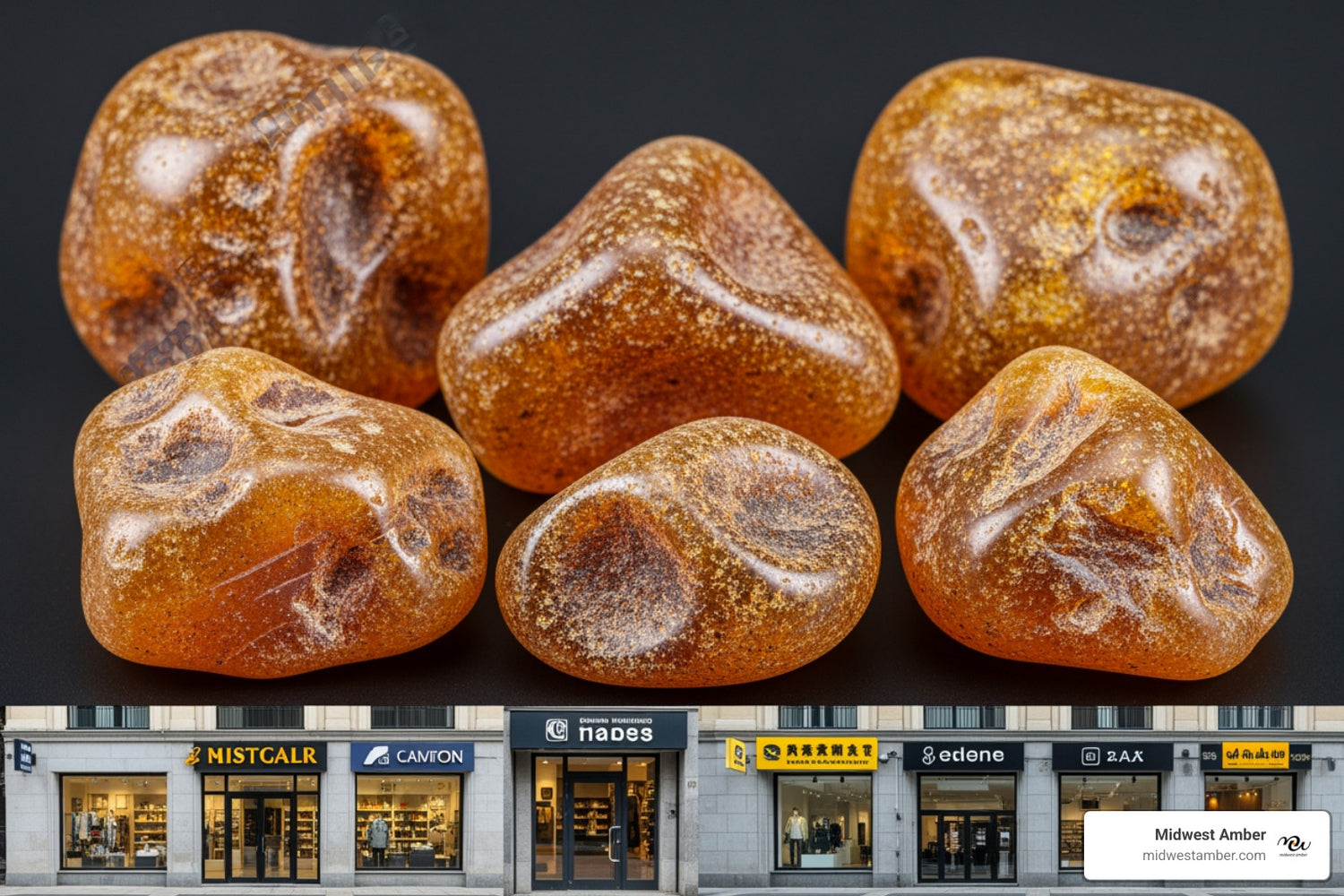
Why Knowing How to Identify Raw Amber Could Save You From a Costly Mistake
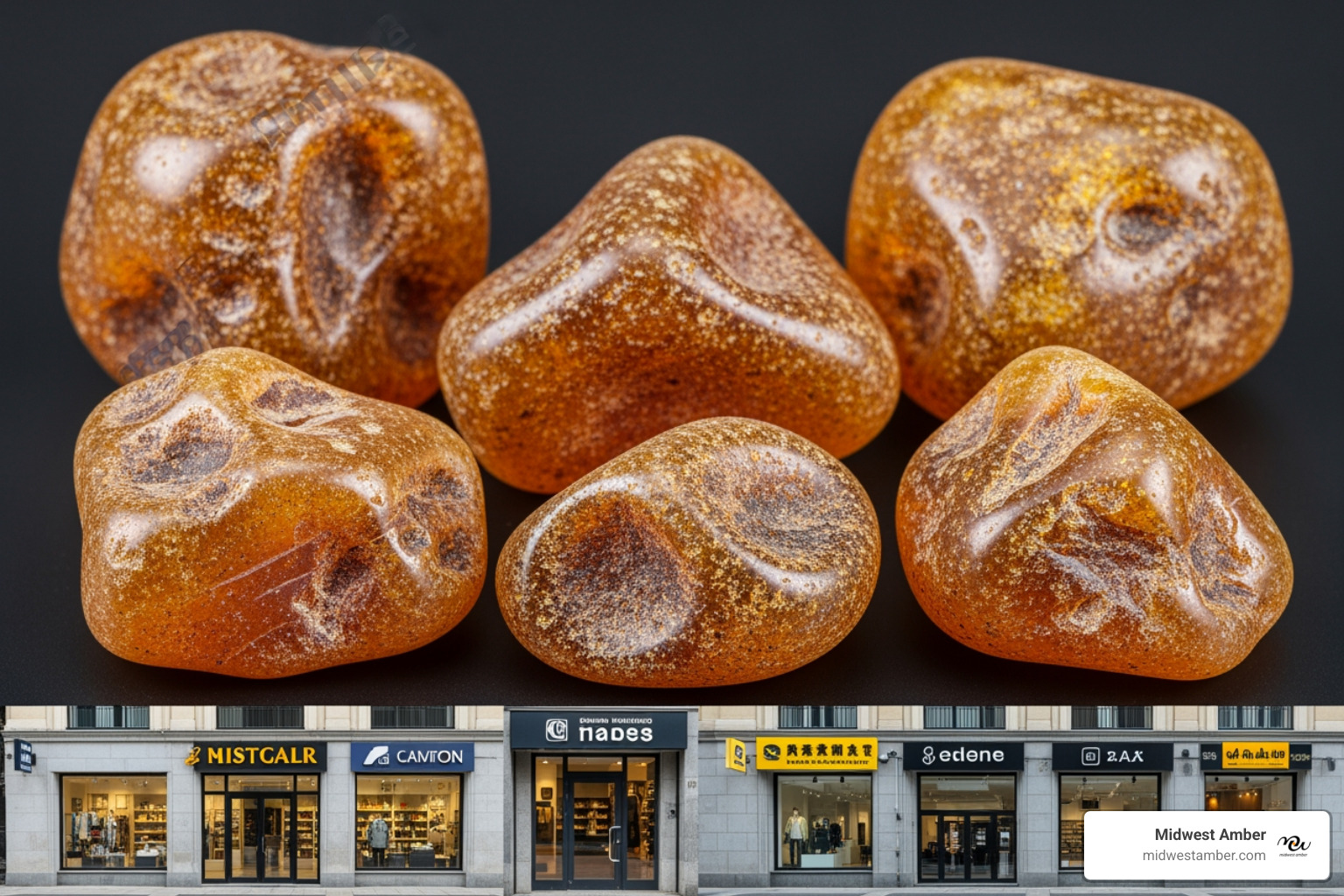
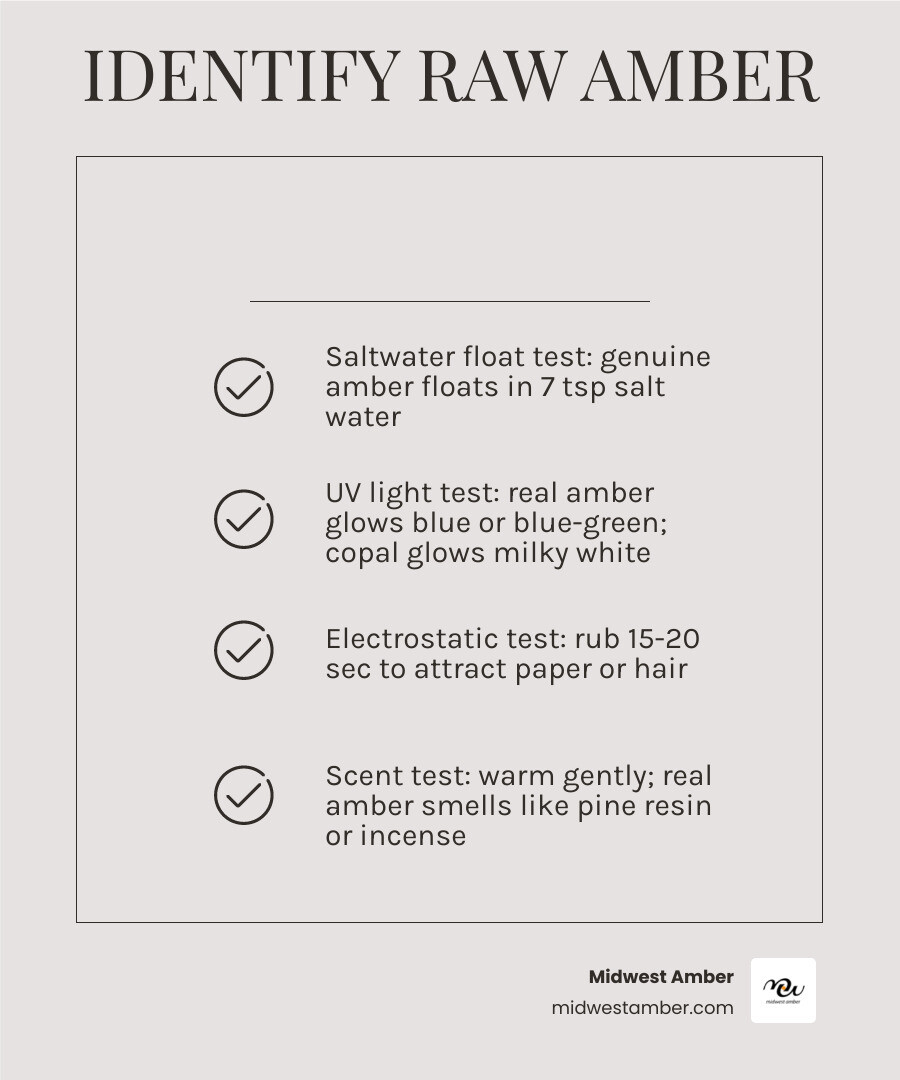
Knowing how to identify raw amber is easier than most people think — once you know what to look for. Here's a quick-reference summary before we dive deeper:
Quick Ways to Identify Raw Amber:
- Saltwater float test — Dissolve 7 teaspoons of salt in a cup of water. Genuine amber floats. Glass and most plastics sink.
- UV light test — Real amber glows blue or blue-green under a blacklight. Copal glows milky white.
- Electrostatic test — Rub amber on a soft cloth for 15–20 seconds. Genuine amber attracts small bits of paper or hair. Copal becomes sticky instead.
- Scent test — Warm a hidden spot gently. Real amber smells like pine resin or incense. Fakes smell like burning plastic or chemicals.
- Visual inspection — Raw amber has a matte, uneven surface with natural cracks, pits, and irregular edges. Perfect surfaces and uniform color are red flags.
The market for amber is flooded with imitations — plastics, copal, glass, and pressed amber are all commonly sold as the real thing. With amber used in jewelry for over 10,000 years and genuine Baltic specimens taking 40 million years to form, the gap between authentic and fake is enormous — in both value and meaning.
I'm Gabriel Ciupek, President and owner of Midwest Amber, Inc., and after years of sourcing, pricing, and working directly with genuine Baltic amber, I've developed a sharp eye for spotting fakes — knowledge I'll walk you through here so you can confidently identify raw amber before you buy.
What Is Raw Amber and How Does It Form?
Raw amber is fossilized tree resin in its natural, unpolished state. Unlike a finished bead or pendant, raw amber has not been buffed to a glossy shine, cut into a uniform shape, or heavily refined. It is the rough, natural version of an organic gemstone.
If you want a deeper background on the material itself, our guide to raw baltic amber is a helpful place to start, along with our overview of natural amber stone.
Amber begins as sticky resin that ancient trees released as a defense against injury, insects, fungi, or broken bark. Over immense spans of time, that resin was buried, protected from complete decay, and transformed through polymerization and geological pressure. In simple terms, the resin’s chemistry changed until it became stable fossil resin rather than fresh sap or soft resin.
Baltic amber, also called succinite, is especially well known because it formed tens of millions of years ago and is associated with the ancient forests of northern Europe. In many references, amber formation is dated to roughly 40 to 50 million years ago, though the resin-producing forests themselves are older. That age matters because one of the easiest ways to get fooled is to mistake younger resin for true amber. For readers who want a neutral scientific overview of amber as a material, the Encyclopaedia Britannica entry on amber is a useful external reference.
Copal is the classic example. It is resin too, but much younger and not fully fossilized. That means it can look convincing at first glance while behaving very differently in tests.
A few key facts help explain why amber is distinctive:
- It is an organic gemstone, not a mineral.
- It has a low hardness of about 2 to 2.5 on the Mohs scale, so it scratches easily.
- Its specific gravity is usually around 1.08, which is why it can float in saturated saltwater.
- It has been used by humans for more than 10,000 years, making it one of the oldest gem materials in human use.
Visual and Physical Traits of Genuine Specimens
Before doing any test, we always recommend starting with your eyes and hands. Genuine raw amber often gives itself away through small imperfections. Ironically, the more “perfect” a piece looks, the more skeptical we become.
For a broader look at natural amber character, see unearthing natural amber what makes this ancient gem so special and the amber truth unlocking the secrets of genuine stones.
Texture
Raw amber usually has:
- A matte or soft luster rather than a mirror-like shine
- Uneven surfaces
- Natural pits, tiny cracks, or weathered spots
- Unrefined edges instead of machine-perfect symmetry
Polished amber looks smoother, clearer, and glossier because the outer rind has been removed and the surface has been finished. Raw amber can appear duller even when it is completely genuine.
Transparency
Raw amber ranges from:
- Opaque
- Cloudy
- Semi-translucent
- Occasionally more transparent in thinner areas
A common mistake is assuming real amber must be crystal clear. It does not. In fact, many genuine raw pieces diffuse light softly because the surface is rough and the interior may contain natural microbubbles or cloudiness.
Color
Genuine raw amber can occur in several colors, including:
- Honey yellow
- Golden yellow
- Cognac brown
- Reddish brown
- Creamy white or butterscotch tones
- Dark brown
Rare hues exist too, but when a seller is pushing unusually vivid colors without clear provenance, caution is wise. Natural raw amber tends to look softer and less flashy than dyed or synthetic lookalikes.
Weight and feel
Real amber feels surprisingly light for its size. Most pieces are small, and fragments weighing several pounds are exceptionally rare. Amber also tends to feel warmer to the touch than glass. Glass often feels colder and heavier.
Hardness
Because amber is soft, it can scratch more easily than many gemstones. That softness helps identify it, but it is also why we avoid aggressive “test first, regret later” methods on valuable pieces.
Raw vs polished amber at a glance
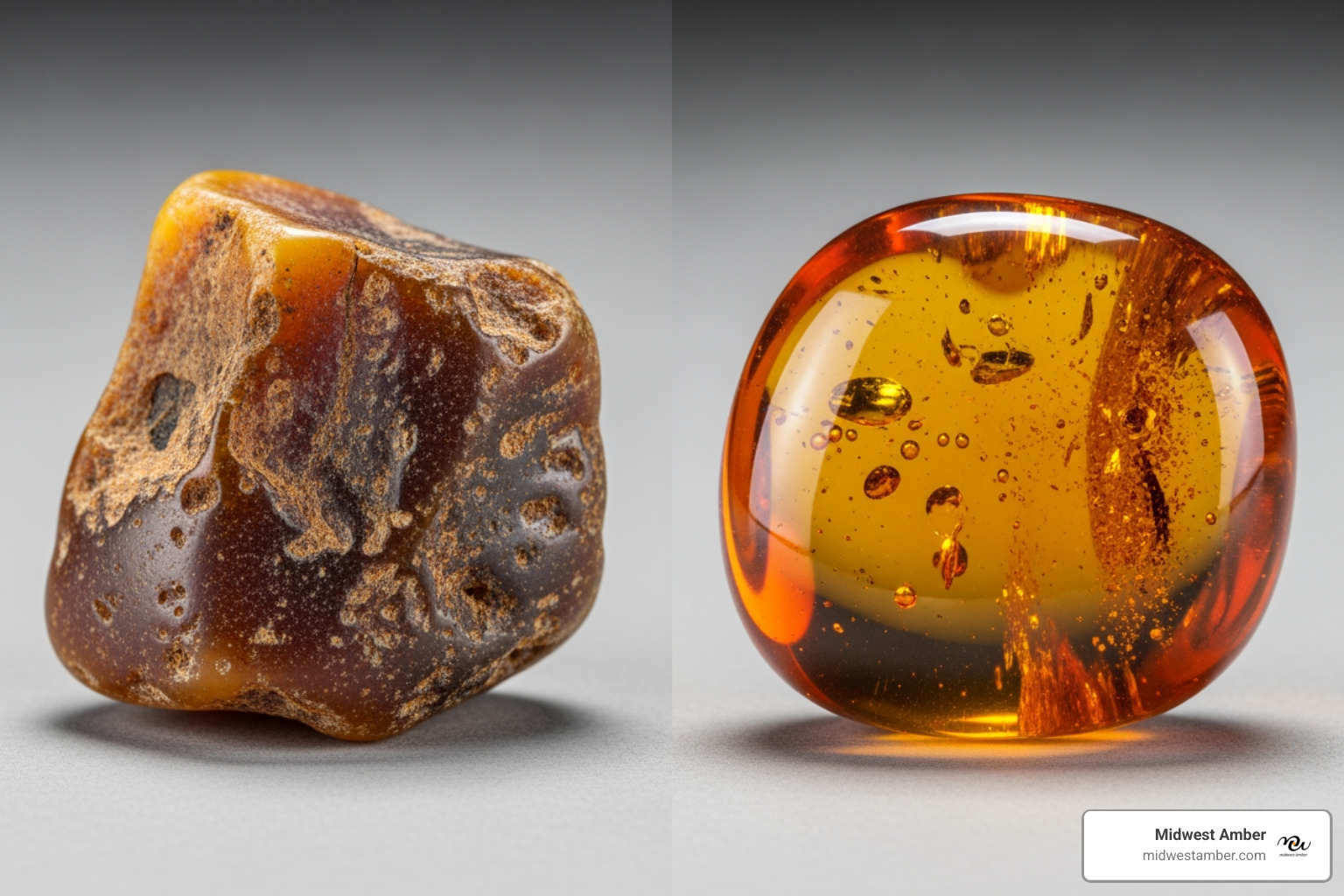
A raw specimen often shows:
- Rough outer skin
- More muted color
- Less sparkle
- Natural weathering
- Irregular shape
A polished specimen often shows:
- Smooth surface
- Stronger shine
- More visible internal detail
- More saturated appearance
- Finished shape for jewelry use
Neither form is more “real” than the other. They are simply different stages of finishing.
5 Reliable Tests to Verify Authenticity
No single home test is perfect on its own. The safest approach is to combine two or three non-destructive tests and look for a consistent result. If one test says “maybe” and another says “absolutely not,” trust the contradiction and investigate further.
For more on this subject, our article real or resin how to tell if your amber jewelry is genuine expands on practical authenticity checks.
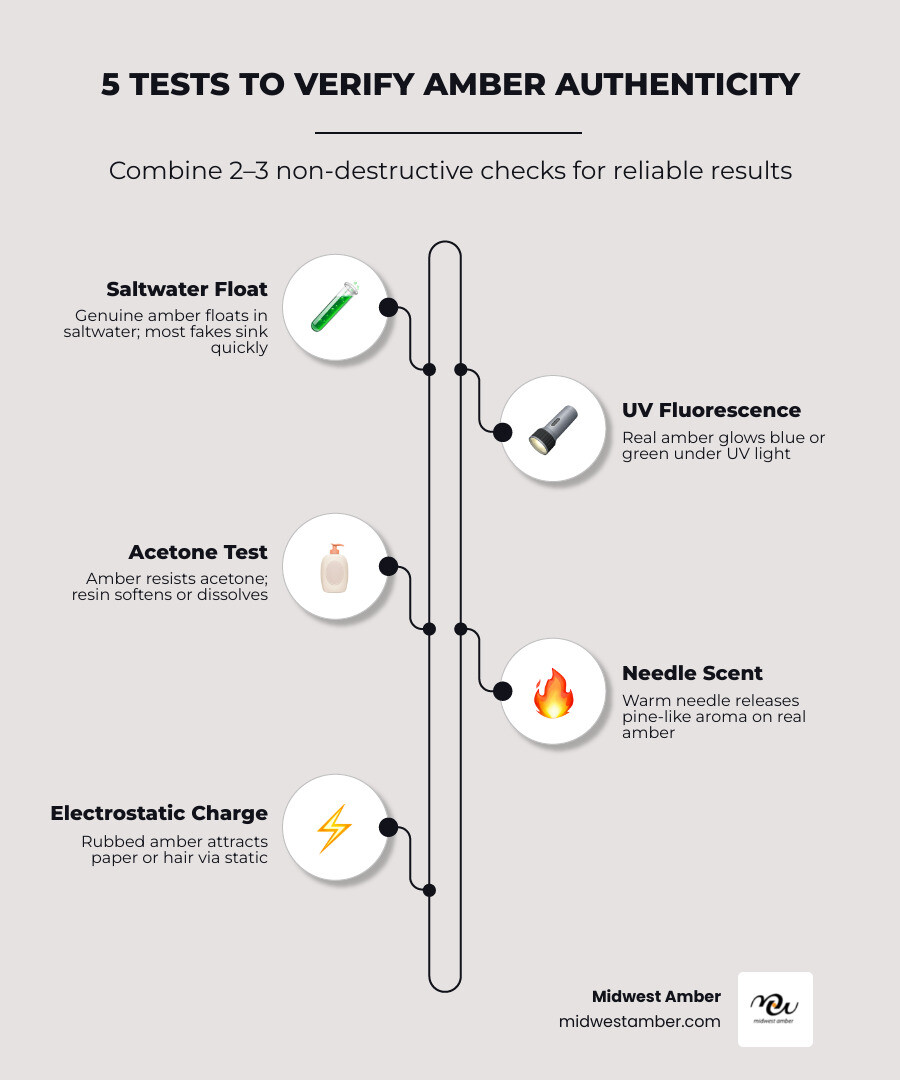
1. Saltwater float test
This is one of the best low-tech checks for loose amber pieces.
How to do it:
- Dissolve about 7 teaspoons of salt in 1 cup of water.
- Stir until the solution is saturated.
- Drop in the loose amber piece.
- Observe whether it floats or sinks.
What to expect:
- Genuine amber usually floats because its specific gravity is about 1.05 to 1.096.
- Glass sinks.
- Many denser fakes sink too.
Important caution:
- Some plastics may also float, so this test is useful but not final.
- Do not use this test on finished jewelry with metal components, stringing materials, or glued findings.
- Rinse and dry the piece afterward.
2. Electrostatic test
Amber’s name is tied to static electricity for a reason. The ancient Greeks noticed this property long ago.
How to do it:
- Rub the specimen with a soft cloth or wool for 15 to 30 seconds.
- Hold it near tiny paper scraps, lint, or a strand of hair.
What to expect:
- Genuine amber often develops a static charge and attracts lightweight particles.
- Copal may become tacky or sticky instead of producing a clean static effect.
- Many plastics can also build static, so use this along with other tests.
This is a great screening test because it is quick and non-destructive.
3. UV light test
A blacklight can reveal useful clues.
How to do it:
- Take the piece into a darker room.
- Shine a UV light on the surface.
What to expect:
- Genuine amber often fluoresces blue, blue-green, or a milky yellowish tone depending on type and conditions.
- Copal often appears whiter or milkier under UV.
- The response varies by source and treatment, so think of UV as supporting evidence, not a courtroom confession.
This is one of the best ways to compare suspected amber against known genuine amber side by side.
4. Warmth and scent from gentle friction
This is safer than going straight to a hot needle.
How to do it:
- Rub the amber briskly with your palm or a soft cloth.
- Warm it gently through friction.
- Smell it immediately.
What to expect:
- Genuine amber often gives off a light resinous, pine-like, or incense-like aroma.
- Plastic smells chemical.
- Younger resin may smell sharper or fresher.
This test is subtle. If your nose is unsure, that is normal. Amber does not always shout. Sometimes it politely whispers “forest.”
5. Solvent resistance with extreme caution
This is where we slow down. Solvent testing can help distinguish amber from copal, but it can also damage surfaces.
How to do it only if necessary:
- Use a tiny amount of acetone on a cotton swab.
- Touch only an inconspicuous area very briefly.
- Stop immediately if the surface softens or gets tacky.
What to expect:
- True amber is generally more resistant.
- Copal is more likely to soften, become sticky, or show surface reaction.
- Some finishes or coatings can also react, which makes interpretation tricky.
Because of the risk, we do not put this in the same “safe and easy” category as saltwater, static, or UV. For valuable specimens, skip it and seek professional verification instead.
What about the warm needle scent test?
A hot needle test exists, and it can help. But it is destructive. We treat it as a last resort.
If performed on a tiny hidden area:
- Genuine amber may resist slightly, then release a resinous or incense-like smell.
- Plastic smells synthetic and unpleasant.
- Copal can soften faster and may smell sharper or more medicinal.
Because it leaves a mark, we do not recommend it on fine jewelry, collectible pieces, or anything you are not willing to damage.
Common Signs of Non-Genuine Lookalikes
Most fake amber tells on itself if you know the common warning signs.
Plastic
Plastic is one of the most common imitators because it can mimic color and clarity very well.
Watch for:
- Overly uniform color
- Very smooth, manufactured perfection
- Mold lines or casting seams
- Chemical smell when warmed
- Bubbles that look too regular or too obviously “made”
Plastic can also share a similar refractive index with amber, which is why visual sparkle alone is not enough.
Glass
Glass is less convincing in the hand than online photos.
Watch for:
- Heavier weight
- Colder feel
- Very glossy, glassy surface
- No softness or resin scent
- Sinks in saltwater
If a suspected “raw amber” piece feels like a marble with a tan tint, that is not a great sign.
Copal
Copal is the most commonly confused material because it is also a natural resin.
Watch for:
- Surface that seems too fresh or tacky
- Greater softness
- More obvious crazing or fine surface cracks
- Stronger reaction to acetone
- Whiter fluorescence under UV
- Stickiness when rubbed instead of strong static charge
Copal is real resin, but it is not the same as ancient amber.
Pressed or reconstructed material
Some amber products are made by compressing smaller fragments together. In the market, this is often called pressed amber or ambroid. It may contain real amber material, but it is not the same as a single natural piece of raw amber.
Watch for:
- Swirled internal structure
- Sharp transitions in color
- Elongated bubbles
- Patchwork appearance under magnification
- Seams or flow-like patterns
If you are specifically learning how to identify raw amber, reconstructed material should not be mistaken for a naturally formed rough specimen.
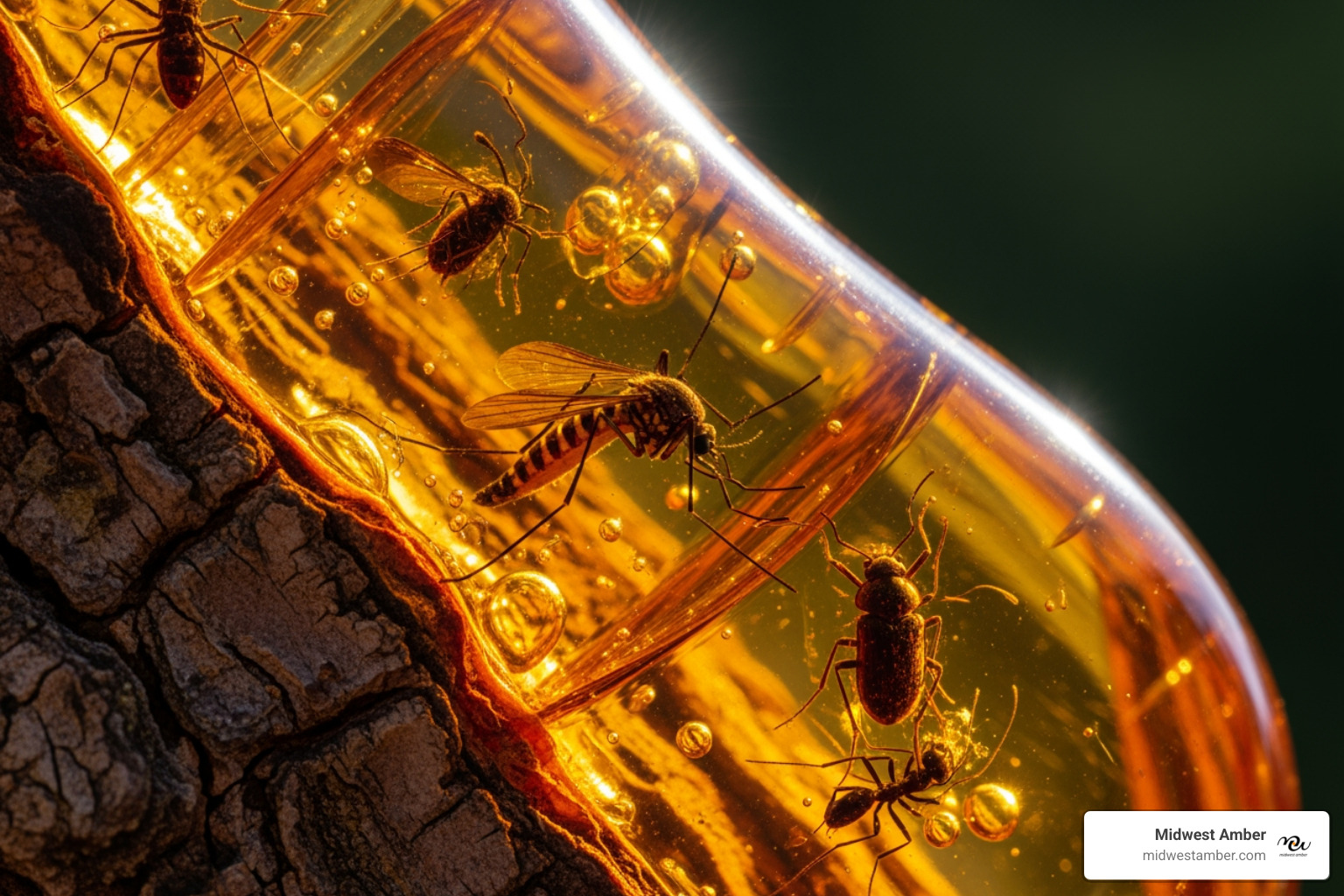
Fake inclusions
Insects and plant matter can be exciting, but they are not automatic proof.
Be skeptical if you see:
- Large, perfectly centered insects
- Inclusions that look too dramatic or staged
- Air bubbles arranged oddly around an insect
- Insects that appear unnaturally pristine
- Visible signs of drilling, filling, or joining
Museum conservation guidance has long warned that fake inclusions can be made by inserting modern specimens into resin or altered pieces. In other words, “It has a bug in it” is not the same as “It is genuine amber.”
Frequently Asked Questions About How to Identify Raw Amber
A few amber myths refuse to retire. Let us clear them up.
- Myth: All real amber is bright golden and transparent.
Reality: Genuine amber can be cloudy, opaque, pale, butterscotch, brown, or semi-translucent.
Myth: If it has an insect, it must be real.
Reality: Fake inclusions are common.
Myth: One home test proves everything.
Reality: Amber identification works best when multiple clues agree.
Myth: A certificate alone guarantees authenticity.
Reality: Documentation can help, but it is not a substitute for material knowledge, trustworthy sourcing, and consistent testing.
Myth: Amber is hard like most gemstones.
- Reality: Amber is soft, around 2 to 2.5 on the Mohs scale.
How to identify raw amber using the saltwater test?
Use a saturated saltwater solution made with about 7 teaspoons of salt per cup of water. Place the loose specimen in the solution.
- Real amber usually floats.
- Glass sinks.
- Many heavy fakes sink.
This works because amber’s specific gravity is low, usually around 1.08. Still, because some plastics can float too, do not stop here. Follow up with a UV light or electrostatic test.
How to identify raw amber by its scent?
The least risky scent test is friction first, heat last.
Start by rubbing the specimen with a soft cloth or in your palm until it warms slightly. Then smell it right away.
- Genuine amber often smells like warm resin, pine, or incense.
- Plastic smells chemical.
- Copal may smell fresher, sharper, or soften more quickly.
Only consider a warm needle test on a tiny hidden area if the piece is inexpensive and you accept possible damage. Otherwise, skip it.
Can inclusions prove that raw amber is real?
No. Inclusions can support authenticity, but they cannot prove it by themselves.
Natural inclusions that may appear in genuine amber include:
- Tiny bubbles
- Plant matter
- Bits of bark or organic debris
- Insects or arthropods
But convincing fakes exist. A better question is not “Does it have an inclusion?” but “Does the inclusion look natural in context?”
Some signs that an inclusion may be suspicious:
- It is unusually large and perfectly displayed
- It looks too clean or too complete
- It appears inserted rather than trapped
- The surrounding material looks inconsistent
The most valuable inclusion pieces are rare for a reason. If a market table has ten giant flawless insect ambers, our eyebrows go up immediately.
Conclusion
Learning how to identify raw amber is really about building a checklist and trusting patterns, not chasing one magic trick. Start with appearance. Check texture, weight, warmth, color, and irregularities. Then use safe tests like saltwater flotation, static charge, and UV light. Save any risky testing for last, if at all.
If you want to keep learning, we recommend reading our guides on baltic amber certificate of authenticity, dont get fooled the definitive guide to certified baltic amber, and again real or resin how to tell if your amber jewelry is genuine.
At Midwest Amber, we work with genuine Baltic amber rooted in Polish craftsmanship and Lithuanian heritage, and we believe buyers should feel informed before they ever make a purchase. Whether you are comparing a rough specimen, a pendant, a necklace, or a handcrafted piece of Baltic amber jewelry, confidence comes from knowing what real amber should look and feel like.
And if a piece looks a little too perfect, too glossy, too cheap, or too bug-filled to be true, well, your instincts may already be doing some very good gemology.


Leave a comment
This site is protected by hCaptcha and the hCaptcha Privacy Policy and Terms of Service apply.