

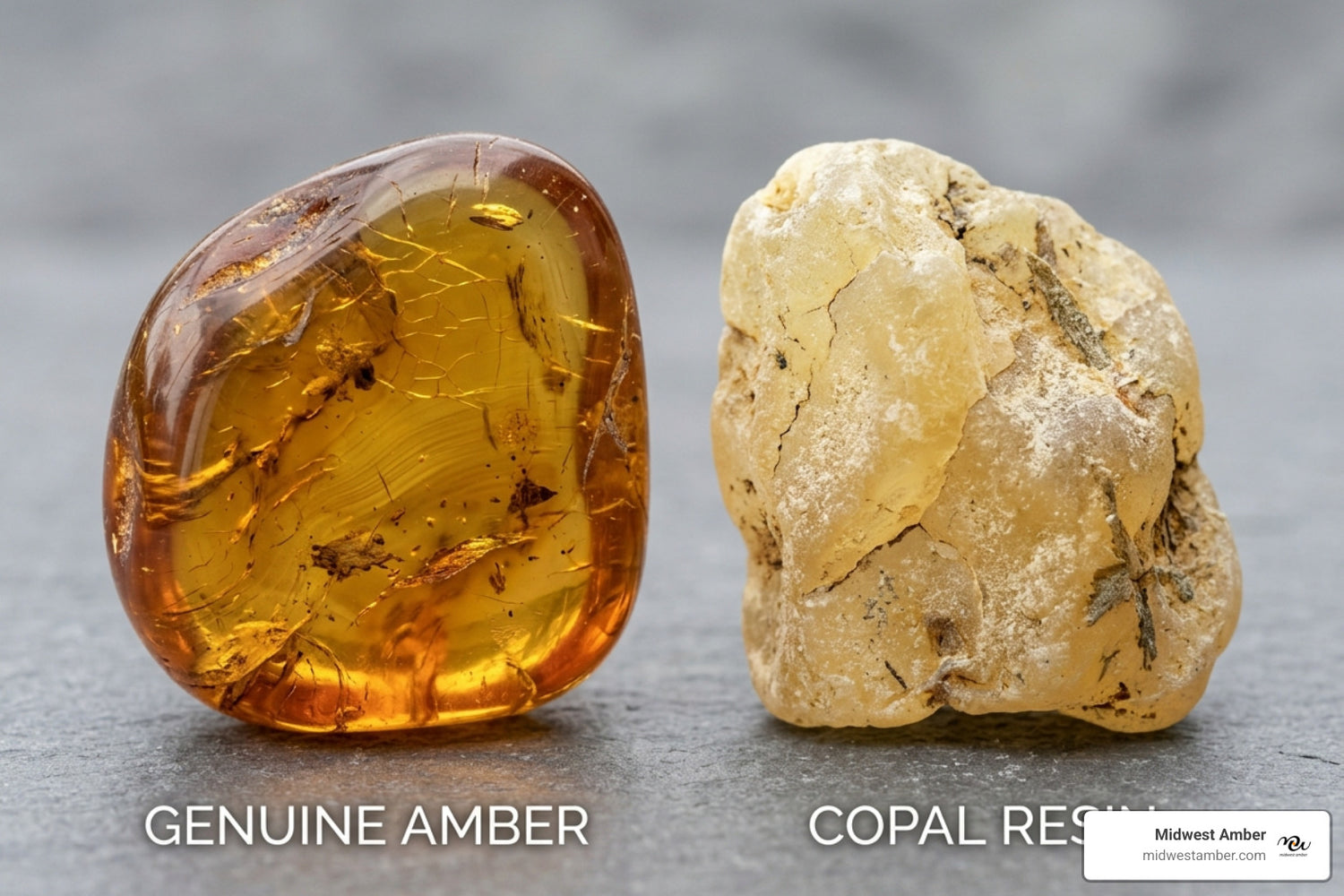
Formation and Age: The Journey from Sap to Gemstone
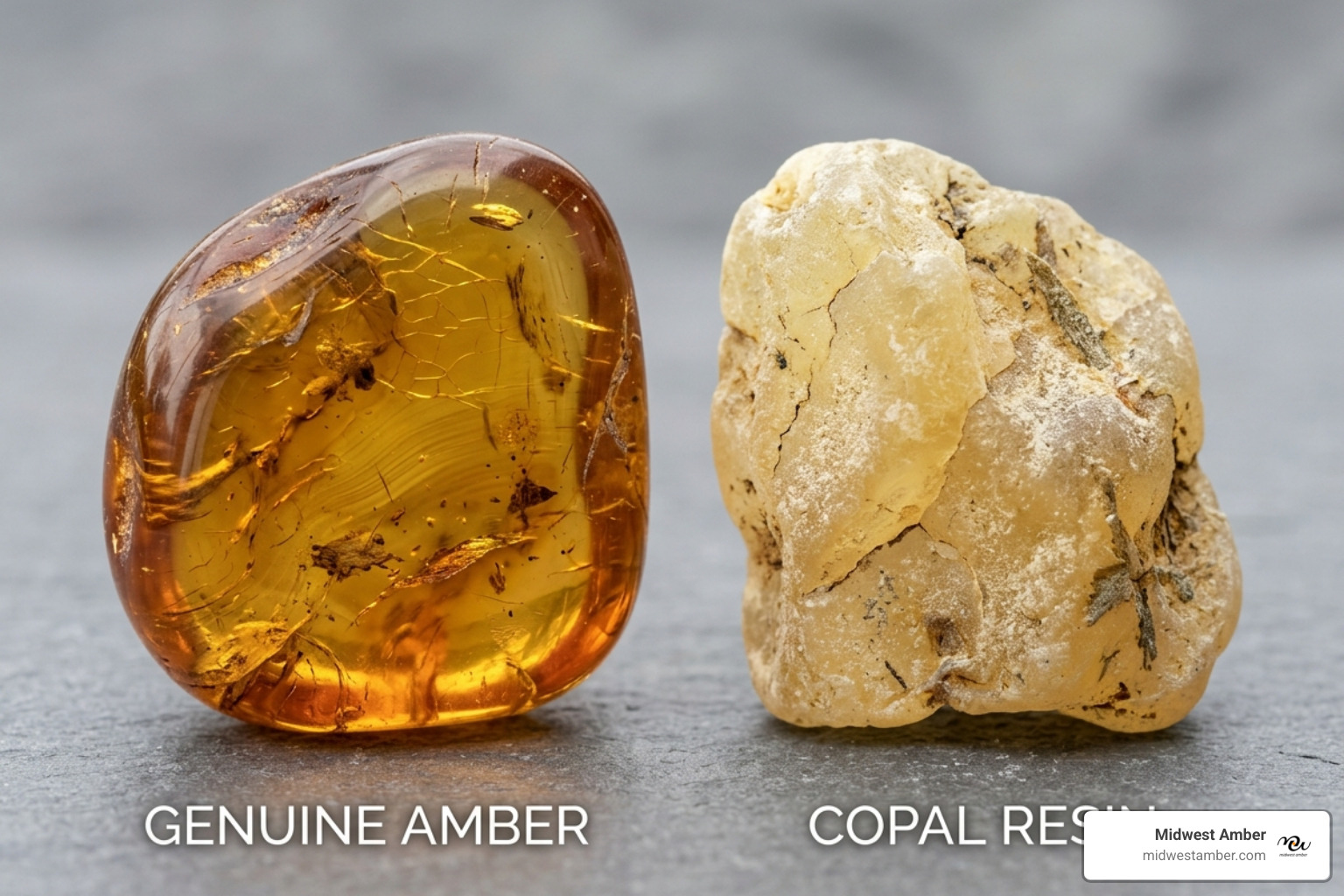
To truly understand the debate of amber vs copal, we have to look at the clock—specifically, a geological one. Both substances began their lives as sticky resin exuded by ancient trees. This resin wasn't just "sap" (which is the watery fluid that carries nutrients through a tree); it was a complex chemical defense mechanism used to seal wounds and protect the tree from insects and fungi.
The transformation from that sticky goo into a gemstone is a saga of heat, pressure, and time. For natural amber stone, this journey takes millions of years. Most of the prized specimens we work with at Midwest Amber come from the Baltic region and are approximately 44 million years old, dating back to the Eocene epoch. These resins primarily originated from an extinct variety of pine tree known as Pinites succinifer.
The secret ingredient in this transformation is polymerization. Over eons, the organic molecules in the resin cross-link and "knot" together. This process is often accelerated in an anaerobic (oxygen-free) environment, such as being buried under layers of sediment or ocean floor. As the volatile oils (terpenes) evaporate and molecular oxygen interacts with the resin, it hardens into a chemically stable fossil.
Copal, by contrast, is essentially "young" resin. It is often described as being in a sub-fossilized state. While amber is millions of years old, copal ranges from just a few decades to a few thousand years old. Because it hasn't had the time to fully polymerize, it remains chemically "immature." It’s a bit like comparing a fine, aged wine to fresh grape juice—both come from the same source, but the ripening process makes them entirely different substances.
One of the most defining characteristics of true Baltic amber is the presence of succinic acid, which typically makes up 3% to 8% of its composition. This specific acid is a hallmark of "succinite" (true Baltic amber) and is one of the reasons it has been used for centuries in traditional European wellness practices. Most copals and other fossil resins from around the world lack this specific chemical signature.
Amber vs Copal: Key Physical and Chemical Differences
When you hold a piece of amber vs copal in your hand, they might look identical to the untrained eye. However, their internal structures tell a very different story.
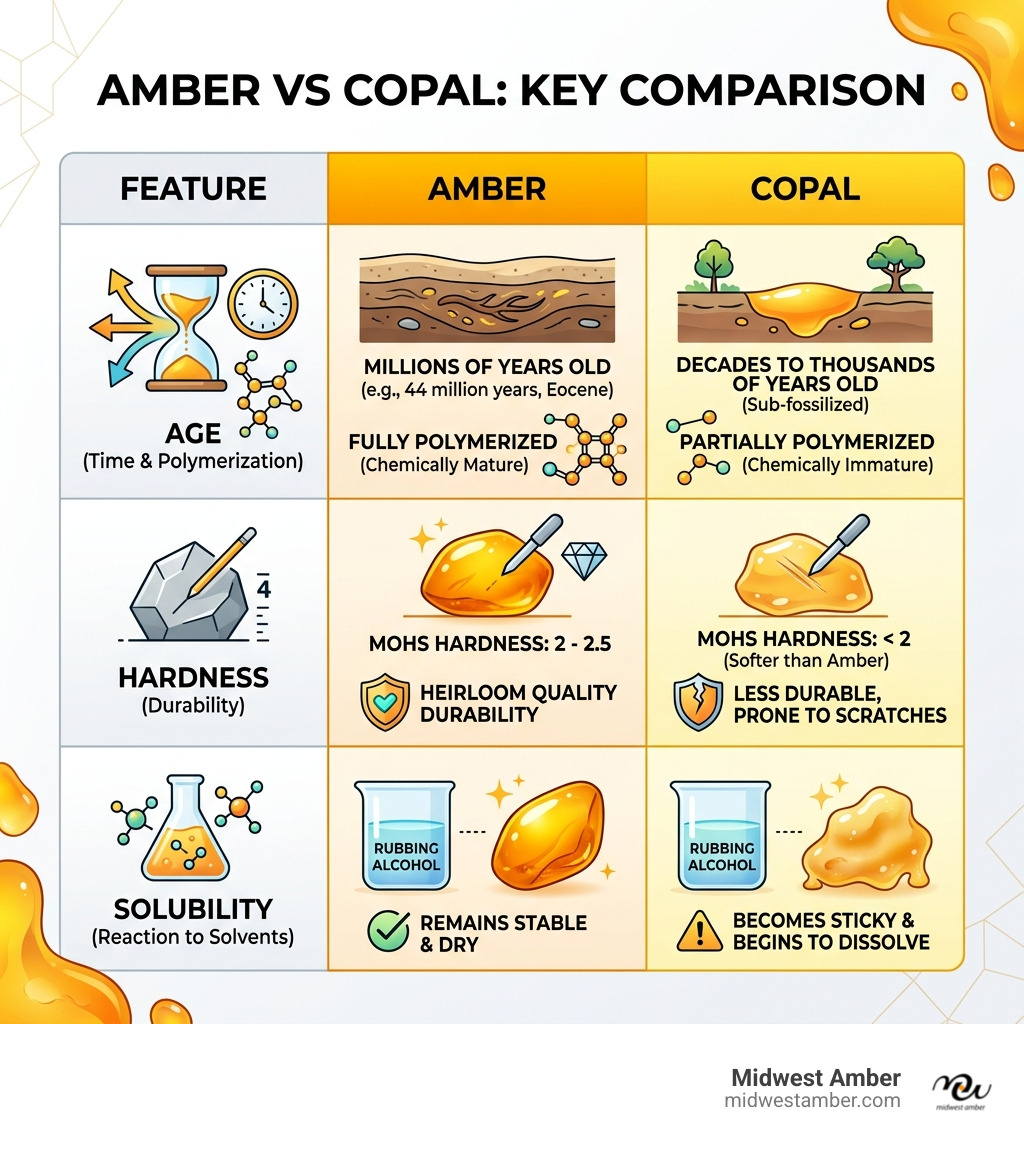
The most significant difference lies in chemical stability. Because amber has finished its polymerization process, it is remarkably resistant to the world around it. It won't melt if you spill a little rubbing alcohol on it, and it won't get sticky if it sits in the sun. Copal, however, is still "active." Its molecules are not fully cross-linked, leaving it vulnerable to solvents and heat.
The Durability of Amber vs Copal in Jewelry
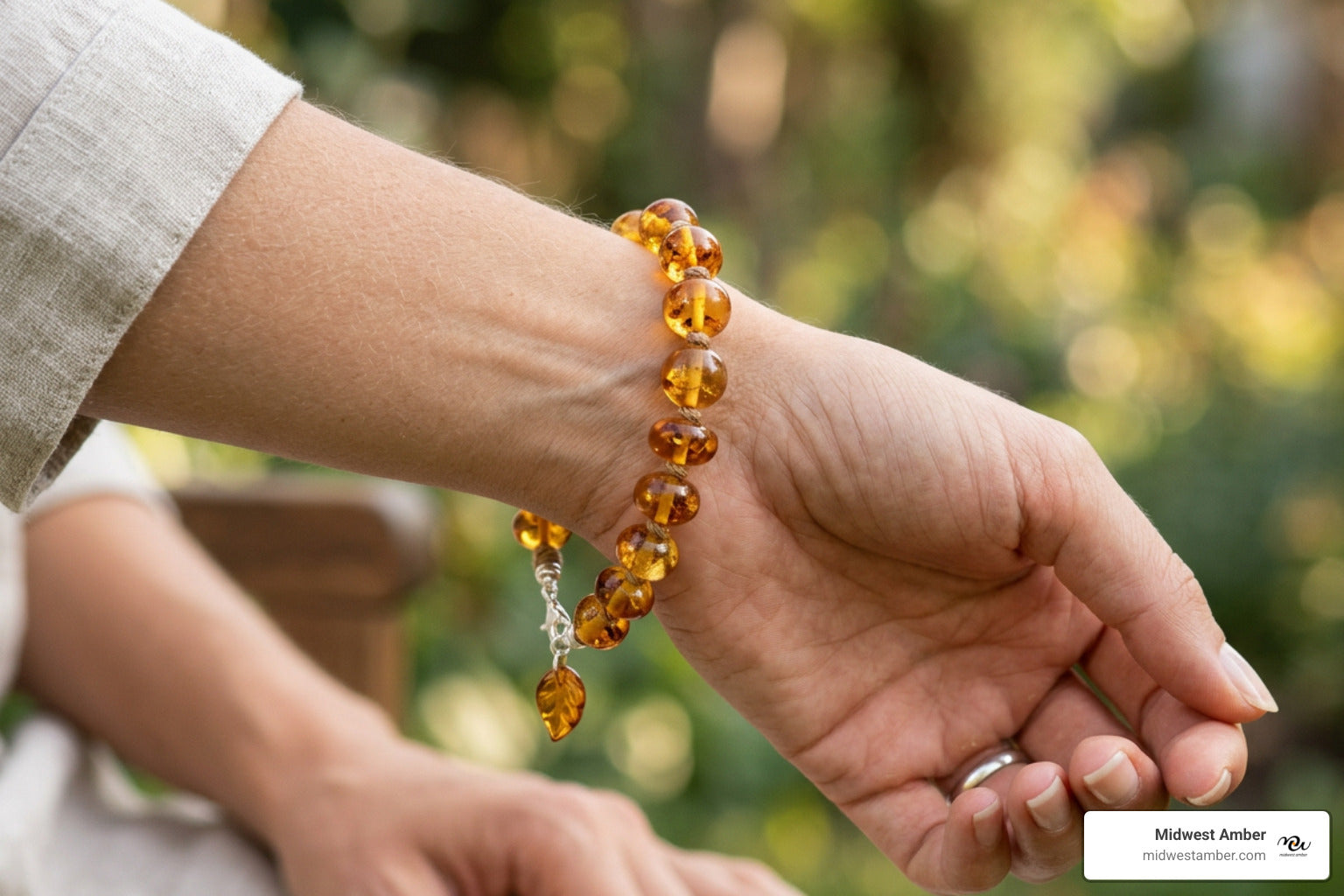
For those of us in the Chicago area looking for heirloom-quality pieces, durability is a major factor. On the Mohs scale of mineral hardness, Baltic amber sits between 2 and 2.5. While this is relatively soft compared to a diamond, it is plenty durable for earrings, necklaces, and pendants that can last for generations.
Copal is significantly softer, usually ranking between 1 and 1.5 on the Mohs scale. This makes it incredibly easy to scratch, even with a fingernail. If you were to wear a copal ring daily, it would quickly lose its luster and become marred by tiny abrasions. Furthermore, copal has a much lower melting point—often deforming at temperatures below 150°C. Amber is thermoplastic, meaning it will soften at high temperatures (150–200°C), but it is far more stable during everyday wear.
When we craft jewelry at Midwest Amber, we exclusively use genuine Baltic amber because we know it provides the longevity our customers expect. A copal "gem" is prone to becoming tacky or clouded over time as it reacts with skin oils, perfumes, or hairspray.
How to Distinguish Authentic Resins Using Simple Tests
If you’ve found a piece of "amber" at a local flea market in Schaumburg or Palatine and want to verify its authenticity, there are several tests you can perform. Because the market is often flooded with copal being sold as the real deal, these tests are your best line of defense.
Reliable Identification of Amber vs Copal
-
The Solvent Test (Acetone Test): This is the "gold standard" for non-destructive (or minimally destructive) testing. Apply a tiny drop of acetone (nail polish remover) or high-grade alcohol to an inconspicuous area of the stone.
- Copal: The surface will become tacky or sticky within a few seconds. If you press your thumb into it, you might even leave a fingerprint.
- Amber: Genuine amber is completely unaffected by short-term exposure to these solvents. It remains hard and smooth.
-
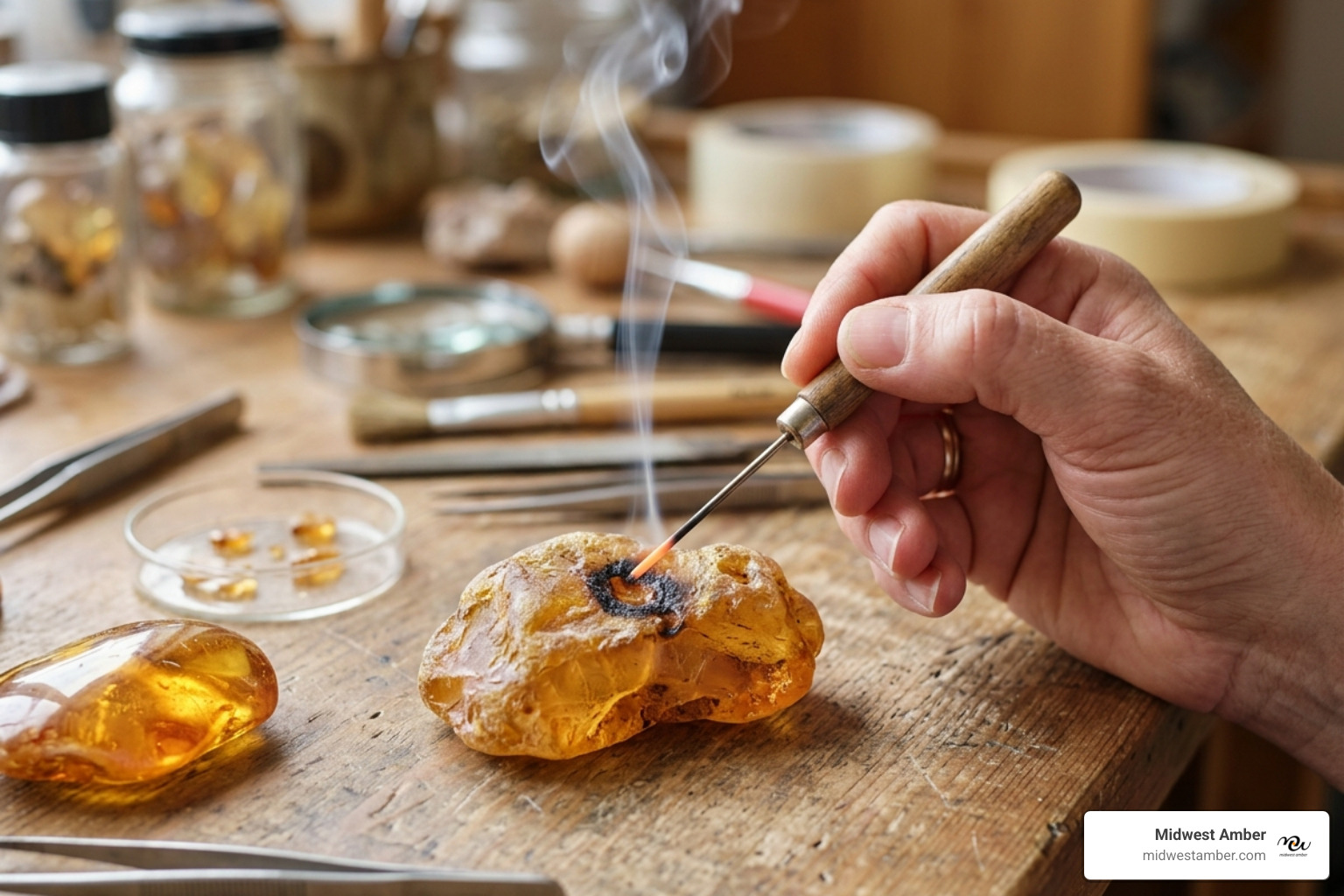
The Hot Needle Test: This is a destructive test, so only do it on the back of a bead or near a drill hole. Heat a needle until it’s glowing red and touch it to the specimen.
- Copal: It will melt quickly and emit a sweet, resinous, or "fresh" smell. The needle will sink in easily.
- Amber: It will resist melting longer and, when it does, it will emit a distinct, pleasant pine-tree scent. Instead of just melting, real amber often cracks or chips around the point of contact.
-
The Saltwater Test: This test helps distinguish natural resins from glass or plastic, though it won't always separate amber vs copal. Mix about 1 part salt with 2 parts water until the salt no longer dissolves.
- Natural Resins: Both amber and most copal will float in saturated saltwater because of their low specific gravity.
- Imitations: Glass, most plastics, and "resin" (the synthetic kind) will sink like a stone.
UV Fluorescence: If you have a UV light, take a look at your stone in a dark room. Most Baltic amber will fluoresce a pale blue, green, or yellowish color. Copal also fluoresces, but the color and intensity often differ.
Static Test: Amber is famous for its electrostatic properties. If you rub a piece of real amber vigorously against a wool cloth for 20-30 seconds, it will become statically charged and can pick up tiny bits of paper or dust. While some copal can do this, amber is much more efficient at it.
For more detailed steps, you can check our guide on how to tell if your amber jewelry is genuine.
Common Market Misrepresentations of Amber vs Copal
The confusion between these two isn't always an accident. In the trade, you might see copal labeled with deceptive names like "Young Amber," "Semi-Amber," or "Manilla Amber." While these sound fancy, they are often used to justify charging amber prices for a much cheaper material.
Another common trick involves falsified inclusions. Because amber is famous for trapping prehistoric insects, forgers will sometimes drill a hole into copal, insert a modern insect, and seal it back up with fresh resin. Real amber inclusions are usually very small (often under 10mm) and show signs of the "struggle" (distorted wings or legs) that occurred 40 million years ago. If you see a perfectly centered, giant scorpion in a clear "amber" pendant for $20, it’s almost certainly a fake or a treated piece of copal.
Why Authenticity Matters: Jewelry and Heritage
At Midwest Amber, our connection to this stone goes beyond just retail. We represent a deep Lithuanian and Polish heritage where amber is known as the "Gold of the North." For centuries, Baltic artisans have passed down the secrets of working with this organic gemstone, treating it with the respect a 40-million-year-old treasure deserves.
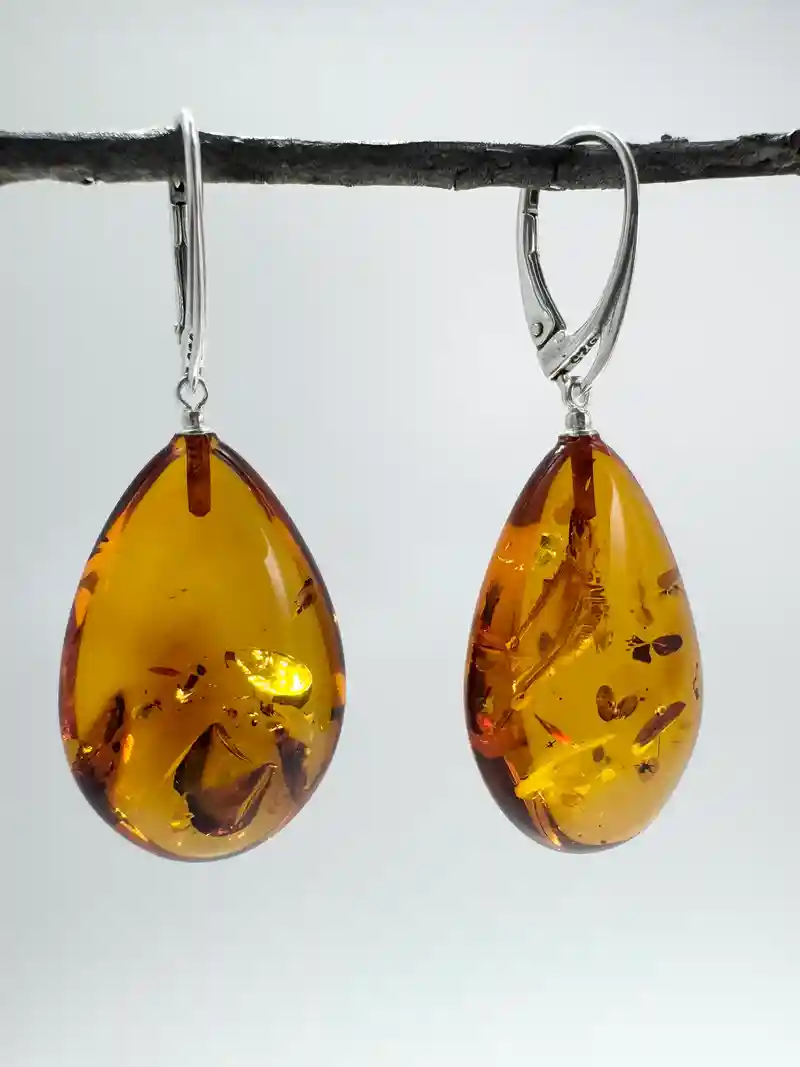
When you choose natural Baltic amber, you aren't just buying a piece of jewelry; you are buying a piece of Earth's history. Handcrafted by skilled artisans in Poland and Lithuania, each piece is unique. Because amber is an organic material, no two stones are ever exactly alike in their swirls, "sun spangles," or internal clouds.
Authenticity matters because copal simply cannot match the heritage and longevity of true amber. A piece of copal jewelry may look beautiful today, but it is not an heirloom. It will degrade, it will scratch, and it lacks the succinic acid content that defines the Baltic experience. By ensuring your jewelry is truly authentic, you are investing in a stone that has already survived millions of years and is ready to survive many more in your family.
Frequently Asked Questions about Fossil Resins
Is amber more valuable than copal?
Yes, in almost every market scenario, genuine amber is significantly more valuable than copal. This is due to its age, rarity, durability, and the complex process required to mine it from deep geological layers (especially in the Baltic Sea). Copal is much more abundant and easier to harvest from near-surface deposits or living trees, making it a more affordable—but less durable—alternative.
Can copal be treated to look like amber?
Yes, and this is a major issue in the jewelry industry. Some manufacturers use an "autoclave" (a high-pressure oven) to artificially age copal. By applying heat and pressure, they can harden the outer shell of the copal and darken its color to mimic the rich cognacs and honeys of Baltic amber. However, a solvent test will usually still reveal the truth, as the interior of the stone remains immature. For a deep dive into avoiding these traps, see our buyer's guide to authentic stone jewelry.
Do both amber and copal contain insects?
They do! However, the insects found in copal are not true fossils; they are "sub-fossils." These insects are often species that still exist today. The insects found in Baltic amber are prehistoric—many are extinct species that provide scientists with a vital window into the Eocene world. If you are a collector, the scientific value of an insect in 40-million-year-old amber is vastly higher than one in 500-year-old copal.
Conclusion
Understanding the nuances of amber vs copal is the first step toward becoming a savvy collector and a confident jewelry owner. While copal has its place in the world—particularly as a beautiful incense used in traditional ceremonies—it is not a substitute for the ancient, polymerized majesty of Baltic amber.
At Midwest Amber, we take the guesswork out of the equation. With over 20 years of experience and deep roots in the Polish and Lithuanian amber-working communities, we provide only certified, 100% natural Baltic amber. Whether you are in Arlington Heights, Chicago, or anywhere in the surrounding suburbs, we invite you to explore our collection and experience the warmth and history of the "Gold of the North" for yourself.
Don't settle for "young" resin when you can own a piece of eternity. Shop our collection of genuine, handcrafted Baltic amber today and carry a 40-million-year-old story with you.

Leave a comment
This site is protected by hCaptcha and the hCaptcha Privacy Policy and Terms of Service apply.