

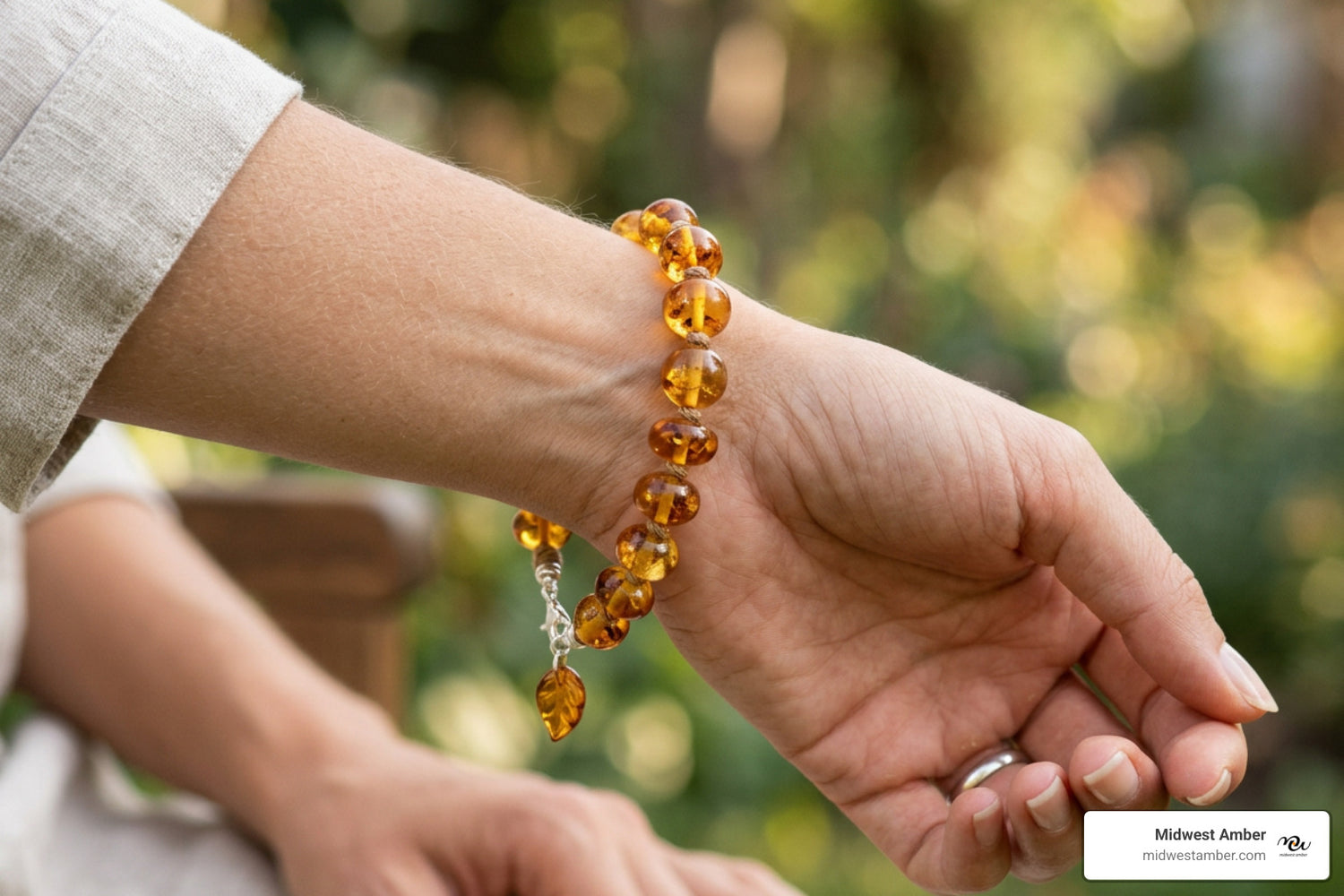
What Is an Amber Bracelet? Your Quick Answer
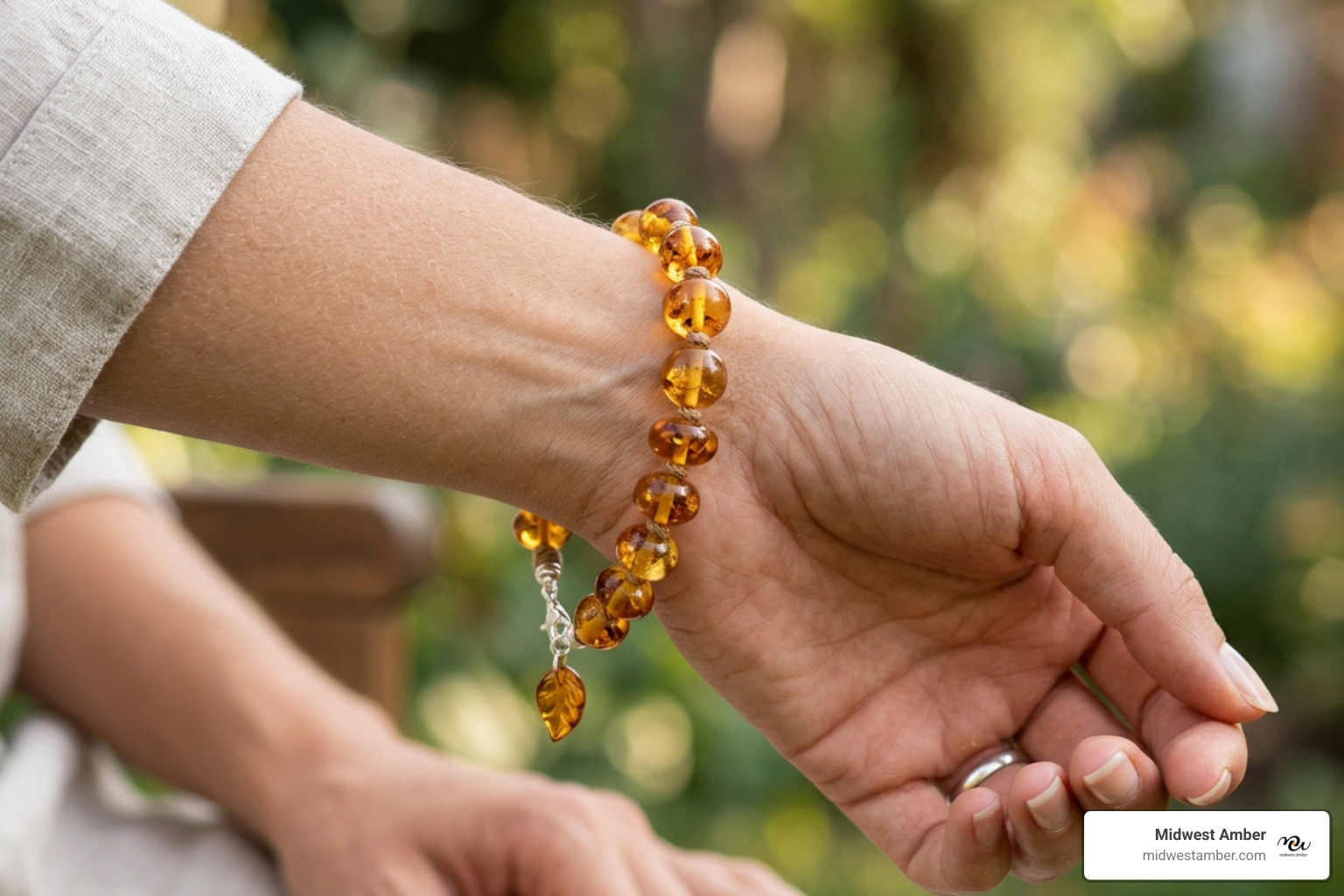
What is an amber bracelet is one of the most common questions we hear from people discovering this ancient gem for the first time — and the answer is simpler than you might think.
An amber bracelet is a piece of wrist jewelry made from amber — a natural, fossilized tree resin that formed over 45 million years ago. The most prized variety comes from the Baltic Sea region, particularly Lithuania and Poland. It is not a stone, rock, or synthetic gem. It is organic material from ancient trees, preserved by time.
Here's a quick breakdown:
| Feature | Details |
|---|---|
| Material | Fossilized tree resin (organic, not a mineral) |
| Primary source | Baltic Sea region (Lithuania, Poland, Russia) |
| Age | ~45 million years old |
| Common settings | Sterling silver, stretch cord, raw string |
| Colors | Cognac, butterscotch, cherry, lemon, green, multicolor |
| Common uses | Fashion jewelry, wellness, gifting, cultural heritage |
Amber bracelets range from simple beaded stretch designs to elegant sterling silver link pieces. Each one is completely unique — no two pieces of amber are identical in color, texture, or natural inclusions.
People are drawn to amber bracelets for many reasons: their warm, glowing appearance, their deep connection to natural history, and their cultural roots in Baltic tradition. Whether you're looking for a meaningful gift or a one-of-a-kind piece for yourself, amber bracelets sit at the intersection of nature, history, and handcrafted artistry.
I'm Gabriel Ciupek, President and owner of Midwest Amber, Inc., with decades of hands-on experience sourcing and selling genuine Baltic amber jewelry — including answering the everyday question of what is an amber bracelet for customers across the globe. In this guide, I'll walk you through everything you need to know, from how amber forms to how to spot a bell-ringer fake.
Relevant articles related to what is an amber bracelet:
What is an Amber Bracelet and How is it Formed?
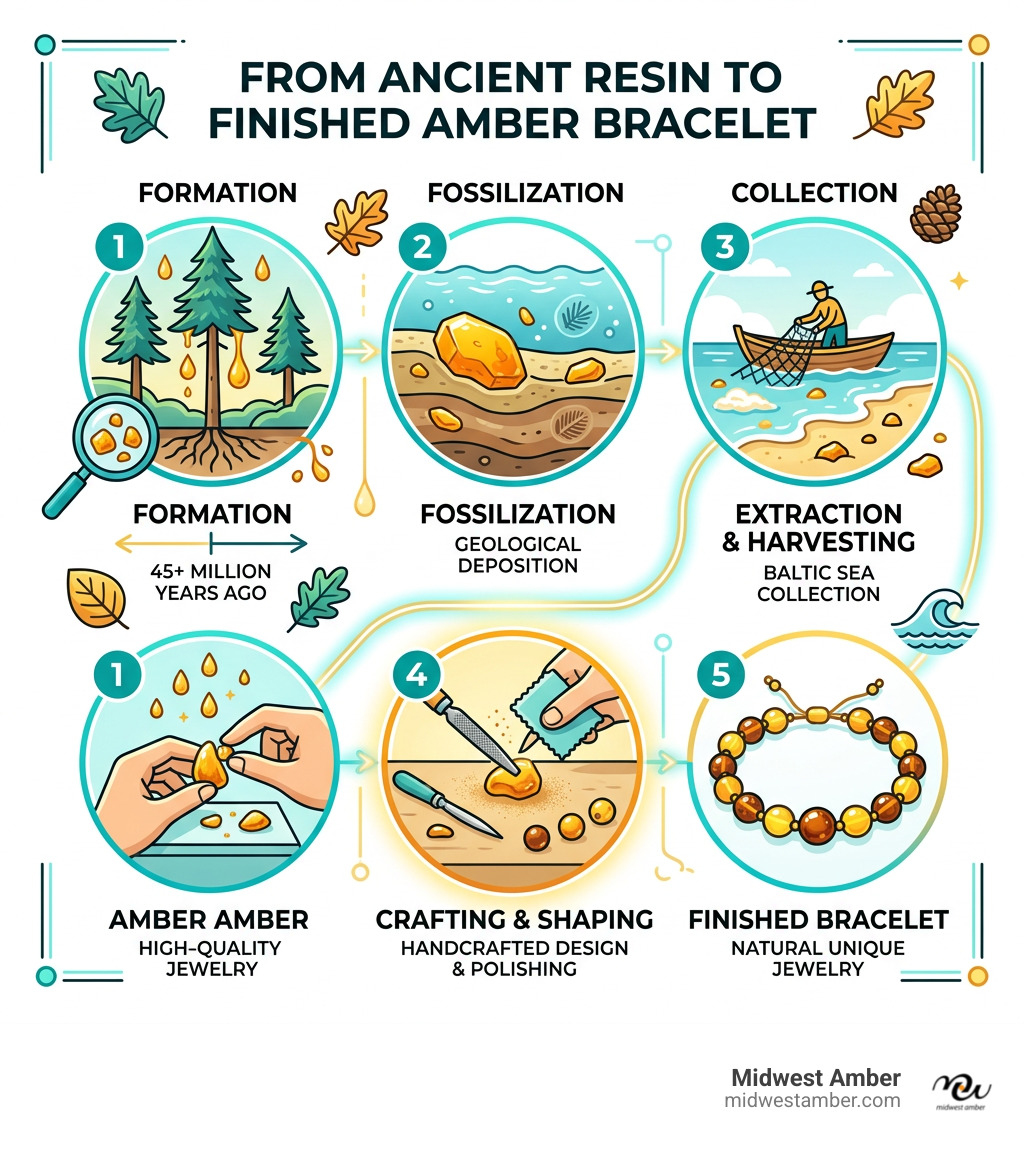
To truly understand what is an amber bracelet, we have to travel back in time—about 45 million years, to be exact. At that time, Northern Europe was covered in dense "amber forests." Amber isn't a mineral like a diamond or a sapphire; it is an organic material. It began as the sticky, protective resin of ancient coniferous trees, specifically the Pinus succinifera.
When these trees were injured or subjected to climate stress, they bled resin to seal their wounds. Over millions of years, this resin underwent a process called "succinosis"—a combination of high pressure and temperature that caused the organic compounds to polymerize. This transformed the soft, sticky sap into the hard, durable material we recognize today. Scientific research on amber production indicates that while the oldest amber dates back 320 million years, the Baltic variety we use for our jewelry is famous for its high quality and unique chemical composition.
Historically, this "Gold of the North" was so valuable it sparked the creation of the "Amber Road," a series of trade routes connecting the Baltic Sea to the Mediterranean. The ancient Greeks were fascinated by it, calling it ἤλεκτρον (ēlektron). They noticed that when you rubbed amber with a cloth, it created a static charge that attracted small particles—a discovery that eventually gave us the word "electricity."
If you’ve ever wondered about the mechanics behind these pieces, you can find more info about how amber bracelets work on our blog. Essentially, when you wear a bracelet, the warmth of your skin interacts with the fossilized resin, making it a "living" piece of jewelry that feels warm to the touch, unlike cold stones.
Exploring the Styles and Materials of Lithuanian Amber Jewelry
Lithuania has a deep-rooted heritage of amber craftsmanship. When we select pieces for Midwest Amber, we look for that perfect marriage between ancient organic material and modern jewelry-making techniques.
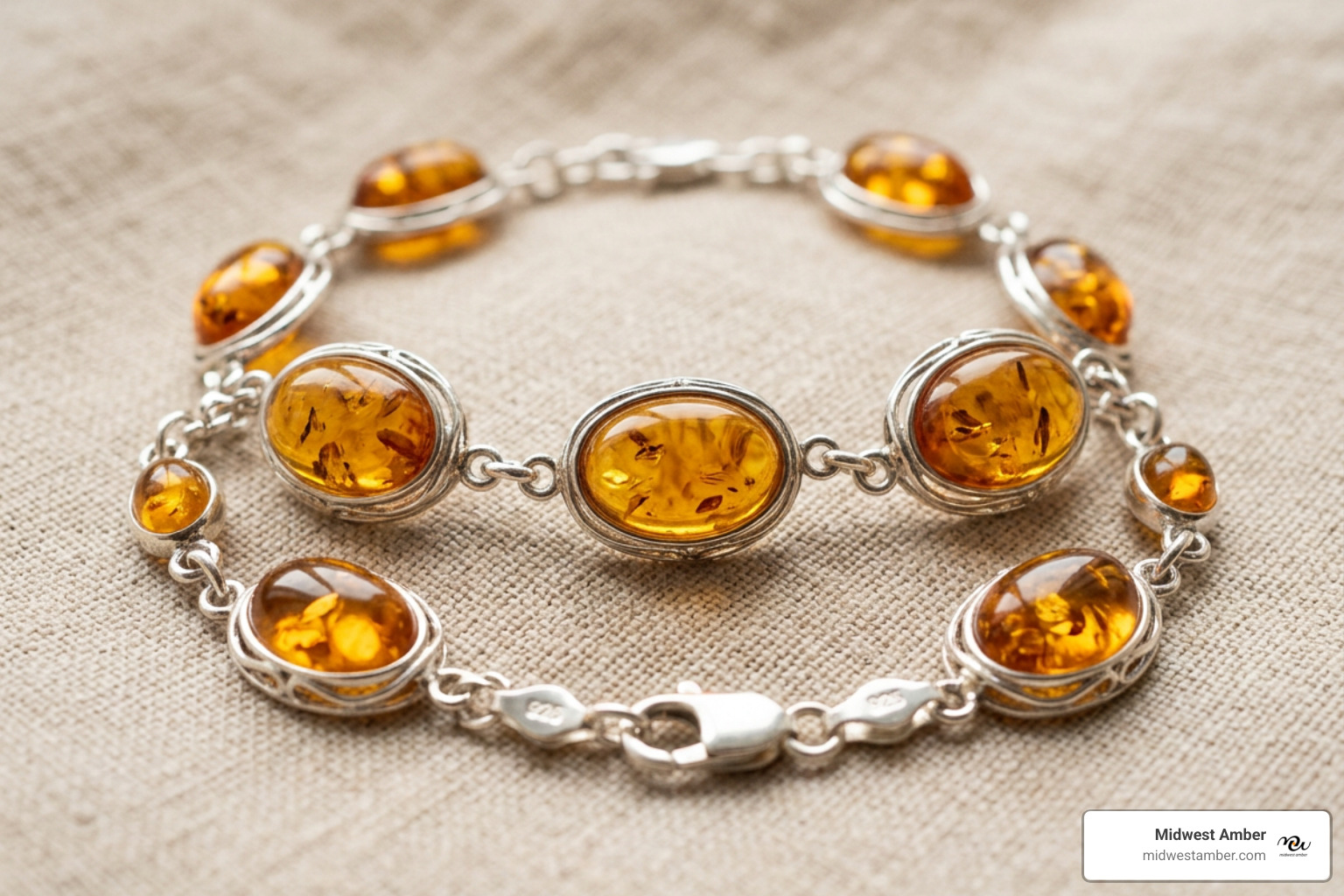
The most common metal used in these designs is 925 sterling silver. This metal provides a bright, durable frame that makes the warm tones of the amber pop. Whether it is a delicate leaf-edged design or a bold geometric setting, sterling silver ensures the piece lasts for generations. You can explore our dazzling guide to amber bracelets in sterling silver for a deeper look at these pairings.
Beyond silver, many bracelets use high-quality stretch cords or silk strings. These are especially popular for beaded styles because they are easy to slide on and off and sit comfortably against the skin. We also distinguish between "raw" and "polished" amber. Polished amber is smooth and glassy, showcasing the internal "sun spangles" (internal fractures caused by natural heating), while raw amber retains its natural, matte crust for a more earthy, rustic look.
If you're curious about the process of turning a rough piece of fossilized resin into a wearable work of art, check out our article on from rough to radiant crafting.
Popular Designs: What is an Amber Bracelet Style for You?
When asking "what is an amber bracelet style that fits my personality?" the options are nearly endless.
- Beaded Bracelets: These are the most classic. They can feature "baroque" (rounded but slightly irregular) beads or perfectly smooth spheres.
- Link Chains: These feature individual amber cabochons—often in oval, marquise, or pear shapes—set in sterling silver links.
- Multicolor Designs: Why choose one color when you can have them all? Many of our favorite pieces feature a "rainbow" of amber. You can find your perfect multicolor amber bracelet featuring shades of cognac, butterscotch, cherry, and lemon.
The color palette of Baltic amber is truly stunning:
- Cognac: The most famous "honey" hue.
- Butterscotch: An opaque, milky yellow that is highly prized.
- Cherry: A deep, dark red that looks almost black until the light hits it.
- Green: Often achieved by heating the back of the amber to enhance its natural mossy tones.
Men's and Women's Collections
Amber is truly a gender-neutral gemstone. For women, designs often lean toward elegance, with floral motifs, infinity symbols, and delicate silver work. You can find your perfect match for every woman in our curated collection, ranging from minimalist sliders to statement cuffs.
Men’s designs have seen a massive surge in popularity recently. Men's amber bracelets often feature larger, matte-finish beads or raw, unpolished nuggets on durable cords. These pieces offer a statement of natural sophistication and look great when stacked with a watch. Whatever your style, we want to help you find your perfect glow with Baltic amber bracelets that speak to your individual journey.
The Science and Folklore of Amber Health Benefits
For centuries, Baltic amber has been used in folk medicine. While we primarily sell amber for its beauty, many people wear it for its purported wellness properties. The key to these claims is succinic acid, a natural substance found in high concentrations (up to 8%) in Baltic amber.
In traditional European folklore, it was believed that when amber is worn against the skin, the body's warmth causes the resin to release trace amounts of succinic acid, which is then absorbed into the bloodstream. Succinic acid is a known natural analgesic and antioxidant. Many of our customers use amber bracelets for wellness to help with joint discomfort or to support the immune system. Some even ask, "do amber bracelets help sleep?" While the evidence is largely anecdotal, the calming, warm energy of the resin is a favorite for those seeking a natural lifestyle.
Safety and Suitability: What is an Amber Bracelet for Babies?
You may have seen "teething bracelets" or anklets for infants. It is a tradition in many parts of Europe to use amber to soothe teething pain. However, safety is our absolute priority at Midwest Amber.
There are many myths surrounding amber for kids. It is important to know that these are not toys and should never be chewed on. If you are considering one for a child, ensure it has specific safety features:
- Safety Screw Clasps: Designed to break under tension.
- Individually Knotted Beads: If the string breaks, only one bead will fall off, preventing a choking hazard.
We always recommend following FDA warnings on teething jewelry and never leaving a child unattended with jewelry. For a full breakdown of how to handle these pieces safely, read our guide on unraveling the risks and safety.
Buying Guide: Sizing, Care, and Authenticity
Buying an amber bracelet is an investment in a piece of natural history. To get the most out of your piece, you need to choose the right finish and the right fit.
| Property | Raw Amber | Polished Amber |
|---|---|---|
| Appearance | Matte, textured, earthy | Shiny, transparent, glassy |
| Feel | Slightly rough, organic | Smooth, silky |
| Inclusions | Harder to see through the crust | Highly visible "spangles" or flora |
| Care | Low maintenance | Needs occasional soft cloth buffing |
To find your size, wrap a flexible tape measure snugly around your wrist. Note the measurement and add about half an inch (1.3 cm) for a comfortable fit. If you like a looser "bangle" style, you might add a full inch. Finding bracelet bliss and your perfect amber piece starts with a comfortable fit!
Cleaning your amber is easy, but you must be gentle. Amber is soft (only a 2 to 2.5 on the Mohs scale). Use lukewarm water and a tiny drop of mild soap. Avoid all harsh chemicals, ultrasonic cleaners, and perfumes, which can dull the resin over time.
Identifying Genuine Baltic Amber vs. Fakes
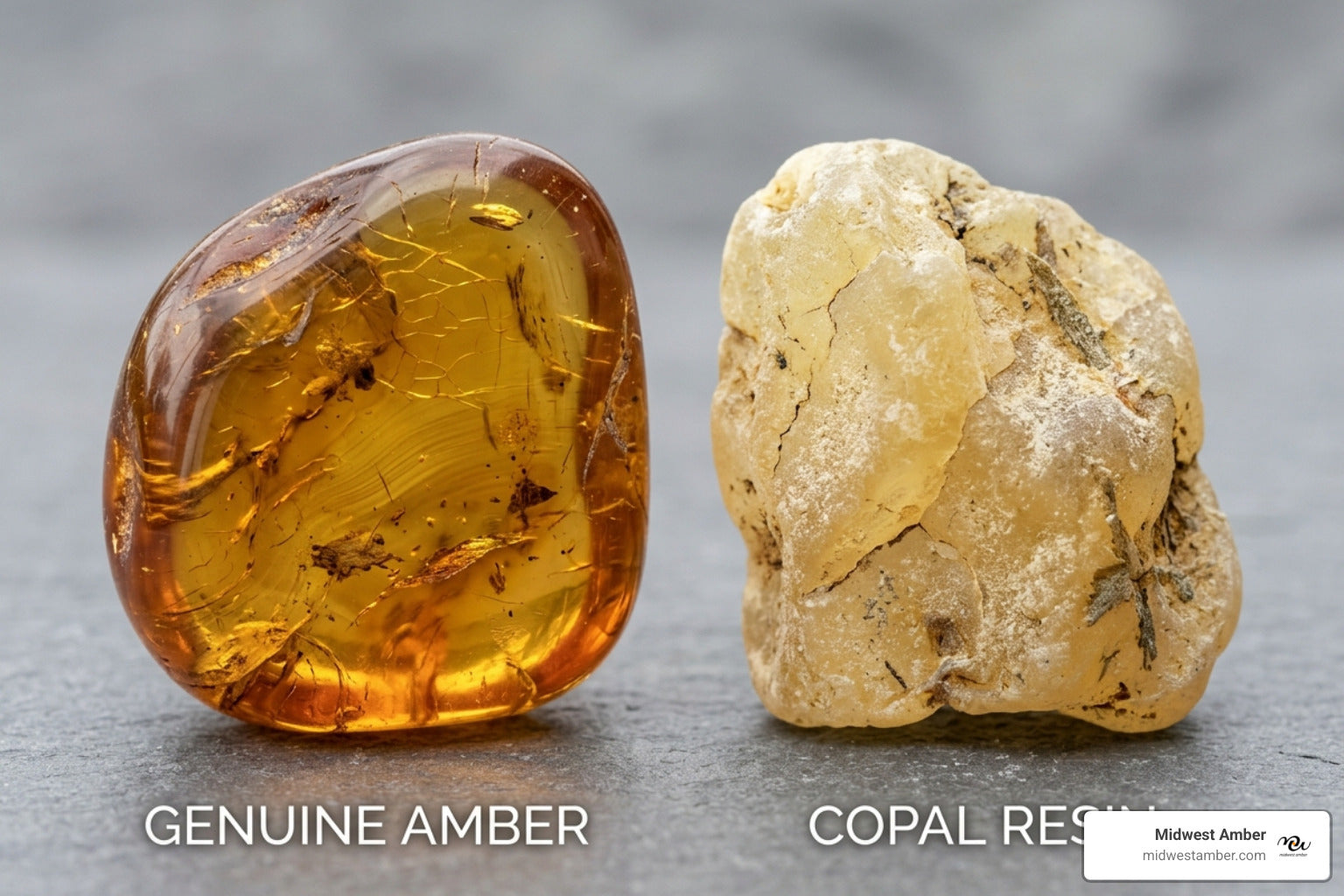
Because amber is so valuable, the market is unfortunately flooded with fakes made of plastic, glass, or "copal" (immature resin). Authenticity matters—not just for value, but because only genuine Baltic amber contains succinic acid.
Here are a few ways we verify authenticity:
- The Saltwater Test: Genuine amber floats in highly salty water but sinks in fresh water. Most plastics sink in both.
- UV Fluorescence: Under a UV light, genuine Baltic amber will usually glow a pale blue or greenish color.
- Static Charge: Rub the amber on a piece of wool; it should attract tiny bits of paper or dust.
- Scent: If you rub amber vigorously until it gets warm, it should emit a faint, pleasant scent of pine needles.
Scientific research on fossil preservation helps us understand the unique chemical markers of true succinite. At Midwest Amber, we provide certified authenticity because we believe you deserve the real deal.
Frequently Asked Questions about Amber Bracelets
How do I measure my wrist for the perfect fitting amber bracelet?
As mentioned, use a soft tape measure or a piece of string. Measure the circumference of your wrist just above the wrist bone. Add 0.5 inches for a standard fit or 1 inch for a loose fit. Most of our stretch bracelets are designed to be versatile, but link bracelets require a more precise measurement.
What are the price ranges for genuine amber bracelets?
Price depends on the size of the amber, the complexity of the silver work, and the rarity of the color (like butterscotch or white amber). Generally, you can find high-quality beaded stretch bracelets for $25–$60, while intricate sterling silver link designs can range from $80 to over $300.
How should I clean and maintain my amber jewelry?
Keep it away from high heat and direct sunlight for long periods, as it can become brittle. Wipe it with a soft, damp flannel cloth after wearing to remove skin oils. If it loses its luster, a tiny drop of olive oil on a soft cloth can help restore its shine.
Conclusion
We hope this guide has answered the question of what is an amber bracelet and inspired you to explore this incredible organic gemstone. At Midwest Amber, we are proud to bring the heritage of Poland and Lithuania to our neighbors in the Chicago area and beyond — from Arlington Heights to Schaumburg and everywhere in between.
With over 20 years of experience, we specialize in handcrafted, 100% natural, and ethically sourced Baltic amber. Whether you are looking for a raw healing piece or a polished sterling silver statement, our collection is backed by certified authenticity.
Ready to find your own piece of ancient history? Find your perfect amber piece today and experience the warm, natural glow of genuine Baltic amber.

Leave a comment
This site is protected by hCaptcha and the hCaptcha Privacy Policy and Terms of Service apply.