


What Are Amber Insect Inclusions — and Where Can You Find Genuine Ones?

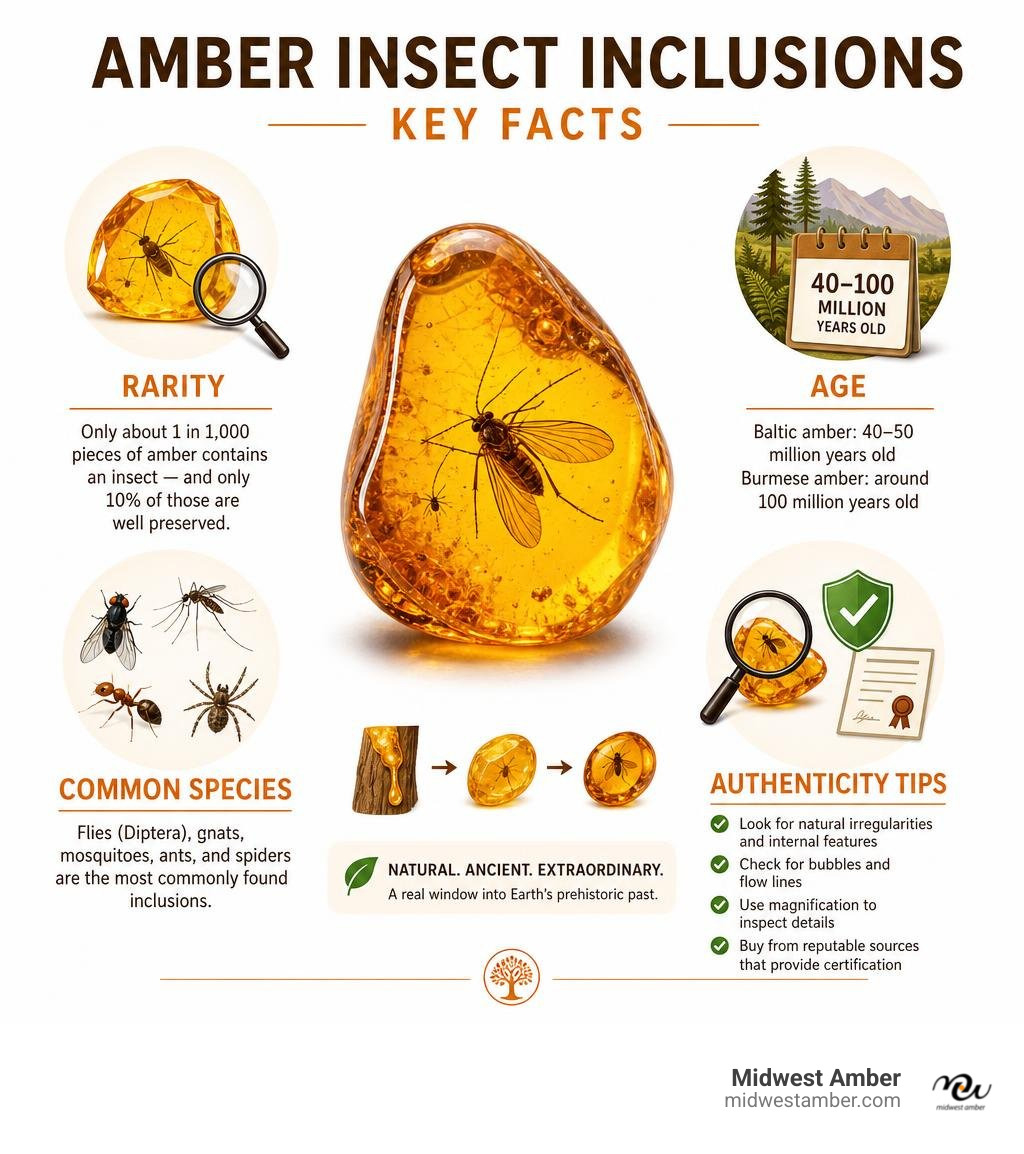
Amber insect inclusions are prehistoric insects and other small organisms preserved inside fossilized tree resin, often in extraordinary three-dimensional detail. Here is a quick overview of what you need to know before buying:
- What they are: Insects, spiders, and other tiny organisms trapped in tree resin that hardened into amber over millions of years
- How old: Baltic amber inclusions are typically 40–50 million years old; Burmese amber inclusions can be around 100 million years old
- How rare: Only about 1 in 1,000 pieces of Baltic amber contains an insect — and only 10% of those are preserved well enough to identify
- Most common types: Flies (Diptera), gnats, mosquitoes, ants, and spiders
- Where to buy genuine specimens: Reputable dealers offering certified, ethically sourced Baltic amber jewelry and raw fossil specimens
Holding a piece of genuine Baltic amber with a trapped insect is unlike anything else. You are looking at a real organism — wings, legs, microscopic hairs and all — frozen in time tens of millions of years before humans existed. It is not a painting or a cast. It is the actual thing, perfectly sealed inside warm golden resin.
That is what makes amber insect inclusions so compelling to collectors, scientists, and jewelry lovers alike. And it is also what makes fakes so frustratingly common in the market.
I'm Gabriel Ciupek, President of Midwest Amber, Inc., with years of experience sourcing and curating genuine Baltic amber insect inclusions from trusted Polish and Lithuanian artisans. In this guide, I'll walk you through everything you need to know to find authentic specimens — whether you're building a fossil collection or looking for a truly one-of-a-kind piece of wearable history.
Amber insect inclusions definitions:
Understanding the Science of Amber Insect Inclusions
To truly appreciate the wonder of amber insect inclusions, we must first look at the science behind how they came to be. Many people mistakenly refer to amber as fossilized tree sap, but this is a common misconception. Sap is the watery, nutrient-rich fluid that circulates through a plant's vascular system. Amber, however, is fossilized tree resin.
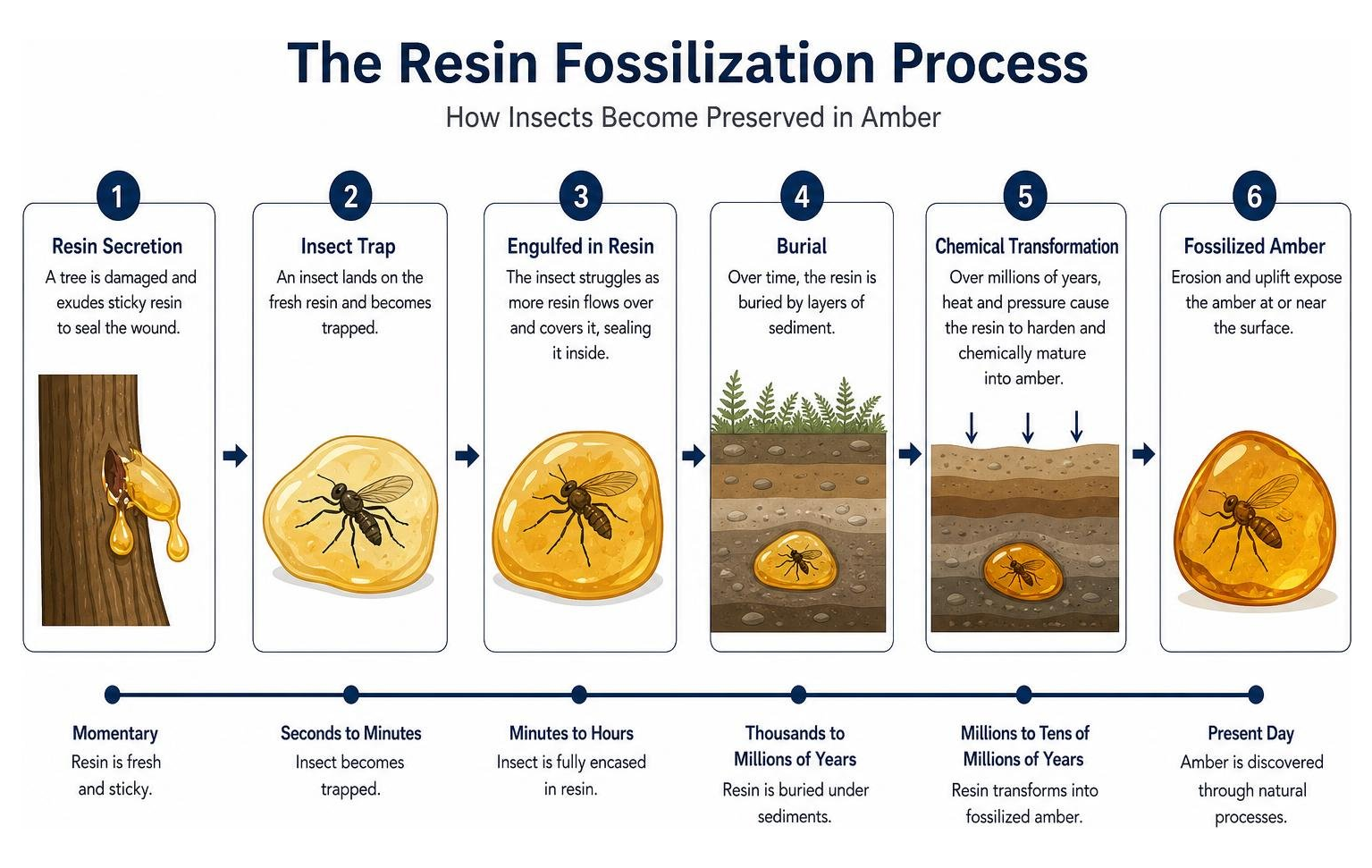
Resin is a thick, sticky, organic substance secreted by certain trees—particularly conifers—as a defense mechanism against damage, fungal infections, and boring insects. When the bark of an ancient tree was punctured, the tree exuded resin to seal the wound.
Over millions of years, this resin underwent a complex chemical transformation. As the volatile organic compounds evaporated, the resin began to cross-link and polymerize. This process of polymerization, isomerization, and molecular maturation gradually hardened the soft, sticky goo into a durable, semi-fossilized substance called copal, and eventually into fully fossilized, chemically stable amber.
This geological journey took tens of millions of years of heat and pressure beneath layers of sediment. In the Baltic Sea region, these ancient forests flourished during the Eocene epoch, roughly 40 to 50 million years ago, leaving behind the world's most famous and abundant deposits of succinite (the scientific name for Baltic amber). To dive deeper into this scientific marvel, you can read our Amber Inclusions overview.
How Organisms Become Preserved in Amber
The preservation of organisms in amber is a masterclass in natural taphonomy. When ancient trees oozed fresh, sticky resin, it acted as a highly effective, active trap for any small creature unfortunate enough to land on it or crawl across it.
Once an insect stepped onto the fresh resin, it became hopelessly stuck. As it struggled to free itself, its movements often triggered the tree to release even more resin, quickly engulfing the creature. Because the resin was highly viscous, it flowed around the organism, sealing it in an airtight, sterile environment. This lack of oxygen immediately halted the decay process and prevented aerobic bacteria and fungi from breaking down the organic tissue.
What makes this process truly unique is that it provides a perfect three-dimensional preservation medium (known geologically as a Lagerstätte). Unlike traditional fossilization, where sediment compresses and flattens bones or shells, amber preserves the exact 3D structure of the organism. However, there is a fascinating paradox: while you can see the incredibly fine, microscopic details of the insect's wings, antennae, and legs from the outside, the actual organic tissue inside has completely decomposed over millions of years.
The insect remains as a highly detailed, hollow mold or a carbonized film on the inner walls of the cavity. If you were to crack the amber open, the delicate internal structural mold would instantly disintegrate upon exposure to the air, which is why we must always study and appreciate these specimens from the outside. For more on this, you can check out the discussions on Insects In Amber: Fossil Or Not? - Questions & Answers.
Why Most Amber Insect Inclusions Are Small Organisms
If you have ever browsed a catalog of fossilized amber, you have likely noticed that the vast majority of inclusions are very small—usually measuring between 1 and 5 millimeters. This is not a coincidence; it is a direct result of physical size limitations and the mechanics of the sticky trap.
Larger, stronger organisms like beetles, wasps, or small vertebrates usually had the physical strength to pull themselves free from the sticky resin before it could fully entomb them. They might leave behind a leg or an antenna in their escape, but they rarely became fully trapped. On the other hand, tiny organisms like gnats, midges, and miniature spiders lacked the leverage to escape.
Furthermore, tree resin typically flowed in relatively small drops or thin laminations down the bark, meaning there simply wasn't enough volume of liquid resin at any one time to engulf a large creature.
Among the small organisms that did get trapped, the overwhelming majority belong to the order Diptera (true flies, including non-biting midges and mosquitoes). In Baltic amber, Diptera make up about 45% of all fauna inclusions, spanning over 74 families and 800 species. Other common inclusions include microscopic mites, small spiders, and ants.
To learn more about what types of tiny wonders are preserved in these ancient stones, check out our Amber Insect Inclusion Complete Guide.
Key Characteristics of Authentic Fossil Specimens
As the popularity of fossil collecting has soared, so has the market for counterfeit specimens. Because amber insect inclusions are highly prized, understanding how to spot a genuine fossil is crucial.
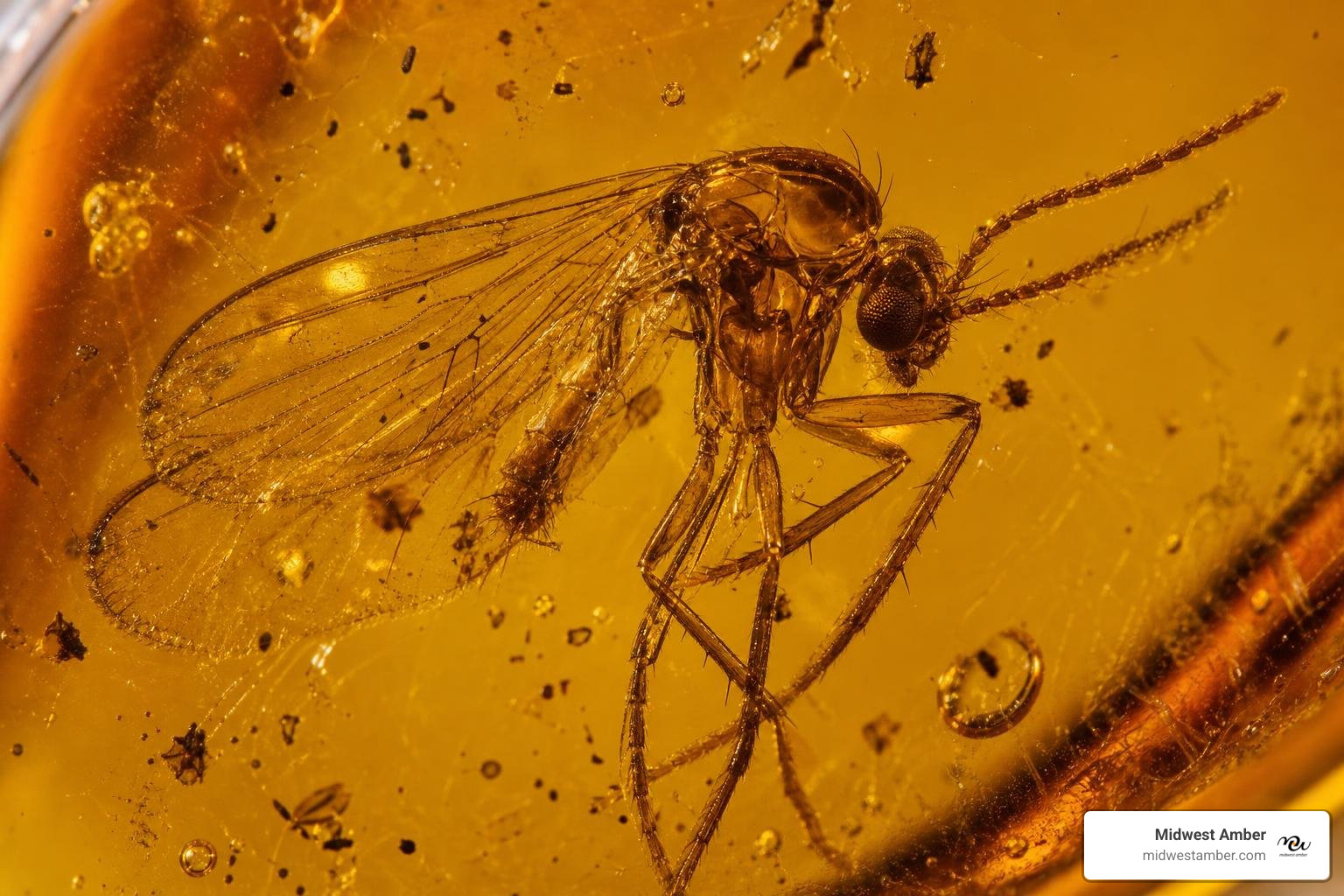
When examining a piece of amber under magnification, a genuine inclusion will almost always show signs of a prehistoric struggle. Because the insect was trapped alive, its legs will often be bent, shriveled, or splayed in natural, distressed angles. You may also see tiny, microscopic air bubbles clustered around its mouthparts or spiracles—the result of the insect's final breaths or gases escaping its body as it was entombed.
In contrast, counterfeit pieces often feature perfectly posed, pristine insects that look like they were carefully laid out in a display case. To understand the baseline differences between real and imitation stones, take a look at our guide on Real vs Fake Amber.
Distinguishing True Amber Insect Inclusions from Fakes
Fake amber inclusions are unfortunately incredibly common. Unscrupulous sellers use several methods to manufacture these imitations:
- Plastic and Synthetic Resins: Modern plastics, polyesters, and epoxy resins are easily cast into amber-like shapes. Fakers will take a modern insect (such as a common housefly, ant, or even a small scorpion), place it in a mold, and pour liquid plastic over it. These fakes are often completely clear, cheap, and contain unnaturally large, perfectly preserved modern insects.
- Copal Mislabeling: Copal is young, semi-fossilized resin (ranging from a few hundred to a few thousand years old). While it is natural, it is not true amber. It is much softer, melts at a lower temperature, and is far less valuable. Sellers often market Madagascar or Colombian copal as "millions-of-years-old Baltic amber."
- Drilled and Reconstructed Fakes: Some clever counterfeiters will take a genuine piece of clear Baltic amber, cut it in half, drill a small cavity into the center, insert a modern insect, and then seal the piece back together with matching liquid resin.
To protect yourself from these deceptive practices, always consult our guide on Real or Resin How to Tell if Your Amber Jewelry Is Genuine.
Testing Tools and Verification Techniques
While some high-end fakes require advanced spectroscopic analysis in a laboratory, there are several simple tests you can perform at home or at a gem show to verify authenticity:
- The UV Light Test: Genuine natural amber fluoresces a distinct pale blue, yellow, or green color under ultraviolet (UV) light. Most synthetic plastics and modern resins do not fluoresce at all, or they glow a dull purple.
- The Static Charge Test: Amber is an excellent electrical insulator. If you rub a piece of genuine amber vigorously against a natural wool or silk cloth for 20–30 seconds, it will build up a static charge. It should easily attract tiny pieces of paper, dust, or ash. (In fact, the Greek word for amber is elektron, which is the origin of our modern word "electricity"!).
- The Scent and Touch Test: Genuine amber is warm to the touch because of its low thermal conductivity, unlike cold glass. If you gently rub it until it warms up, it should emit a faint, pleasant pine-like or resinous scent. Copal, on the other hand, will become sticky when exposed to a drop of acetone (nail polish remover), whereas true amber remains completely unaffected.
For a comprehensive breakdown of these tests, read our article Don't Get Fooled The Definitive Guide to Certified Baltic Amber, and learn more about the physical properties in The Amber Truth Unlocking the Secrets of Genuine Stones.
Major Global Sources of Fossilized Amber
Amber is found in several deposits around the globe, but only a few locations are famous for producing high-quality specimens with rich bioinclusions.
| Feature | Baltic Amber (Succinite) | Burmese Amber (Burmite) |
|---|---|---|
| Geological Age | ~40 to 50 Million Years (Eocene) | ~99 to 100 Million Years (Cretaceous) |
| Resin Source | Prehistoric Conifers (Pinaceae family) | Araucarian Trees (Agathis-like) |
| Key Chemical Marker | Succinic Acid (3% to 8% yield) | Minimal to no Succinic Acid |
| Primary Inclusions | Terrestrial insects, spiders, mosses | Cretaceous insects, rare marine life |
| Durability | High (Mohs 2.0 - 2.5); ideal for jewelry | Variable; can be brittle or highly fractured |
Baltic Amber and Its 40-Million-Year-Old History
Baltic amber is the gold standard for both jewelry and paleontology. Originating in the vast, ancient forests of Northern Europe, about 90% of the world's extractable amber is located in the Kaliningrad Oblast region on the Baltic Sea, with significant deposits also washing ashore in Poland and Lithuania.
Baltic amber is highly prized for its rich, warm colors—ranging from honey yellow to deep cherry red—and its unique chemical composition. It is classified scientifically as succinite because it yields between 3% and 8% succinic acid upon distillation.
For generations, Polish and Lithuanian artisans have hand-carved and polished this "Gold of the North," preserving its natural beauty while creating exquisite, wearable works of art. At Midwest Amber, we work directly with these traditional European craftspeople to bring you ethically sourced, certified Baltic amber. You can read more about this rich heritage in Beyond the Shine Uncovering Truly Authentic Amber Jewelry and Unearthing Natural Amber What Makes This Ancient Gem So Special.
Cretaceous Burmese Amber and Other Regional Deposits
Another major source of fossil amber is the Hukawng Valley in northern Myanmar (Burma), which produces Burmese amber, or "Burmite." Dating back to the mid-Cretaceous period (around 99 to 100 million years ago), Burmite is significantly older than Baltic amber and dates back to the age of the dinosaurs.
Burmese amber has yielded incredible scientific discoveries, including incredibly rare Cretaceous insects like the Carcinonepa libererrantes—a bizarre true bug with crab-like claws described in Ancient Amber Reveals 100-Million-Year-Old True Bug With Epic Crab-Like Claws | IFLScience .
Even more astonishingly, scientists have found marine organisms trapped in Burmite, such as a juvenile ammonite shell that washed up on a prehistoric beach and was engulfed by dripping coastal resin, as documented in An ammonite trapped in Burmese amber | PNAS and An Ammonite Trapped in Burmese Amber - DocsLib .
Other notable deposits include Dominican amber (famous for its high clarity and rare blue variety) and Jordanian amber, which represents some of the oldest Cretaceous deposits but is highly brittle and difficult to prepare, as detailed in the scientific paper First Insect Inclusions from the Amber of Jordan (Mid Cretaceous).
Collecting and Wearing Fossilized Insect Jewelry
For many collectors, the ultimate joy of amber is not just displaying it in a cabinet, but wearing it. Amber jewelry containing insect inclusions allows you to carry a literal piece of deep time with you wherever you go.
Whether you are drawn to the dramatic look of a hand-polished raw specimen or the refined elegance of a sterling silver setting, there is a piece of wearable history for everyone.
Finding Your Perfect Amber Insect Inclusions Ring
Amber rings featuring bug inclusions are incredibly popular, offering a bold and fascinating conversation starter right on your hand. From classic feminine designs to rugged, earthy men's styles, these rings showcase the natural beauty of the fossil.
Mosquito inclusions, in particular, hold a special place in pop culture, evoking the adventurous spirit of prehistoric exploration. If you are looking to add one of these unique pieces to your collection, explore our guides on Ring in the Past Discovering the Best Amber Mosquito Rings and Amber Rings for All Including Mens Styles and Bug Inclusions.
Exquisite Necklaces and Pendants with Amber Insect Inclusions
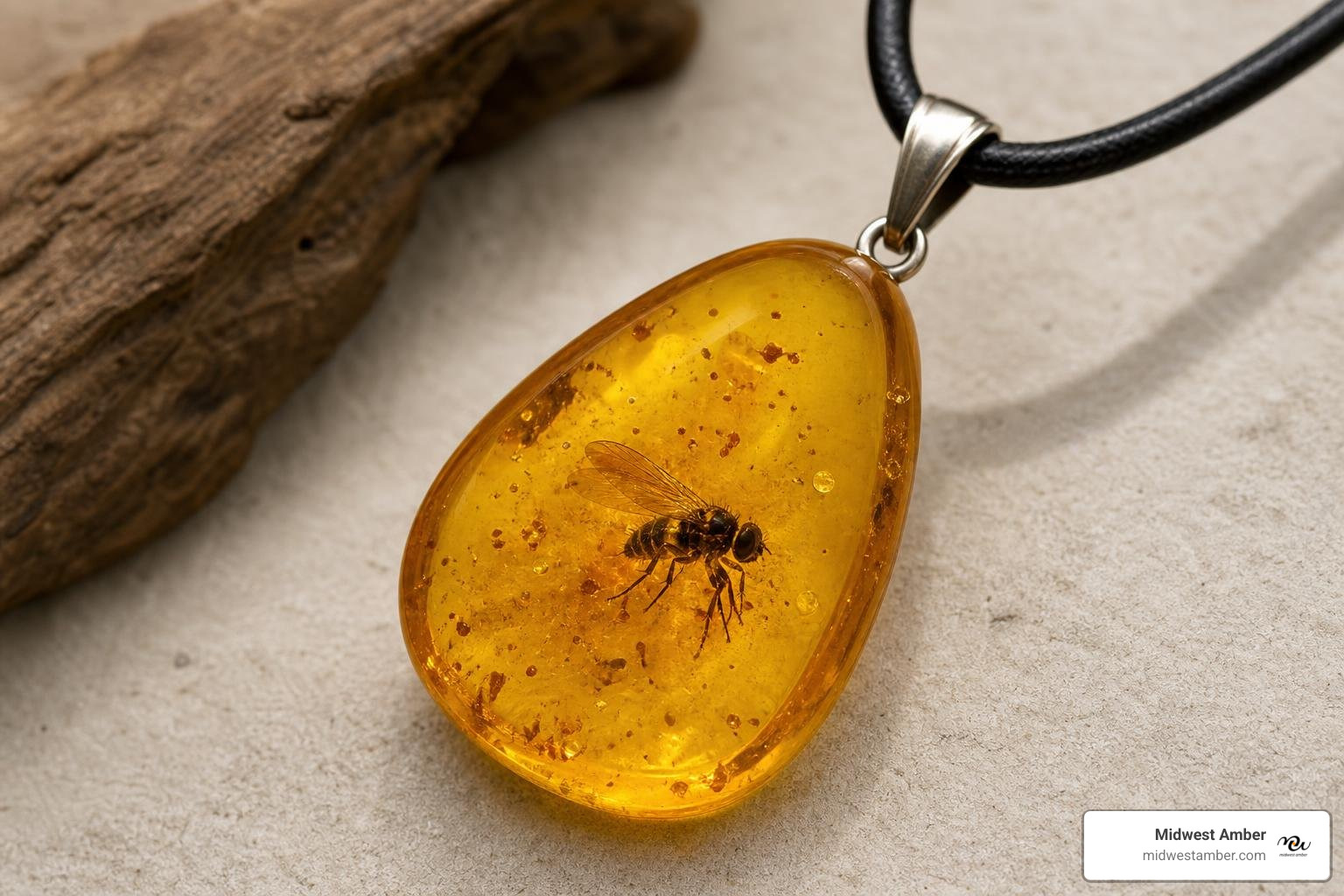
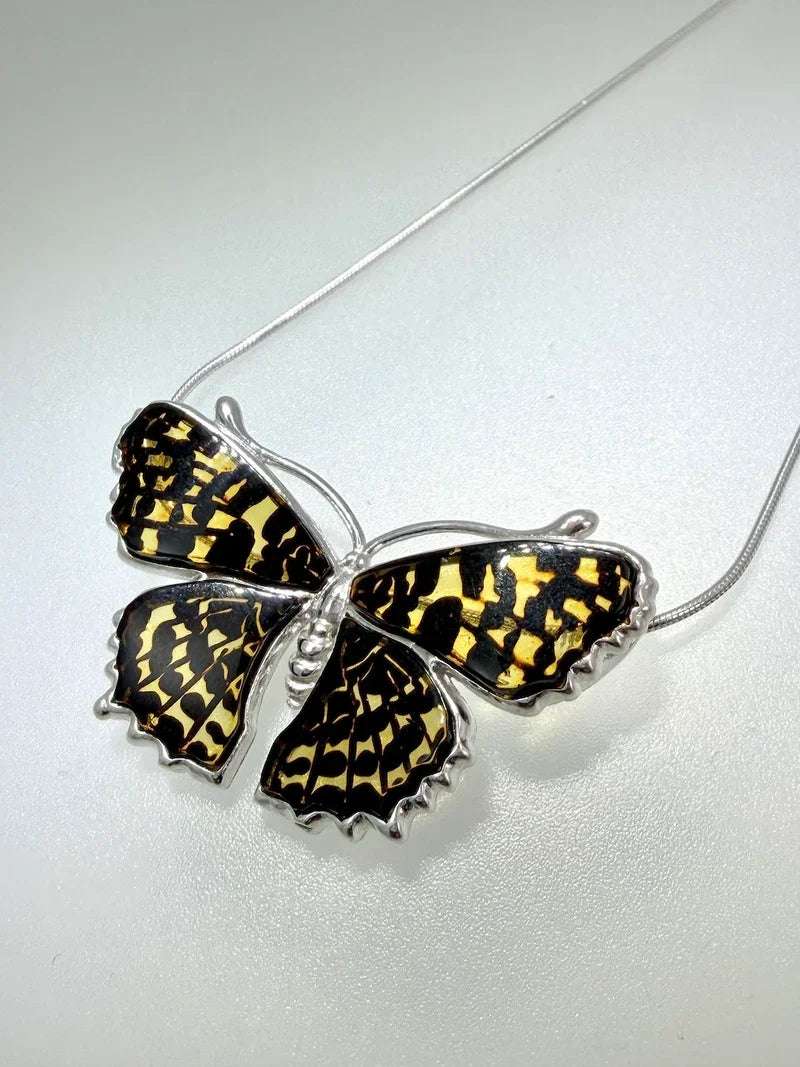
If you prefer to wear your fossils closer to your heart, a delicate pendant or necklace is the perfect choice. Skilled artisans often mount clear, honey-colored Baltic amber cabochons in sterling silver or gold-plated designs, ensuring that the light can shine directly through the stone to illuminate the tiny, perfectly preserved insect inside.
From dainty, everyday pendants featuring a single prehistoric gnat to statement necklaces containing multiple inclusions, these pieces are both elegant and scientifically fascinating. Discover where to find your own by checking out Jurassic Gems Where to Find Mosquito in Amber Necklaces and Find Your Fossil Amber with Bugs Near You.
Frequently Asked Questions about Amber Fossils
As experts in Baltic amber with over 20 years of experience, we hear many of the same questions from curious collectors and first-time buyers in the Chicago area and beyond. Here are the facts as of July 2026:
Can DNA be extracted from insects preserved in amber?
Despite what you may have seen in Jurassic Park, the short answer is no. While insects in amber look pristine, their actual organic tissue has completely decomposed.
Furthermore, DNA is a fragile molecule with a half-life of approximately 521 years. Even under ideal preservation conditions, all usable genetic information completely degrades after about 6.8 million years. Since Baltic amber is at least 40 million years old (and Cretaceous amber is 100 million years old), cloning extinct species from amber inclusions remains firmly in the realm of science fiction.
What is the difference between amber and copal?
Copal is an intermediate stage of polymerization between fresh tree resin and fully fossilized amber. While true amber is millions of years old and chemically stable, copal is much younger (often only thousands of years old).
Copal is significantly softer, highly aromatic, and melts at a much lower temperature. It will react and become sticky if exposed to solvents like acetone or alcohol, whereas true Baltic amber is completely resistant.
How rare are insect inclusions in Baltic amber?
They are incredibly rare! Only about 1 in 1,000 pieces of raw Baltic amber contains a visible insect inclusion. Furthermore, out of those rare pieces that do contain an insect, only about 10% are preserved well enough and are in clear enough amber to be identified by paleontologists. This double layer of rarity is why genuine, high-quality inclusions are so highly valued by collectors. For more insights into this rarity, you can read Ancient Inclusions in Amber - Amber Artisans .
Conclusion
At Midwest Amber, we believe that holding a piece of genuine Baltic amber is like holding a warm, golden time capsule. Our deep connection to Polish and Lithuanian heritage allows us to source only the finest, 100% natural, and ethically harvested amber directly from the Baltic coast. Backed by over 20 years of experience, we are proud to serve collectors and jewelry lovers across our local communities—from Chicago and Schaumburg to Long Grove, Barrington, and Elmhurst—with certified authentic pieces.
If you are ready to find your own piece of prehistoric history, we invite you to explore our curated collection of genuine Baltic amber jewelry. Discover our unique designs and find a timeless treasure today by checking out Fascinating Finds Amber Jewelry for Men Featuring Ancient Inclusions.


Leave a comment
This site is protected by hCaptcha and the hCaptcha Privacy Policy and Terms of Service apply.