

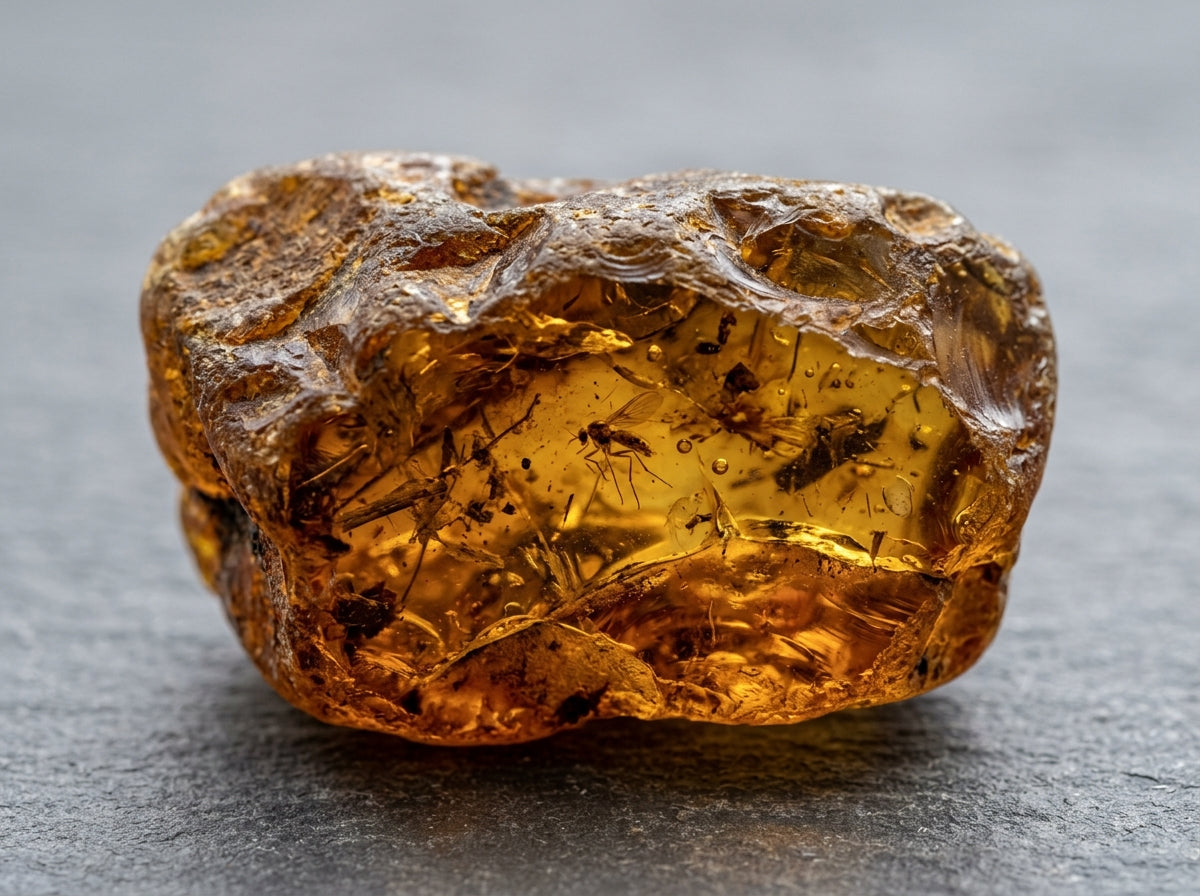
Amber Stone: Nature's Ancient Treasure Explained
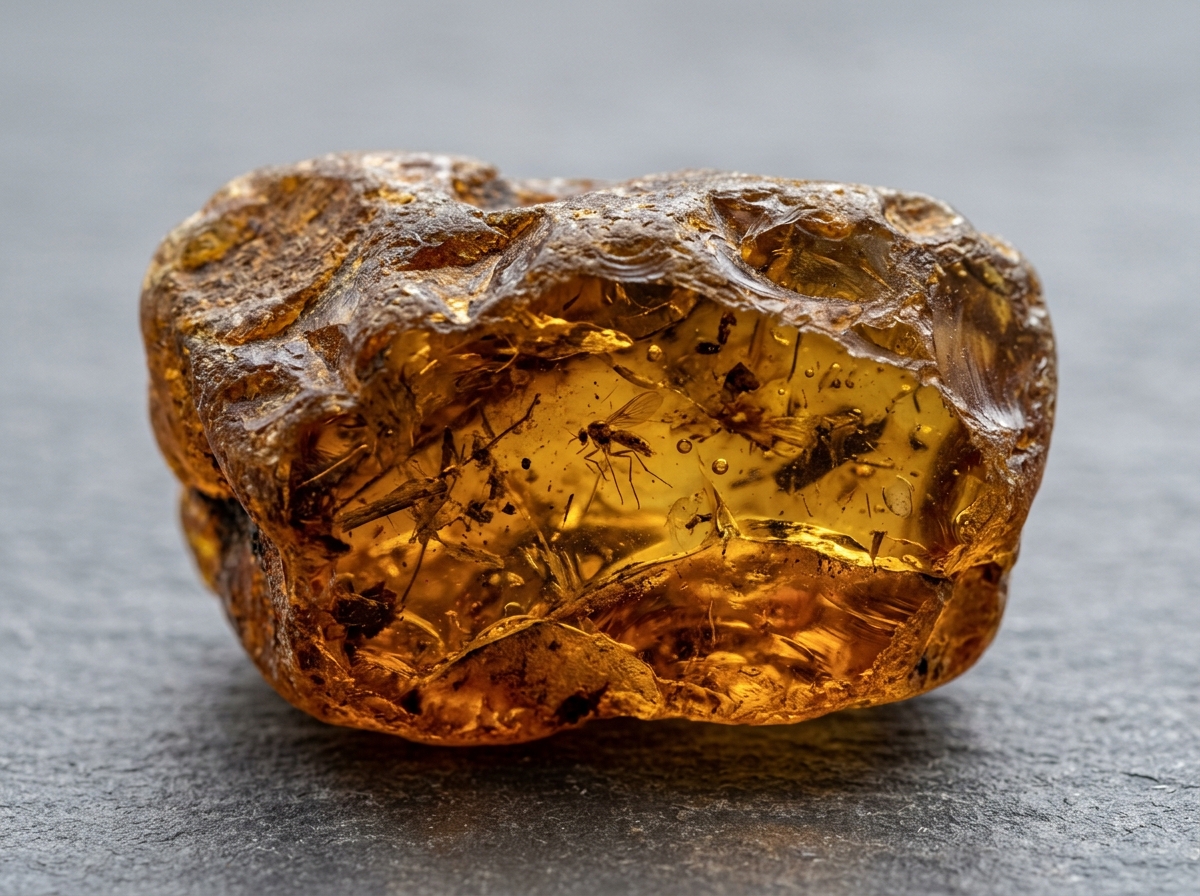
Amber stone is fossilized tree resin — an organic gemstone formed over millions of years, prized since the Stone Age for its warm glow, natural beauty, and the prehistoric life often preserved inside it.
Quick facts about amber stone:
| Property | Detail |
|---|---|
| What it is | Fossilized tree resin (organic gemstone) |
| Age | Up to 320 million years old |
| Hardness | 2.0–2.5 on the Mohs scale |
| Colors | Yellow, orange, brown, black, green, white, red, blue |
| Main source | Kaliningrad Oblast, Russia (~90% of world supply) |
| Key feature | Can contain preserved insects, plants, and other ancient life |
Amber isn't a mineral. It's organic — closer to pearl or jet than to quartz or sapphire. Yet it has been shaped, polished, and worn as jewelry for over 13,000 years.
What makes it truly remarkable is what it holds inside. Amber acts as a natural time capsule, trapping insects, plant fragments, and even feathers from ecosystems that no longer exist. Scientists have identified over 1,000 extinct animal species from amber specimens alone.
Whether you're drawn to it for its golden warmth, its deep history, or the tiny prehistoric world it sometimes carries within — amber rewards a closer look.
I'm Gabriel Ciupek, President and owner of Midwest Amber, Inc., with years of hands-on experience sourcing, pricing, and presenting genuine amber stone jewelry handcrafted by Polish and Lithuanian artisans. In the sections below, I'll walk you through everything you need to know — from how amber forms to how to spot the real thing.
What is Amber Stone and How Does it Form?
To understand amber stone, we first have to clear up a common myth: it isn't tree sap. While sap is the nutrient-rich "blood" of a tree, resin is its immune system. When a prehistoric tree was wounded by a storm or a hungry beetle, it oozed a thick, sticky resin to seal the gap and prevent infection.
Over millions of years, this resin underwent a magical transformation called molecular polymerization. As the resin was buried under layers of sediment, heat and pressure caused the small molecules to link together into long, sturdy chains. This process turns the sticky goo into a hard, glass-like substance. You can read more about this in our article on natural amber stone.
While the oldest known amber dates back to the Upper Carboniferous period—roughly 320 million years ago—most of the high-quality amber stone we use in jewelry today formed during the Eocene epoch, about 40 to 50 million years ago. This was a time when massive subtropical forests of Pinus succinifera (an extinct species of pine) covered what is now the Baltic region.
It is important to distinguish between "young" resin, known as copal, and true amber. Copal is only thousands or a few million years old and hasn't fully polymerized, meaning it will melt or soften if it touches alcohol or heat. True amber is a seasoned survivor of the ages. Recent research has even found amber containing grass, proving that these resin "traps" captured the very first evolution of many plant species we see today.

Physical and Chemical Properties of Amber Stone
From a scientific perspective, amber stone is a complex hydrocarbon with the chemical formula C10H16O. Because it doesn’t have a crystalline structure like a diamond, it is classified as "amorphous." Here are the key technical specs:
- Mohs Hardness: 2.0 to 2.5 (It’s soft enough to be carved but durable enough for daily wear).
- Specific Gravity: 1.08 (This is very light; amber actually floats in saltwater!).
- Refractive Index: 1.540 (This gives it that warm, honey-like glow when light passes through).
- Succinic Acid: Baltic amber is unique because it contains 3% to 8% succinic acid, a natural substance traditionally linked to wellness.
One of the coolest properties of amber stone is that it is "electrostatic." If you rub a piece of amber against a cloth, it develops a static charge that can pick up small bits of paper. This property was so famous in the ancient world that the Greek word for amber, elektron, became the root for our modern word "electricity."
The Paleontological Significance of Inclusions
Amber is often called "nature's time capsule" for a reason. Because the original resin was so sticky, it acted like prehistoric flypaper. Anything that landed in it was perfectly preserved in three dimensions.
In 2026, scientists even identified "Goethe’s amber ant," a discovery that helped bridge gaps in our understanding of insect evolution. From tiny gnats to flower petals and even extinct feathers, these inclusions offer a window into 50-million-year-old ecosystems that would otherwise be lost to time.
Global Varieties and Mining Locations
While amber is found in several spots around the globe, not all amber is created equal. At Midwest Amber, we specialize in Baltic amber because of its superior quality and rich history.
| Type | Region | Age (Approx.) | Notable Features |
|---|---|---|---|
| Baltic Amber | Poland, Lithuania, Russia | 40–50 Million Years | High succinic acid; best for jewelry |
| Dominican Amber | Dominican Republic | 15–20 Million Years | Famous for blue fluorescence and many insects |
| Burmese Amber | Myanmar | 99 Million Years | Hardest variety; often contains Cretaceous fossils |
The vast majority of the world's extractable amber—about 90%—is located in the Kaliningrad Oblast. However, the most beautiful, ethically sourced pieces are traditionally crafted by Polish and Lithuanian artisans. We take great pride in sourcing our material directly from these regions, ensuring that every amber stone we sell is 100% natural and legally obtained.
Colors of the Amber Stone
When most people think of an amber stone, they picture a warm, honey-yellow. But nature is far more creative than that! The color of amber depends on the type of tree it came from, what was trapped inside it, and the environment where it was buried.
- Yellow/Cognac (70%): The classic, most common variety.
- Black (15%): This amber contains a lot of organic plant matter or soil. When held up to the light, it often reveals deep red or brown hues.
- Green (2%): Often formed when resin fell into marshy areas with heavy plant life.
- White/Bony (1-2%): Contains millions of tiny air bubbles that scatter light, giving it a milky, "royal" appearance.
- Red/Cherry (0.5%): Very rare in nature; usually caused by natural oxidation over millions of years.
- Blue: The rarest of all, primarily found in the Dominican Republic. It looks yellow-brown but glows a vibrant neon blue under UV light.
History, Culture, and the Famous Amber Room
Humanity’s love affair with amber stone goes back to the Neolithic period. Ancient Greeks were fascinated by it, creating myths like the story of Phaëton’s sisters, whose tears turned into amber after their brother’s death. The etymology of elektron reflects this "beaming sun" energy.
For centuries, the "Amber Road" was a vital trade route that brought Baltic amber from the cold northern shores down to the wealthy Mediterranean civilizations. Romans valued amber so highly that a small amber figurine was sometimes worth more than a healthy slave.
Perhaps the most famous use of amber in history was the Amber Room. Originally gifted to Russia’s Peter the Great in 1716, this "Eighth Wonder of the World" was a chamber made entirely of six tons of exquisitely carved amber panels. Sadly, it was dismantled and lost by the Nazis during WWII, though a stunning reconstruction was completed in 2003 near St. Petersburg.
Metaphysical Meanings and Healing Traditions
Beyond its beauty, amber stone has always been associated with warmth and vitality. Because it feels warm to the touch (unlike cold minerals), many cultures believe it carries the energy of the sun.
In traditional Baltic folklore, amber was used as a protective amulet to deflect negativity. Today, many people seek out amber for its soothing vibrations. The presence of succinic acid has led to its use in traditional folk medicine for centuries, particularly in Europe, where it is often associated with emotional cleansing and physical comfort.
Identifying and Valuing Genuine Amber
Because amber stone is so valuable, the market is unfortunately flooded with fakes—everything from plastic and glass to "pressed amber" (small scraps melted together). At Midwest Amber, we believe in unlocking the secrets of genuine stones so you can shop with confidence.
Here are a few ways to test your amber at home:
- The Saltwater Test: Mix 1 part salt with 3 parts water. Real amber will float, while most plastics and glass will sink like a stone.
- The Static Test: Rub the stone vigorously on a piece of wool for 20 seconds. If it picks up small bits of paper or dust, it’s likely real.
- The Scent Test: If you rub a real amber stone until it gets warm, it should give off a faint, pleasant smell of pine or resin. Plastic will smell like chemicals.
- UV Light: Under a blacklight, natural Baltic amber will usually fluoresce a milky blue or green color.
Quality Factors and Care for Amber Stone Jewelry
When we value an amber stone, we look at four main factors: Color, Clarity, Cut, and Carat Weight.
While "AAA" clarity (inclusion-free) is prized for traditional jewelry, many collectors find that a stone with a perfectly preserved prehistoric mosquito or leaf is actually more valuable. The rarity of the inclusion can drive the price from a few dollars to thousands.
Because amber is an organic material, it needs a little "TLC" to stay beautiful. It is sourced from the Eocene epoch, and it has survived for millions of years—let's keep it that way!
- Clean gently: Use only lukewarm water and a soft cloth.
- Avoid chemicals: Hairspray, perfume, and household cleaners can dull the polish of your amber.
- No heat: Never use an ultrasonic cleaner or steam cleaner.
- Store separately: Because amber is soft (Mohs 2.0-2.5), harder gems like diamonds can scratch it if they are stored in the same box.
Frequently Asked Questions about Amber
Is amber a mineral or a gemstone?
Amber is an organic gemstone, not a mineral. Minerals are inorganic and have a specific chemical crystal structure. Amber is fossilized biological matter, putting it in the same category as pearls, coral, and jet.
How can I tell if my amber is real?
The best way is the saltwater buoyancy test or checking for a pine scent when rubbed. However, the only 100% sure way is to buy from a reputable source like Midwest Amber, where we provide certified authenticity for our 100% natural Baltic amber.
Why is Baltic amber considered the most valuable?
Baltic amber is the "gold standard" because it contains the highest levels of succinic acid and is significantly older and harder than copal. Its rich history and the incredible craftsmanship of Polish and Lithuanian artisans make it the most sought-after variety for fine jewelry.
Conclusion
At Midwest Amber, we don't just sell jewelry; we share a piece of Earth's history. Based in the heart of the Midwest—serving communities from Arlington Heights and Chicago to Elk Grove Village and Lake Zurich—we are a US-based company committed to the heritage of the Baltic region.
Our collection features 100% natural, ethically sourced amber stone jewelry, meticulously handcrafted by artisans who have passed down their skills for generations. With over 20 years of experience and a guarantee of certified authenticity, we invite you to explore the warm, timeless magic of Baltic amber.
Ready to find your own piece of prehistoric history? Explore our Ultimate Guide to Amber Jewelry and discover the perfect handcrafted piece for your collection today.

Leave a comment
This site is protected by hCaptcha and the hCaptcha Privacy Policy and Terms of Service apply.