


Choose Genuine Amber Stones for Jewelry Making
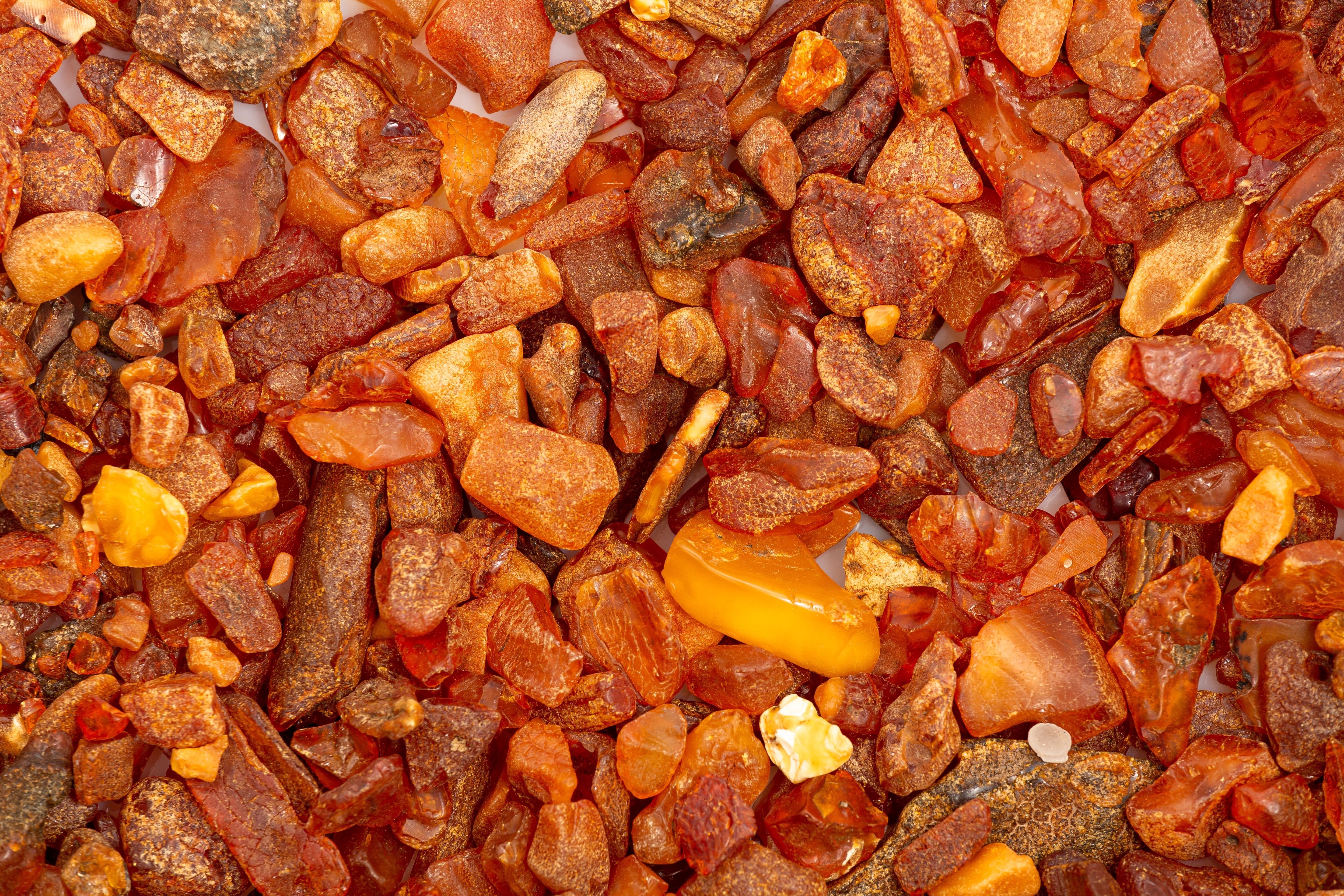
To buy amber stones for jewelry making with confidence, choose natural Baltic amber from a seller that clearly states its origin and authenticity. Select polished beads or calibrated cabochons for easy, finished-looking designs; choose raw rough for organic, one-of-a-kind work. Because amber is soft and lightweight, use gentle settings, avoid tight prongs, and protect it from heat and chemicals.
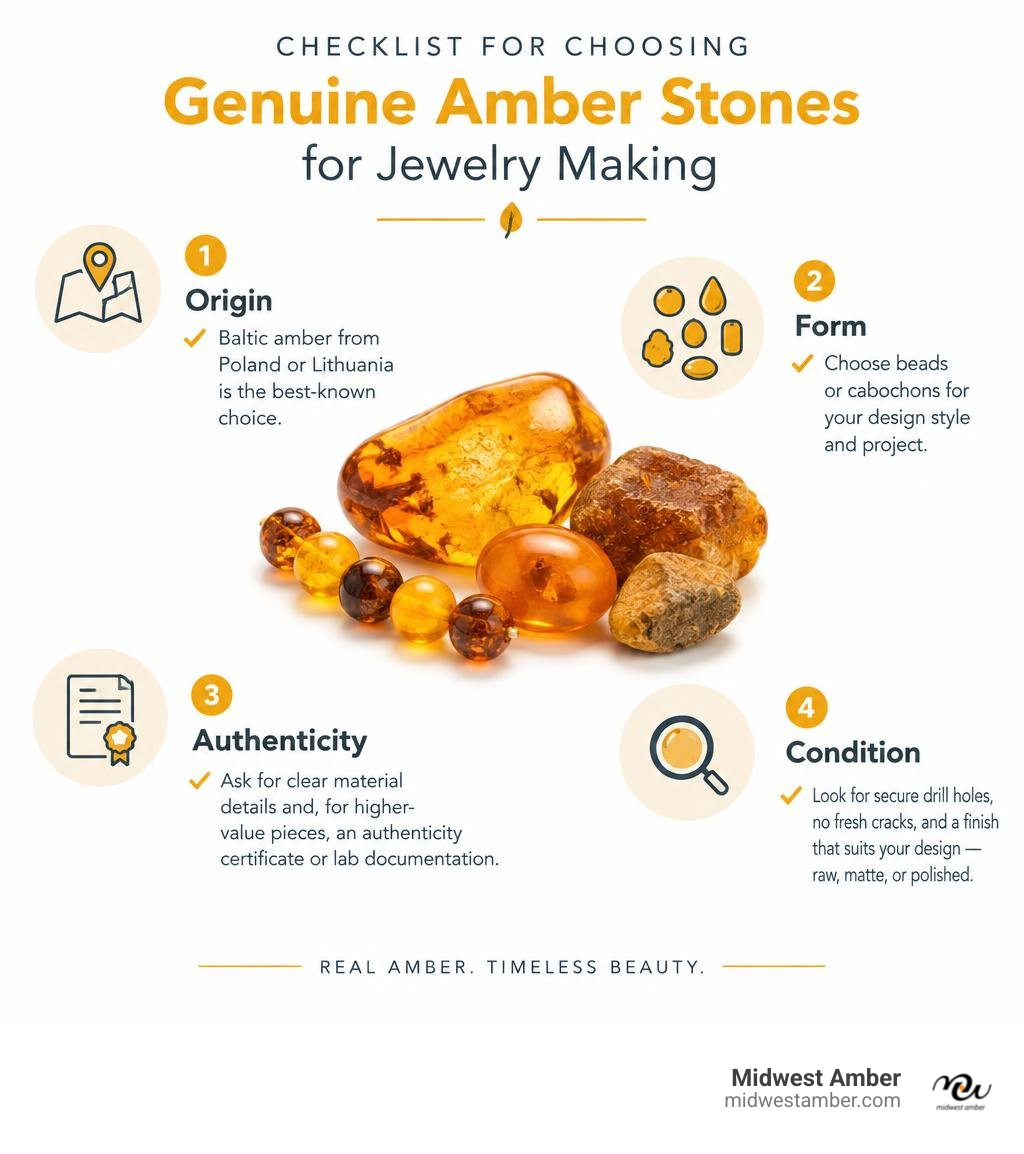
For a strong first purchase, check these essentials:
- Origin: Baltic amber from Poland or Lithuania is the best-known choice for handcrafted amber jewelry.
- Form: Buy drilled round, baroque, chip, nugget, or freeform beads for stringing; buy cabochons for pendants, rings, earrings, and brooches.
- Authenticity: Ask for clear material details and, for higher-value pieces, an authenticity certificate or lab documentation.
- Condition: Look for secure drill holes, no fresh cracks, and a finish that suits your design - raw, matte, or polished.
Amber is fossilized tree resin, not a mineral crystal. Its warm feel, light weight, and honey-to-butterscotch color have made genuine amber a cherished jewelry material for thousands of years. Baltic amber jewelry also offers natural variation: no two pieces have exactly the same color, cloudiness, or tiny internal details.
This guide explains how to source authentic stones, compare Baltic and global amber, distinguish copal from genuine amber, select beads and cabochons, and care for your finished work. Whether you are making a meaningful gift or building a collection of handcrafted amber, the goal is simple: buy material that is beautiful, traceable, and suited to the way you create.
I am Gabriel Ciupek, President and owner of Midwest Amber, with hands-on experience in supplier quality, product selection, pricing, and customer needs for amber jewelry. I help buyers understand how to choose genuine amber stones for jewelry making and turn them into lasting, distinctive designs.
Common amber stones for jewelry making vocab:
What Is Amber and Why Choose Amber Stones for Jewelry Making?
Amber is an organic gemstone formed from the hardened resin of prehistoric trees millions of years ago. Unlike inorganic minerals such as quartz, diamonds, or sapphires that crystallize under heat and pressure within the Earth's crust, natural amber underwent a prolonged process of molecular polymerization. Over tens of millions of years, volatile organic compounds escaped, leaving behind a resilient, fossilized matrix.
For jewelry designers and artisans, natural amber provides unique advantages that inorganic gemstones cannot match:
- Ultra-Low Density: Natural amber has a specific gravity ranging between 1.05 and 1.10 g/cm³. This means it is only slightly denser than fresh water. You can create dramatic, chunky statement necklaces or large drop earrings that remain remarkably comfortable to wear all day without weighing down the wearer.
- Warmth to the Touch: As a poor thermal conductor, amber does not feel ice-cold against bare skin like glass or quartz. Instead, it quickly adopts body temperature, offering a pleasant, organic tactile experience.
- Workability: Registering between 2.0 and 2.5 on the Mohs hardness scale, natural amber is soft enough to carve, file, sand, and drill with standard bench tools, yet durable enough to last for generations when handled properly.
- Electrostatic Charm: When rubbed vigorously with a natural cloth like silk or wool, natural amber develops a negative electrostatic charge that attracts tiny bits of paper, lint, or ash.
| Physical Property | Baltic Amber (Succinite) | Standard Mineral Gemstones (e.g., Quartz, Agate) |
|---|---|---|
| Origin | Organic (Fossilized Resin) | Inorganic (Crystalline Minerals) |
| Mohs Hardness | 2.0 – 2.5 | 6.5 – 7.0+ |
| Specific Gravity (Density) | 1.05 – 1.10 g/cm³ | 2.65 – 4.00+ g/cm³ |
| Refractive Index | ~1.54 | 1.54 – 1.77+ |
| Thermal Feel | Warm, insulative | Cold to the touch |
| Weight Wearability | Exceptionally lightweight | Heavy in large statement pieces |
Organic Gemstone Formation and Physical Properties
The majority of premium jewelry material is Baltic amber, known scientifically as succinite. This variety originated approximately 40 to 50 million years ago during the Eocene epoch, when ancient coniferous forests blanketed Northern and Central Europe. These trees secreted copious resin to seal bark wounds and protect against boring insects. As climate shifts and rising seas submerged these forests, the resin was buried under marine sediments, where sustained anaerobic pressure transformed it into genuine amber stone.
Succinite is distinguished by its content of succinic acid (ranging between 3% and 8%), a natural organic compound historically valued for its soothing properties. With an optical refractive index of approximately 1.54, natural Baltic amber bends light similarly to quartz crystal, creating a radiant inner glow when light passes through clear specimens.
Key Color Varieties: Honey, Egg Yolk, Green, and Rare Red Amber
Natural amber occurs in a broad spectrum of natural shades, influenced by ancient botanical debris, microscopic gas bubbles, and trace soil minerals present during fossilization.
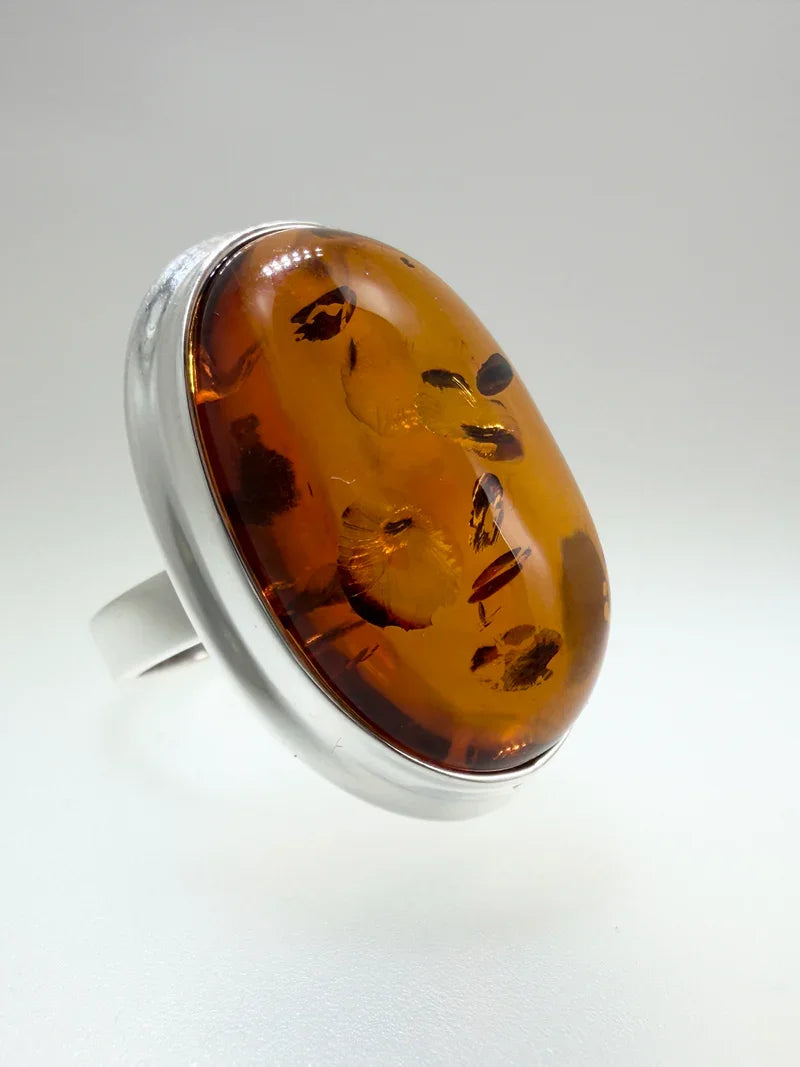
- Classic Yellow & Honey: Representing around 70% of all harvested amber, this variety spans translucent golden honey, cognac, and deep champagne hues. It offers exceptional transparency, making it a favorite for bezel-set rings and pendants.
- Butterscotch & Egg Yolk: Opaque to semi-opaque, this prized stone features a rich creamy yellow or buttery tone. The opacity results from millions of microscopic air bubbles trapped within the resin. Designers frequently source egg yolk amber beads to build striking, high-contrast bohemian bracelets and artisan necklaces.
- Natural Green Amber: Making up roughly 2% of Baltic deposits, genuine green amber gets its earthy moss and olive tones from decomposed plant matter and chlorophyll trapped inside during resin flow.
- Rare Red Amber: Often referred to as "cherry" or "dragon blood" amber, natural red shades are among the most sought-after colors in the world, prized for their rich, deep tones in fine jewelry settings.
- Fluorescent Blue Amber: Found primarily in the Dominican Republic, this resin exhibits a natural blue surface sheen under ultraviolet rays and natural sunlight due to aromatic hydrocarbons.
Sourcing, Quality Grading, and Origins of Natural Amber
Understanding where amber originates helps jewelry makers curate quality collections while honoring the cultural traditions behind the stone.
Baltic vs. Global Resin Deposits
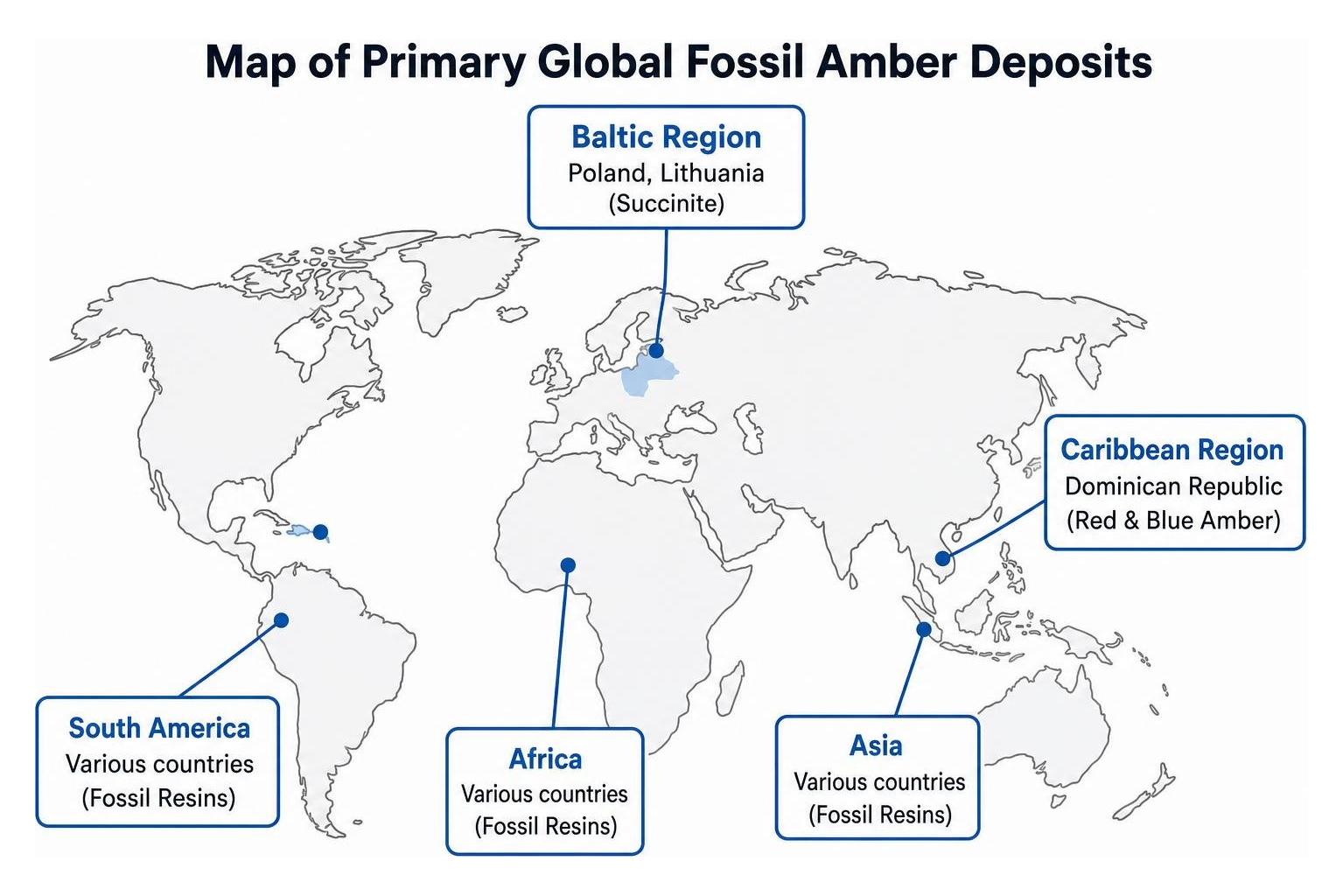
The Baltic Sea region—primarily the coastal shores and mining areas of Poland and Lithuania—is the undisputed capital of the global amber trade. Baltic amber accounts for roughly 70% to 90% of the world's supply. Steeped in centuries of jewelry tradition, Polish and Lithuanian artisans have developed unmatched expertise in cutting, carving, and mounting succinite. Choosing custom Polish amber jewelry gives jewelry designers access to stones shaped by centuries of European craftsmanship. Discovering where Baltic amber comes from highlights why succinite remains the most structurally stable and durable resin for heirloom wire-wrapping, silversmithing, and stringing.
Global deposits also include:
- Dominican Amber: Derived from the extinct legume tree Hymenaea protera, this Miocene-era resin (15–20 million years old) is celebrated for its high optical clarity and rare fluorescent blue and red hues.
- Burmese Amber (Burmite): Sourced from Myanmar, this Cretaceous-era amber dates back roughly 99 million years. Burmite is harder than Baltic amber and frequently contains well-preserved prehistoric fossil inclusions.
Evaluating Clarity, Carat Weight, and Fossil Inclusions
Grading amber requires a different eye than evaluating mineral crystals:
- Clarity: Clear, transparent amber allows light to illuminate the depth of the stone. Conversely, milky, cloudy, or butterscotch amber is valued for its rich texture and dense concentration of micro-bubbles.
- Carat Weight & Grams: Because amber is so light, the jewelry trade often prices bulk beads and rough stones by the gram rather than the carat. For instance, smaller 4–5 mm round beads yield approximately 10 to 14 beads per gram, whereas larger 6–7 mm beads average 5 to 6 beads per gram.
- Fossil Inclusions: Stones containing prehistoric flora and fauna represent snapshots of ancient ecosystems. Pieces featuring rare insect inclusions—such as ancient gnats, ants, beetles, spiders, or botanical oak hairs—are valued by collectors and command premium prices when featured as focal pendants.
Selecting Raw vs. Polished Amber Stones for Jewelry Making
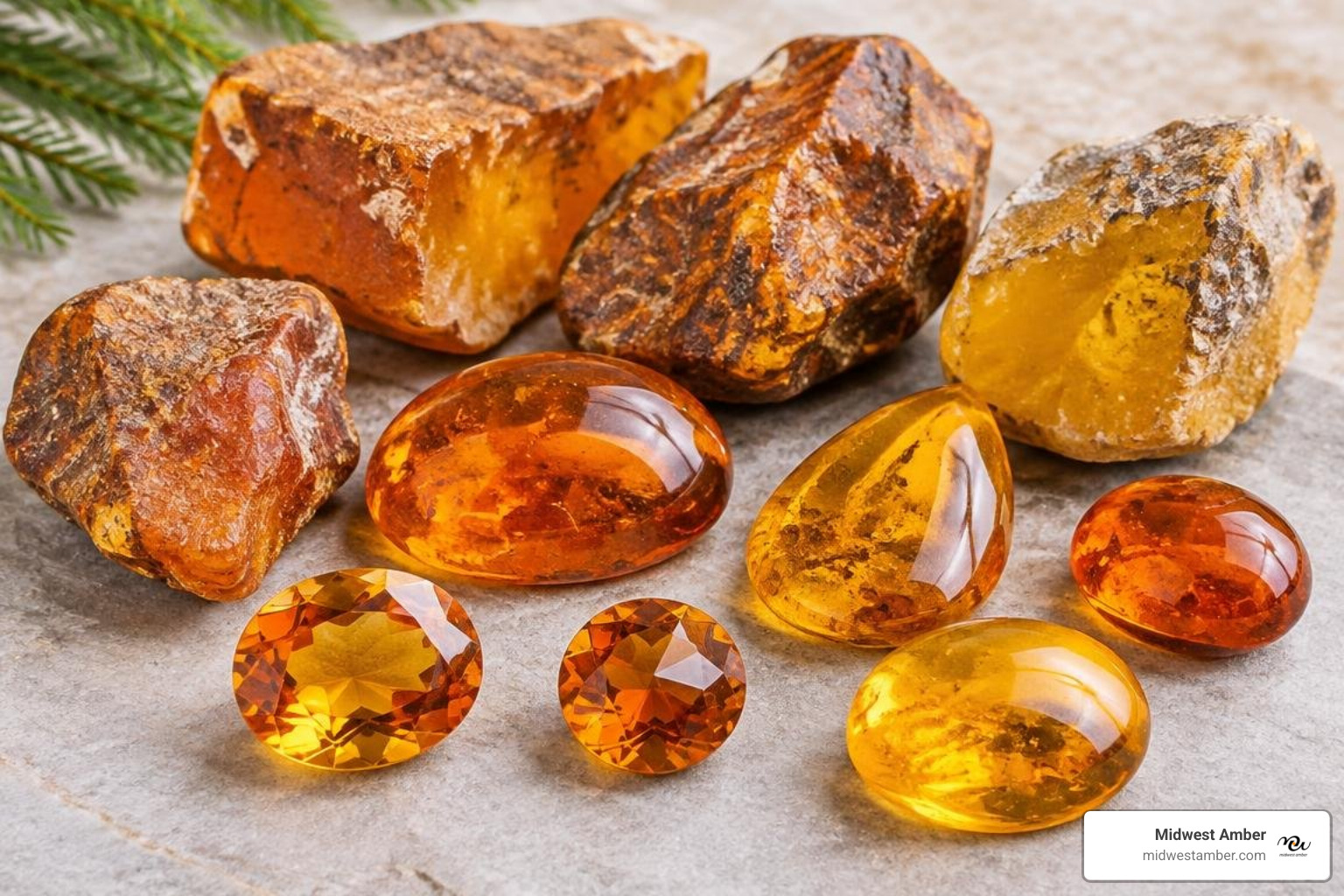
When sourcing stones for your studio, decide between raw (rough) and polished materials based on your design goals:
- Raw Amber Stones: Featuring an untouched, natural weathering crust (cortex), Baltic amber rough stones display tactile ridges, earthy textures, and matte finishes. They are ideal for raw-crystal wire wrapping, rustic unisex jewelry, and grounding talismanic designs.
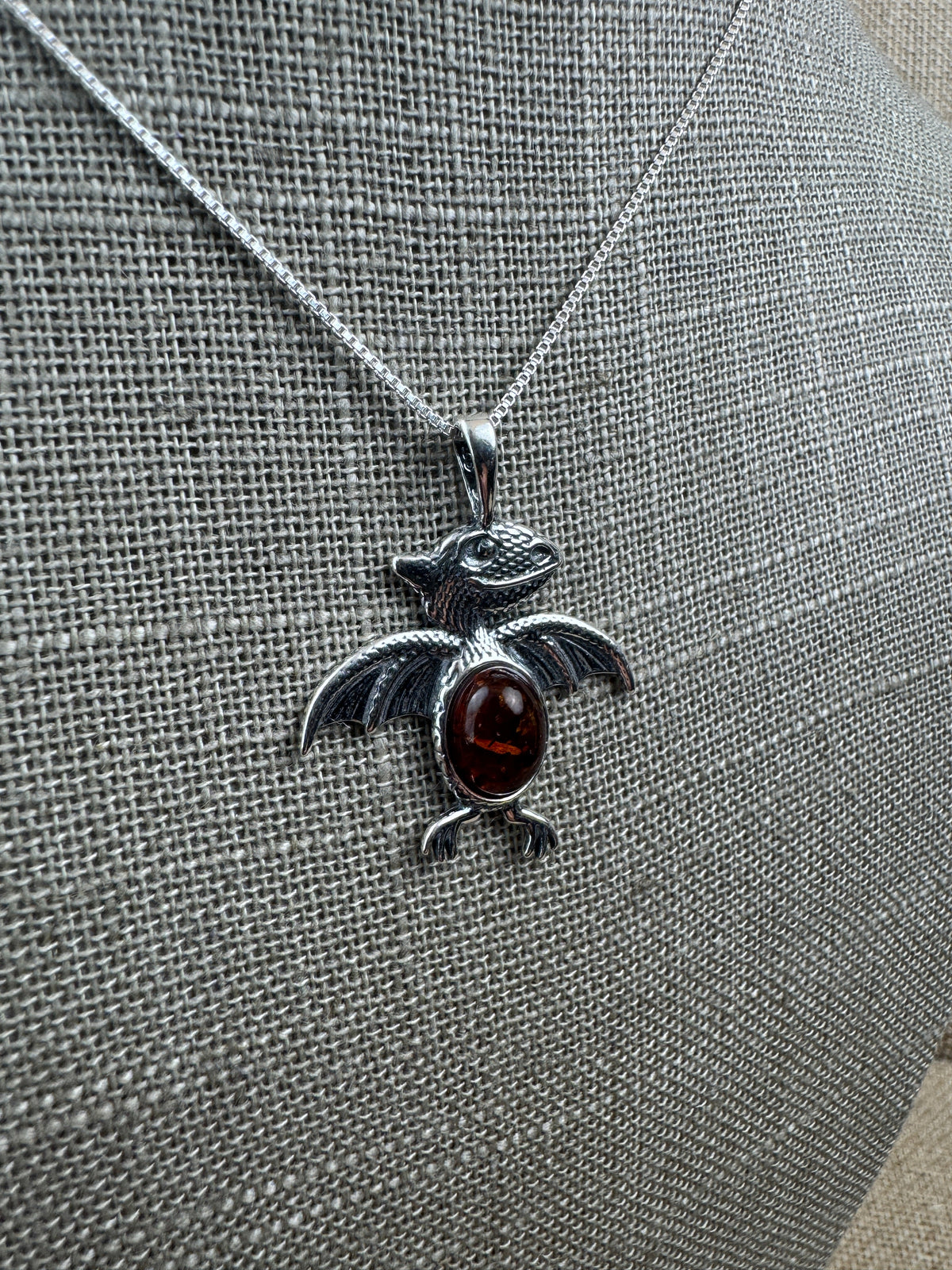
- Polished Cabochons & Beads: Tumbled or hand-polished to a glass-like luster, polished stones reveal glowing internal depth, swirling clouds, and inclusions. Calibrated cabochons fit directly into standard silver bezel cups for rings, brooches, and pendants.
How to Verify Genuine Amber
Because authentic Baltic amber is so popular, the market contains materials that can be mistaken for it. Immature tree resins are sometimes offered to unsuspecting buyers. Learning how to identify raw amber protects your investment and ensures your jewelry line maintains integrity.
Distinguishing Real Amber from Immature Copal
The most frequent natural material confused with genuine fossil amber is copal. Copal is young tree resin originating from sub-fossilized deposits in Madagascar, Colombia, or West Africa. While it looks similar to amber, copal is only hundreds or thousands of years old—not tens of millions.
Understanding the difference between amber vs copal comes down to chemical stability:
- The Acetone Drop Test: Place a single drop of acetone (or high-proof nail polish remover) on an inconspicuous surface of the stone. Copal will soften and become sticky within seconds as the solvent dissolves its young resin matrix. Genuine Baltic amber is completely inert to short solvent contact; the surface remains smooth and unaffected.
- Thermal Melting Point: Copal has a much lower melting threshold than fossilized amber and will soften under minimal frictional heat or warm water.
Non-Destructive Testing and Authenticity Certification
To verify stones without damaging them, apply these jeweler-approved non-destructive tests:
- The Saltwater Float Test: Dissolve 1 part non-iodized table salt into 2 parts warm water (approximately 1 cup of water to 2 tablespoons of salt). Thoroughly stir until dissolved. Clean, unmounted natural amber will float gently to the surface due to its low specific gravity (1.05–1.10 g/cm³), while common plastics, glass, and heavy minerals sink to the bottom. (Note: Rinse your stones with fresh water immediately after testing).
- UV Light Fluorescence: Expose the stone to a long-wave (365–395 nm) ultraviolet light. Genuine Baltic amber fluoresces with a cloudy, pale blue, greenish, or yellowish-white glow.
- Electrostatic Rubbing: Vigorously rub the stone against clean wool or microfiber for 20 seconds. Genuine amber will reliably generate enough static electricity to lift small shreds of tissue paper.
- Pine Scent Test: When rubbed firmly with the thumb to generate friction, Baltic succinite emits a faint, pleasant scent of natural pine resin.
- Formal Certification: For high-value purchases, focal cabochons, or wholesale parcels, always partner with reputable suppliers who provide a verified Baltic amber certificate of authenticity.
Working with Amber: Bead Types, Setting Tips, and Care
Working with natural amber in the jewelry studio is a rewarding experience. Its softness allows for versatile shaping, but it requires mindful handling during drilling, setting, and daily wear.

Popular Bead Shapes: Baroque, Round, Chips, and Nuggets
When designing beaded bracelets, anklets, and graduated necklaces, choosing the right bead silhouette shapes the final aesthetic:
- Baroque Beads: Gently rounded with natural irregular contours, baroque beads offer an organic, artisan look. They sit comfortably against the skin and are the traditional choice for Baltic amber necklaces.
- Round (Spherical) Beads: Precision-ground and polished, uniform round beads (ranging from 4 mm to 10 mm) provide symmetrical elegance for luxury jewelry, classic strands, and mixed-gemstone patterns.
- Chips and Nuggets: Tumbled freeform pieces highlight raw geological charm while keeping material costs accessible. They are excellent for multi-strand statement bracelets and bohemian drop earrings.
- Bead Sizing & Strand Calculation: When planning production runs with drilled amber beads for jewelry making, calculate requirements by weight. For a standard 7-inch bracelet using 6 mm beads, you will need approximately 28 to 32 beads, weighing roughly 5 to 6 grams in total.
Setting and Drilling Amber Stones for Jewelry Making
Because amber registers at 2.0–2.5 Mohs hardness, respect its thermal and mechanical limits at your jewelry bench:
- Slow-Speed Drilling: Always drill amber using high-speed steel or fine diamond-tipped twist bits (0.8 mm to 1.2 mm). Operate your rotary tool or flex-shaft at low RPMs. High drilling speeds generate friction heat, which can scorch the resin, melt internal walls, or cause thermal stress fractures. Lubricate the drill site with a shallow water bath or frequent drops of cool water.
- Bezel Settings Over Prongs: Amber performs best in smooth bezel settings crafted from soft, malleable metals like sterling silver (925) or high-karat gold. A bezel distributes mechanical pressure evenly around the entire perimeter of the stone. If you choose prong settings, use wide, flat prongs and apply gentle, even finger pressure rather than aggressive metal pliers, which can chip the girdle of the stone.
- Gentle Wire Wrapping: When creating wire-wrapped pendants, use dead-soft or half-hard round wire (20 to 24 gauge) in sterling silver, gold-fill, or copper. Avoid sharp right-angle bends directly against the edges of raw amber specimens.
Cleaning, Polishing, and Preserving Finished Amber Jewelry
To keep your finished creations glowing for decades, follow these proper care and maintenance rules:
- Avoid Harsh Chemicals: Keep amber away from household detergents, ultrasonic cleaners, steam machines, rubbing alcohol, acetone, hairsprays, and perfumes. Chemicals will strip the natural polish and leave a cloudy, chalky white residue on the stone.
- Gentle Cleaning: Clean finished jewelry using only lukewarm water and a drop of mild, plant-based dish soap. Wipe clean with a soft, lint-free microfiber cloth.
- Restoring Luster: If a polished stone appears dull over time after frequent handling, restore its shine by applying a drop of high-grade olive oil or sweet almond oil with a soft flannel cloth, then buff the surface dry. Consult our comprehensive amber polishing and maintenance guide for step-by-step restoration methods.
- Proper Storage: Store individual amber pieces in soft velvet pouches or compartmentalized jewelry boxes away from direct sunlight, heating vents, and harder mineral gemstones like quartz or diamonds that could scratch the surface.
Metaphysical Meaning, Healing Traditions, and Chakra Resonance
Beyond its physical beauty, amber carries rich historical lore and symbolic meaning. Across ancient Roman, Greek, Slavic, and Baltic cultures, amber was revered as "the tears of the sun" and worn as a protective talisman against negative energies.
In holistic traditions, amber is celebrated as an energetic cleanser that absorbs heaviness and transmutes it into warm, revitalizing vitality. Astrologically connected to the warmth of the sun and the sign of Leo, amber resonates strongly with the Solar Plexus and Sacral Chakras. Designers crafting mindful wellness jewelry frequently incorporate natural honey, cognac, and red amber beads to symbolize personal empowerment, emotional balance, and grounding harmony. For those seeking holistic wellness pathways, exploring practices like Evolve for Inner Peace can complement the grounded balance that natural amber provides.
Frequently Asked Questions About Amber for Jewelry
How can I tell if raw amber stones are real before buying?
Examine the raw stone for an authentic weathering crust, organic surface variations, and natural texture. Perform a non-destructive saltwater float test (1 part salt to 2 parts water) to ensure the stone floats, and test an inconspicuous edge with a drop of acetone to verify it does not turn sticky. Always buy from reputable suppliers who provide verifiable origin documentation.
What drill bit and hole size should I use for amber jewelry beads?
Use an 0.8 mm to 1.2 mm diamond-coated or high-speed steel twist drill bit. Operate your flex-shaft rotary tool at low speeds (under 2,000 RPM) and keep the stone submerged in or lubricated with cool water. This prevents frictional heat buildup, which can melt or crack the resin.
Can amber stones crack easily during wire wrapping or bezel setting?
Because amber has a low hardness (2.0–2.5 Mohs), it can fracture under concentrated, uneven mechanical force. When wire wrapping, use dead-soft wire and avoid pressing tools directly against the edges of the stone. For cabochon settings, opt for smooth, continuous metal bezels rather than tight prongs to distribute pressure safely.
Is natural Baltic amber rare?
While commercial grades of yellow and honey Baltic amber are widely available, high-clarity specimens, deep butterscotch egg-yolk varieties, natural green stones, and pieces with well-preserved prehistoric fossil inclusions are rare and command premium prices.
Conclusion
Choosing the right amber stones transforms your jewelry creations into meaningful, wearable art rooted in deep geological history. By sourcing authentic Baltic succinite from trusted Polish and Lithuanian artisanal sources, you ensure that every ring, necklace, bracelet, pair of earrings, and brooch you design carries timeless beauty and structural integrity.
At Midwest Amber, we draw on more than 20 years of dedicated experience to bring you 100% natural, ethically sourced Baltic amber jewelry and crafting materials. Whether you are seeking calibrated cabochons for custom silversmithing, raw collector specimens, or drilled beads for distinctive strand designs, our certified collections deliver authentic quality you can trust.
Explore our ultimate guide to amber jewelry to discover more design inspiration, or browse our curated catalog of handcrafted Baltic amber treasures today.

Leave a comment
This site is protected by hCaptcha and the hCaptcha Privacy Policy and Terms of Service apply.