

Where Is Baltic Amber Found? A Quick Answer
Where is baltic amber found is a question with a surprisingly specific answer — the vast majority comes from one small corner of the world.
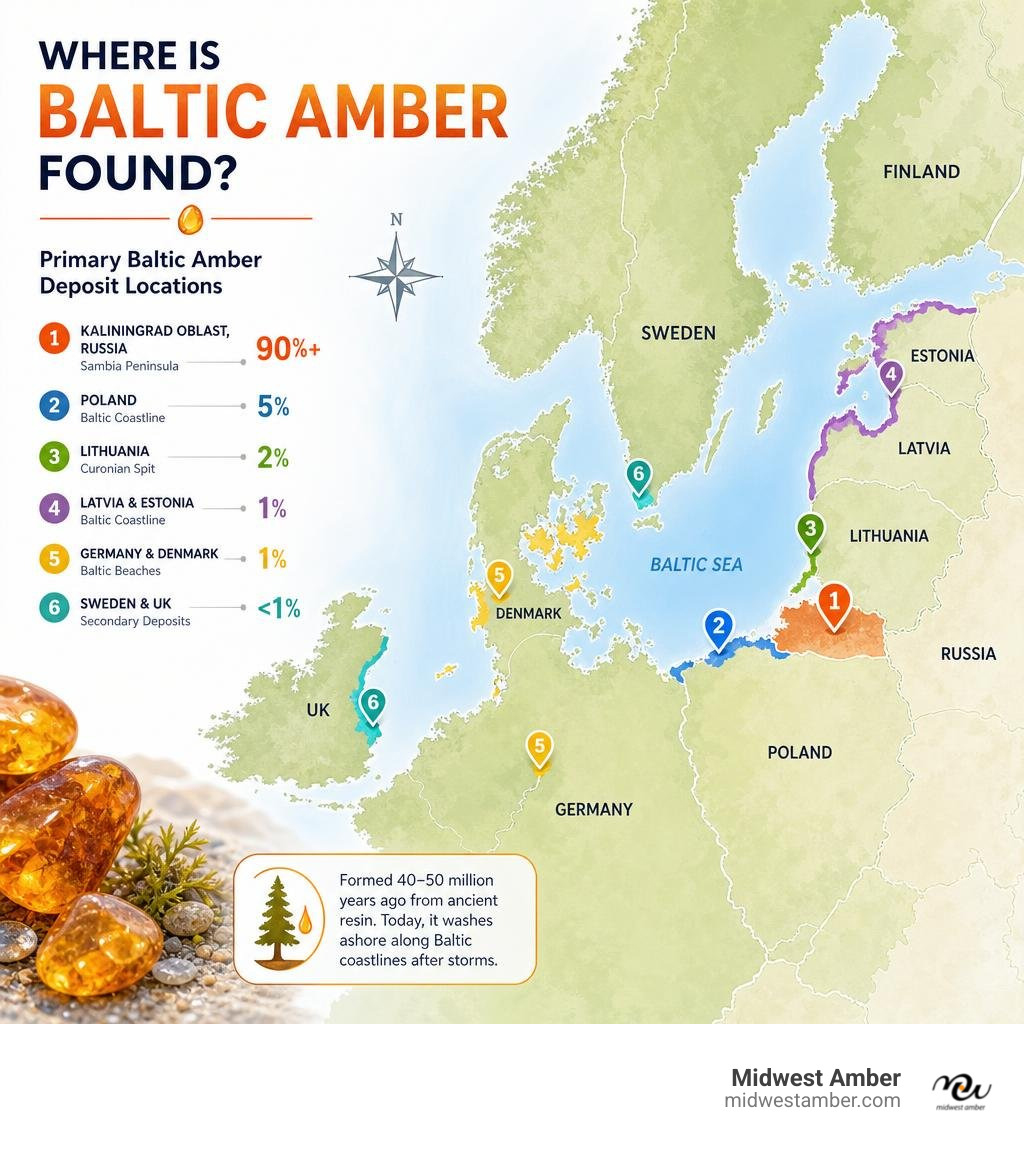
Here are the primary locations where Baltic amber is found today:
| Location | Details |
|---|---|
| Kaliningrad Oblast, Russia | Sambia Peninsula; over 90% of the world's amber supply |
| Poland | Bay of Gdańsk, Vistula Spit, Baltic coastline |
| Lithuania | Curonian Spit, Juodkrante, Baltic Sea beaches |
| Latvia & Estonia | Baltic coastline deposits |
| Germany & Denmark | German Baltic beaches, western coast of Jutland, Frisian Islands |
| Sweden & UK | Secondary deposits from glacial redistribution |
Baltic amber doesn't stay put. Glaciers during the Pleistocene epoch spread it across the entire North European Plain — which is why pieces wash ashore from England to Ukraine.
Think of Baltic amber as a 40- to 50-million-year-old time capsule. Ancient conifer forests once blanketed what is now Scandinavia and the Baltic region. Those trees produced enormous quantities of resin — enough to eventually form an estimated 100,000 tons of amber. Over millions of years, that resin hardened, was buried in marine sediments, and slowly moved across Northern Europe through glacial activity and ocean currents.
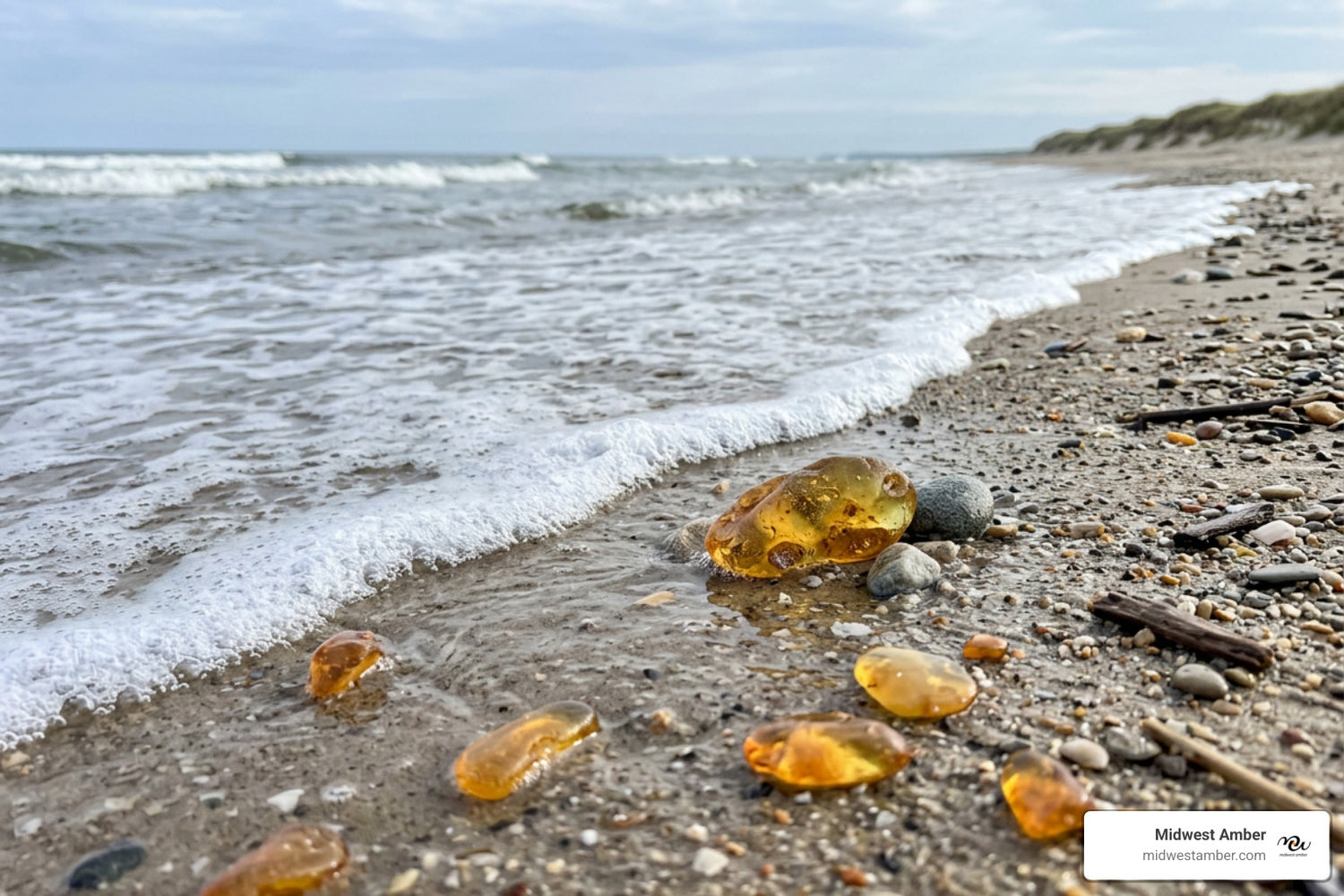
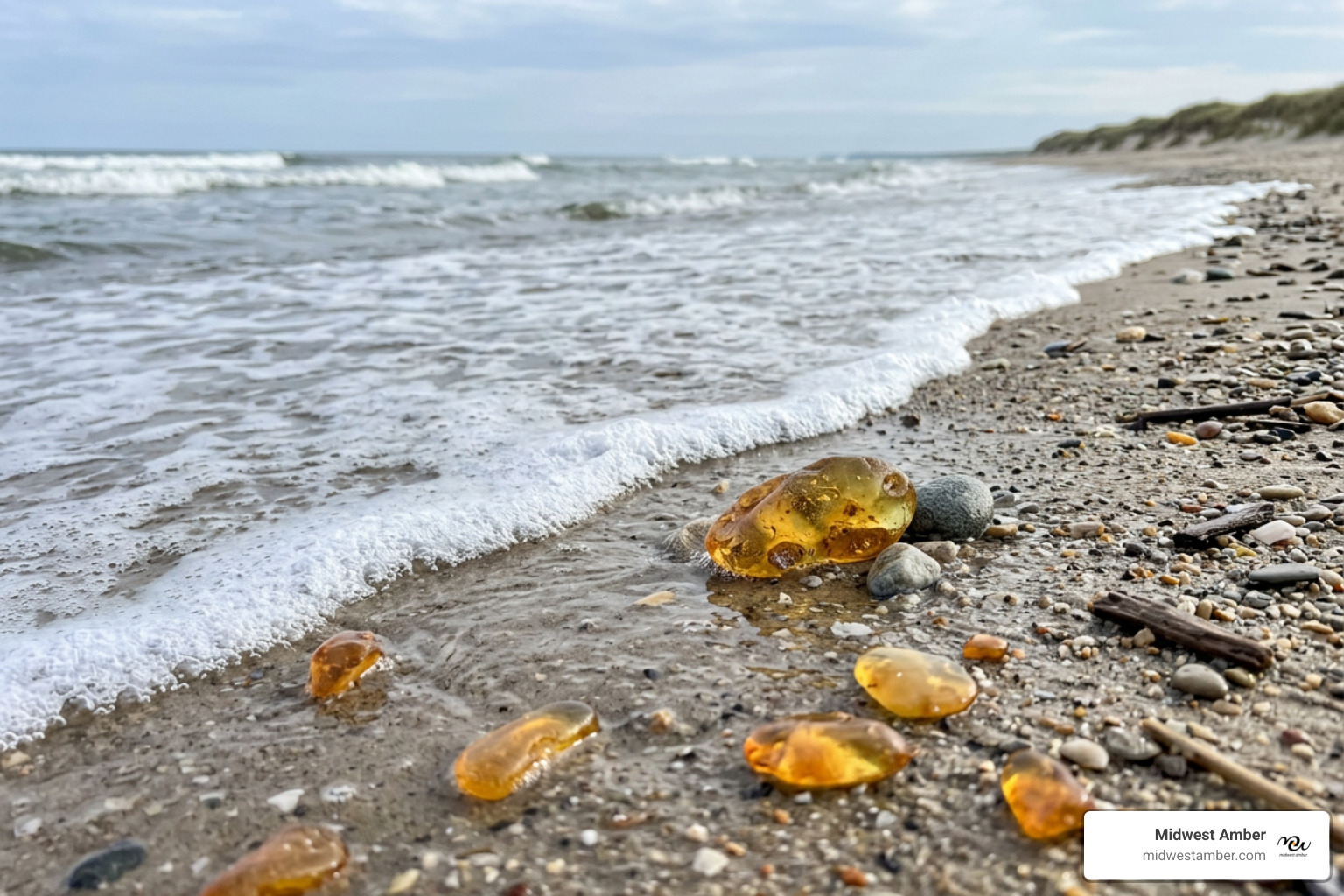
Today, it still washes ashore along Baltic beaches after storms — just as it did when ancient tribes first collected it thousands of years ago.
I'm Gabriel Ciupek, president and owner of Midwest Amber, and my work sourcing and distributing genuine Baltic amber has given me a deep understanding of where Baltic amber is found and what makes each deposit unique. In this guide, I'll walk you through everything — from the geological origins to the specific coastlines and mines where this ancient gem is still being uncovered today.
Easy where is baltic amber found glossary:
What is Baltic Amber (Succinite) and How It Forms
To understand where is baltic amber found, we first have to travel back in time. Baltic amber, scientifically known as succinite, is not a traditional mineral. Because it has an organic origin, it lacks an internal crystalline structure. Instead, it is a fossilized macromolecular supramolecule — a complex, crosslinked network of organic compounds formed from the ancient resin of prehistoric trees.
Our journey begins during the Eocene epoch, roughly 34 to 48 million years ago. During this warm, humid period, massive conifer forests flourished in Northern Europe, specifically in the proto-Scandinavian highlands. For decades, scientists believed a single ancient pine tree, Pinites succinifer, was the sole source of this resin. However, modern scientific research on Baltic amber indicates that the resin actually originated from multiple conifer species. Most notably, evidence points to prehistoric trees belonging to the family Sciadopityaceae — whose only living relative today is the Japanese umbrella pine (Sciadopitys verticillata).
When these ancient trees were damaged by storms, lightning, pests, or rapid climate shifts, they secreted copious amounts of sticky resin to seal their wounds. This resin dripped down to the forest floor, trapping leaves, debris, and unlucky insects along the way. Over millions of years, the forest floor was submerged and covered by heavy layers of sediment. Under intense pressure and geothermal heat, the volatile organic compounds (terpenes) in the resin gradually broke down. This process, known as polymerization and fossilization, transformed the soft, sticky resin into the hard, durable gemstone we cherish today.
Geologically, Baltic amber is found in a very specific rock layer: the Prussian Formation - Wikipedia . Within this geological formation lies the famous "Blue Earth" member (or horizon). The Blue Earth is a glauconite-rich clay and sand layer that is up to 15 meters thick, typically buried 25 to 40 meters beneath the surface. It is this unique marine sediment layer that has preserved the vast majority of the world's succinite. You can read more about this fascinating deep-time history in our detailed post, Where Does Baltic Amber Come From: A Journey to the Eocene Epoch.
What truly sets Baltic amber apart from other fossil resins is its high concentration of succinic acid, which ranges from 3% to 8%. Formed by ancient microorganism fermentation during the fossilization process, succinic acid is highly concentrated in the outer cortex (the weathered "skin") of the raw amber. This chemical signature is why Baltic amber is highly valued not only for jewelry but also in traditional European folk medicine.
Where is Baltic Amber Found? Primary Geological Deposits
If you are looking for the absolute heart of the world's amber reserves, you have to look at the Amber Coast . This geographic region, nestled along the southeastern shores of the Baltic Sea, holds the largest known concentration of fossil resin on Earth. In fact, Baltic amber accounts for approximately 80% to 90% of the entire global amber supply.

The undisputed epicenter of this region is the Sambia Peninsula (also known as the Samland Peninsula), located within the Kaliningrad Oblast of Russia. This small exclave on the Baltic Sea contains more than 90% of the world's commercial amber reserves. The geological deposits here are incredibly dense; in the first decades of the twentieth century, it was estimated that up to a million pounds of amber a year were dug directly from the rich blue earth layer of the peninsula.
Today, industrial extraction is managed by the local Kaliningrad Amber Combine in the town of Yantarny (formerly Palmnicken). To give you an idea of the sheer volume of these deposits, the combine extracted 250 tonnes of amber in 2014 and increased its output to 400 tonnes in 2015.
While Kaliningrad holds the bulk of the underground geological deposits, natural coastal erosion and ancient glacial movements have distributed Raw Baltic Amber across several neighboring countries. Let's look at where these deposits are located in Poland and the Baltic States.
Where is Baltic amber found in Poland?
In Poland, Baltic amber is deeply woven into the country's cultural heritage and history. The primary deposits are concentrated around the Bay of Gdańsk, the Vistula Spit, and the northern beaches stretching toward Pomerania.
For centuries, Gdańsk has been recognized as the "World Capital of Amber." Polish artisans in this region have perfected the art of working with raw amber, transforming it into stunning, world-class jewelry. Rather than relying solely on heavy open-pit mining, much of the amber in Poland is collected from the beaches after fierce winter storms. When strong winds churn up the cold Baltic waters, they tear raw amber nuggets from the shallow offshore sediments and wash them onto the sandy beaches of Gdańsk, Sopot, and Stegna.
We work directly with highly skilled Polish artisans to source our pieces, ensuring that our customers in the United States — from our local Chicago-area communities in Arlington Heights, Barrington, and Palatine to our online collectors nationwide — receive authentic, hand-carved treasures. You can explore this rich artistic tradition in our guide to Baltic Amber Jewelry Poland.
Where is Baltic amber found in Lithuania and the Baltic States?
Further north, Lithuania boasts a profound historical connection to the "Gold of the North." In Lithuania, amber is primarily found along the stunning Curonian Spit, a narrow, 98-kilometer-long sand dune spit shared with Kaliningrad, as well as the coastal resort town of Palanga.
One of the most famous historical events in Lithuanian amber extraction occurred in the mid-19th century near the village of Juodkrante. During dredging operations for a shipping channel in 1854, workers discovered an immense underwater deposit of amber. This led to a major commercial mining operation that extracted roughly 75,000 kilograms of raw amber annually for nearly 30 years, employing over 500 people. This historic excavation also unearthed the famous "Juodkrante Treasure," a collection of Neolithic amber amulets and carvings.
Today, Lithuanian amber remains a symbol of national identity. Lithuanian beaches are still prime hunting grounds for beachcombers who search the shoreline after storms, using specialized hand nets to catch floating seaweed tangled with raw amber. We take great pride in our Lithuanian connections, sourcing beautiful, natural pieces that reflect this timeless Baltic heritage. To learn more about this region, check out our Amber from Lithuania Complete Guide and our dedicated page on Lithuanian Amber.
Comparing Baltic Amber to Other Global Amber Sources
While the Baltic region is the most famous source of amber, fossilized resins can be found across the globe. However, not all amber is created equal. Differences in age, tree species, chemical composition, and durability make Baltic amber the gold standard for jewelry and scientific study.
To help you understand how Baltic amber compares to other prominent global deposits, we have put together this comparison table:
| Property / Feature | Baltic Amber (Succinite) | Bitterfeld Amber (Saxony, Germany) | Rovno Amber (Ukraine) | Dominican Amber (Dominican Republic) |
|---|---|---|---|---|
| Geological Age | ~34 - 48 Million Years (Eocene) | ~24 - 30 Million Years (Oligocene) | ~35 - 40 Million Years (Eocene) | ~15 - 20 Million Years (Miocene) |
| Botanical Origin | Conifers (Sciadopityaceae family) | Conifers (Pinaceae family) | Conifers (Sciadopityaceae family) | Broadleaf Legume (Hymenaea protera) |
| Succinic Acid Content | High (3% to 8%) | Low to Moderate | High (3% to 8%) | Trace to None (0%) |
| Common Colors | Over 250 shades (Yellow, Honey, Butterscotch, Cherry, Green) | Yellow, Brown, Cognac | Honey, Yellow, Reddish-Brown | Yellow, Cognac, Rare Blue/Green |
| Mohs Hardness | 2.0 - 2.5 (Sturdy, highly workable) | 2.0 - 2.5 | 2.0 - 2.5 | 1.5 - 2.0 (Softer, more fragile) |
| Primary Use | High-end handcrafted jewelry, scientific research | Industrial use, some jewelry | Jewelry, scientific research | Jewelry, fossil collectors |
Historically, there has been significant scientific debate regarding where is baltic amber found in relation to other European deposits. For many years, Bitterfeld amber from the brown coal mines of Saxony, Germany, was thought to be Baltic amber that had simply been eroded and redeposited by ancient rivers. However, chemical analyses have shown that Bitterfeld amber is distinct, originating from a different family of trees during a later geological epoch.
Similarly, Rovno amber from Ukraine is highly closely related to Baltic amber and shares its high succinic acid content, though it is mined from forest soils and clay deposits far inland rather than coastal marine sediments.
When compared to Dominican amber, Baltic amber is significantly older, harder, and much more durable. Dominican amber, which formed from the resin of an extinct tropical legume tree, is prized for its clarity and spectacular fossil inclusions, but its lower hardness makes it much more fragile to carve and wear. For everyday jewelry like rings, bracelets, and necklaces, Baltic amber remains the premier choice due to its resilience and spectacular array of over 250 natural shades. You can read more about what makes natural amber so unique in our article, Unearthing Natural Amber: What Makes This Ancient Gem So Special. You can also explore scientific perspectives on European amber distribution through the Where Is Amber Found? - Getty Museum archives.
Frequently Asked Questions about Baltic Amber Sourcing
How has Baltic amber been historically mined and collected?
For thousands of years, humans did not mine amber; they simply gathered it. The earliest recorded gathering method was beachcombing, or "amber picking," along the shorelines of the Baltic Sea. Ancient tribes, such as the Aestii (described by the Roman historian Tacitus), walked the beaches after storms to collect pieces washed up by the waves.
During the Middle Ages, the Teutonic Order established a brutal monopoly over the Baltic amber trade. They declared that all amber found on the beaches belonged to the Order. Anyone caught keeping a piece of amber without authorization faced severe punishment, including execution. The Knights established the "Amber Road," a highly lucrative trade route that connected the Baltic coast to the Mediterranean, supplying Roman and Byzantine nobility with raw amber for luxury goods and amulets.
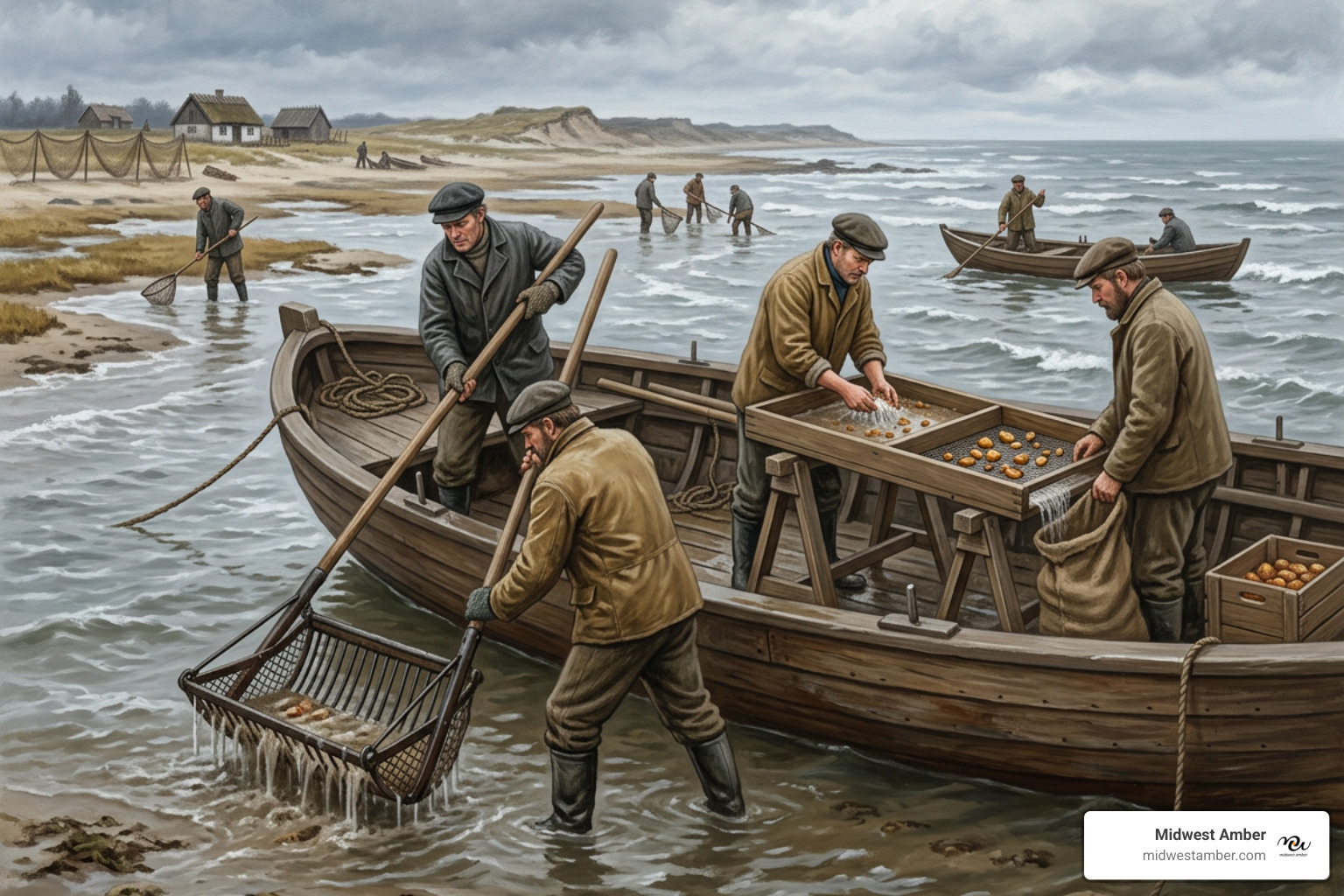
In the 18th and 19th centuries, harvesting became more industrialized. Coastal communities began "amber fishing" using large, hand-held nets in shallow waters to trap floating amber tangled in seaweed. Eventually, dredging operations (like the one in Juodkrante) and underground shaft mining were introduced. Today, the vast majority of commercial amber is extracted through large-scale open-pit mining, where high-pressure water cannons wash away the overlying soil to expose the amber-rich Blue Earth layer.
What types of fossils and inclusions are commonly found in Baltic amber?
Baltic amber is world-renowned for its incredibly preserved fossil inclusions, which offer scientists an unparalleled window into Eocene ecosystems. Because the resin was sticky and slow-flowing, it acted as a natural trap for any small organism that crossed its path.
Arthropods (insects, spiders, and ancient centipedes) make up over 98% of all animal inclusions found in Baltic amber. To date, thousands of extinct species have been identified, including 57 genera and 152 species of ancient ants alone! Plant materials, such as oak leaf hairs, pine needles, and pollen grains, are also common, helping botanists identify at least 214 distinct plant species that lived in the Eocene forests.
Vertebrate inclusions — such as lizard tails, bird feathers, or mammalian hair — are exceptionally rare, representing less than 0.5% of all discoveries. Because the resin preserved these organisms down to the cellular level, some specimens even contain fossilized cellular structures. To dive deeper into the incredible secrets locked inside these golden stones, explore our article on Unveiling the Mysteries of Baltic Amber: A Timeless Treasure.
How can you tell if Baltic amber is genuine?
As the popularity of Baltic amber jewelry has grown, so has the market for imitations made of plastic, copal, glass, or pressed amber. Fortunately, because of its unique physical and chemical properties, there are several simple tests you can perform to verify if a piece of amber is genuine:
- The Saltwater Float Test: Genuine Baltic amber has a specific gravity of 1.05 to 1.10 g/cm³, making it slightly denser than fresh water but lighter than salt water. Dissolve 1 part salt into 2 parts water. Genuine amber will float beautifully, while plastic, glass, and synthetic imitations will sink to the bottom.
- The Electrostatic Test: Amber is an excellent electrical insulator. Rub your amber vigorously against a piece of wool or silk for 20 to 30 seconds. Genuine amber will generate a static charge, easily attracting tiny scraps of paper or dust.
- The Scent Test: When heated gently, genuine Baltic amber releases a pleasant, sweet, piney fragrance. You can test this by rubbing the piece rapidly between your palms until it warms up, or by carefully touching an inconspicuous area with a hot needle to check for a natural resinous smell rather than the acrid, chemical odor of melting plastic.
For a complete guide to protecting yourself from fakes and understanding the true essence of natural succinite, take a look at our article, Beyond the Shine: Exploring the Essence of Natural Baltic Amber.
Conclusion
From its ancient origins in Eocene conifer forests to the wave-swept beaches of Poland and Lithuania, Baltic amber is a true geological miracle. Knowing where is baltic amber found helps us appreciate the incredible journey each individual piece has taken over tens of millions of years before arriving in our hands.
At Midwest Amber, we are passionate about preserving this rich Northern European heritage. Based in the Chicago suburbs, we serve jewelry lovers across our local communities — including Arlington Heights, Barrington, Chicago, Palatine, Schaumburg, and beyond — as well as collectors nationwide. We specialize in 100% natural, ethically sourced Baltic amber jewelry, handcrafted by skilled Polish and Lithuanian artisans who have spent generations mastering this delicate craft.
Whether you are looking for a classic honey-colored pendant, a bold butterscotch ring, or a delicate cherry-red bracelet, we provide certified authenticity with every single piece we offer.
Ready to find your own piece of Eocene history? We invite you to explore our beautiful online collection of genuine, handcrafted jewelry. And if you want to make sure your current collection is the real deal, take a look at our step-by-step guide: Learn how to tell if your amber jewelry is genuine.

Leave a comment
This site is protected by hCaptcha and the hCaptcha Privacy Policy and Terms of Service apply.